Since the 2020 census, Florida has "moved from a Democrat majority to a 1.5 million Republican advantage."

Our only agenda is to publish the truth so you can be an informed participant in democracy.
We need your help.

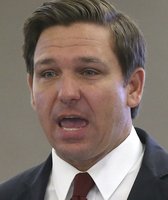
Florida Gov. Ron DeSantis at a roundtable discussion at the White House on March 6, 2026. (AP)


The last time Florida Democrats led Republicans among all registered voters was in 2020. Republicans had been gaining on Democrats for years, taking the lead in 2021 and not relinquishing it since.
While registered Democrats outnumbered registered Republicans in 2020, they weren’t a majority; they were a plurality once No Party Affiliation and third-party voters were factored in.
Republicans have performed well in Florida elections going back further than 2020, controlling the governorship, the Legislature and the congressional delegation for decades and winning the presidential vote starting in 2016.
The day before state lawmakers met for a special session on redistricting, Florida Republican Gov. Ron DeSantis revealed his proposed state congressional map, which could set up Republicans to flip as many as four Democratic-held seats.
DeSantis shared the map April 27 with Fox News before sending it to the state Legislature. He said the new map — which would ordinarily be drawn every 10 years after the census — would more fairly represent Florida’s electorate.
"Florida got shortchanged in the 2020 census, and we’ve been fighting for fair representation ever since," DeSantis told Fox News, referring to a census undercount in the state that year. "Our population has since grown dramatically, and we have moved from a Democrat majority to a 1.5 million Republican advantage."
Florida has about 1.5 million more Republicans registered to vote in Florida than registered Democrats now. But he overstates the Democrats’ former party registration edge.
Democrats had about 100,000 more registered voters than Republicans in 2020, the year of the decennial census. Democrats held a plurality, not a majority, of voter registrations, when taking into account people not affiliated with a party or registered with a third party. A plurality means it was the highest of any single category, but not 50% plus one.
In addition, measured by votes — which determine who serves in office, unlike voter registration data — Republicans performed well in Florida long before 2020, controlling the governorship, the Legislature and the congressional delegation for decades and winning the presidential vote starting in 2016.
"Performance in actual elections, not party registration, is consistently the metric used to judge the fairness of district maps," said Barry Burden, a University of Wisconsin political scientist.
DeSantis’ office didn’t respond to PolitiFact’s request for evidence.
In 2020, Florida Democrats led Republicans in registered voters, 5.3 million to 5.2 million. That gap had been narrowing for years. The GOP took the lead in 2021 and hasn’t relinquished it since.
Today, the Republican edge for registered voters is 5.5 million to 4.1 million, close to what DeSantis said.
DeSantis’ two-party focus ignores that 28% of Florida voters are either registered as No Party Affiliation — Florida’s term for independent voters — or belong to a third party, such as Libertarian.
Including those people in the calculation means Republicans account for about 41% of the state’s registered voters, a plurality. The Democrats’ advantage in 2020 wasn’t a majority either.
The last time Democrats held a true majority of Florida’s registered voters was in 1992. Republicans have never held a majority of registered voters in the state.
Voter registration is one of several metrics used to measure comparative party strength.
Political scientists refer to party registration as a "lagging indicator" because it tends to evolve more slowly than voting behavior. This is mainly because it’s time-consuming for voters to change their party registration, but once registered, they can still vote for anyone in the general election.
In Florida, many registered Democrats were voting for Republicans in key offices well before 2020. This same pattern played out in other parts of the South and Appalachia, where Democrats once dominated but have since lost ground to Republicans. Voter registration tallies were slow to reflect this shift.
Because of the loose connection between party registration and voting behavior, political analysts generally focus on electoral results when measuring the impact of a district map.
Measuring voting patterns is especially important in counties where No Party Affiliation ranks as the second biggest "party," said Aubrey Jewett, a University of Central Florida political scientist. In Florida, these include populous Osceola and Orange counties near Orlando, Broward County (Fort Lauderdale), Lee County (Fort Myers) and Pasco (north of Tampa).
The Democratic registration plurality in 2020 didn’t translate into Florida being a Democratic-leaning state.
The last time a Democratic presidential candidate won the state was in 2012, when Barack Obama won 49.9% of the vote. Of the four Democratic presidential nominees to win the state since 1976, only two — Jimmy Carter in 1976 and Obama in 2008 — did so by a majority rather than a plurality of the popular vote. Republican presidential candidates, meanwhile, won Florida nine times from 1976 to 2024.
At the statehouse, Lawton Chiles was the last Democratic governor, elected in 1994. Democrats haven’t held a majority in either chamber of the Florida legislature since the mid-1990s. And Florida Republicans have held a majority of seats in the state’s congressional delegation for decades.
While the GOP’s advantage in Florida has grown since 2020, it would be wrong to say the state was a Democratic stronghold as late as 2020, experts said.
"Florida was a very competitive state with a small Republican lean at the presidential level before the 2020 presidential election," said Kyle Kondik, managing editor of Sabato’s Crystal Ball, a publication of the University of Virginia Center for Politics.
DeSantis said Florida has "moved from a Democrat majority to a 1.5 million Republican advantage" since the 2020 census.
Florida has about 1.5 million more Republicans registered to vote in Florida than registered Democrats now. But DeSantis overstates Democrats’ party registration edge in 2020.
Democrats weren’t the "majority" of registered voters — they accounted for 36% once No Party Affiliation and third-party voters were taken into account.
Republicans have performed well in Florida elections going back further than 2020, controlling the governorship, the Legislature and the congressional delegation for decades.
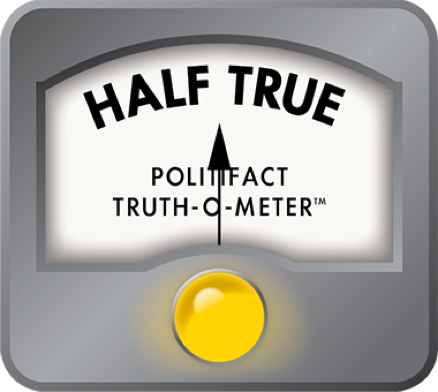
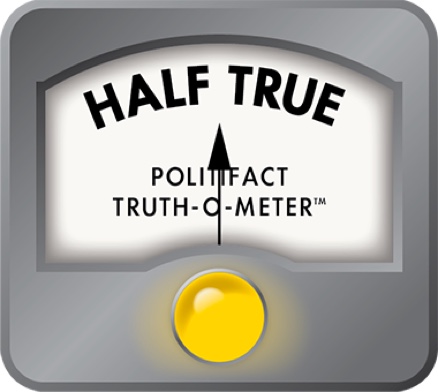
The statement is partially accurate but leaves out important details or takes things out of context. We rate DeSantis’ statement Half True.
Fox News, Ron DeSantis unveils new Florida congressional map that would give the GOP an extra four seats, April 27, 2026
Florida Division of Elections, voter registration by party, accessed April 27, 2026
Florida Division of Elections, voter registration by county and party, accessed April 27, 2026
Census.gov, Census Bureau Today Releases 2020 Census Undercount, Overcount Rates by State, May 19, 2022
Almanac of American Politics, biennial editions from 2000 to 2026
Ballotpedia, Florida state legislature, accessed April 27, 2026
Dave Leip's U.S. Election Atlas, accessed April 27, 2026
Email interview with Kyle Kondik, managing editor of Sabato’s Crystal Ball, April 27, 2026
Email interview with Barry Burden, University of Wisconsin political scientist, April 27, 2026
Email interview with Aubrey Jewett, University of Central Florida political scientist, April 27, 2026














In a world of wild talk and fake news, help us stand up for the facts.