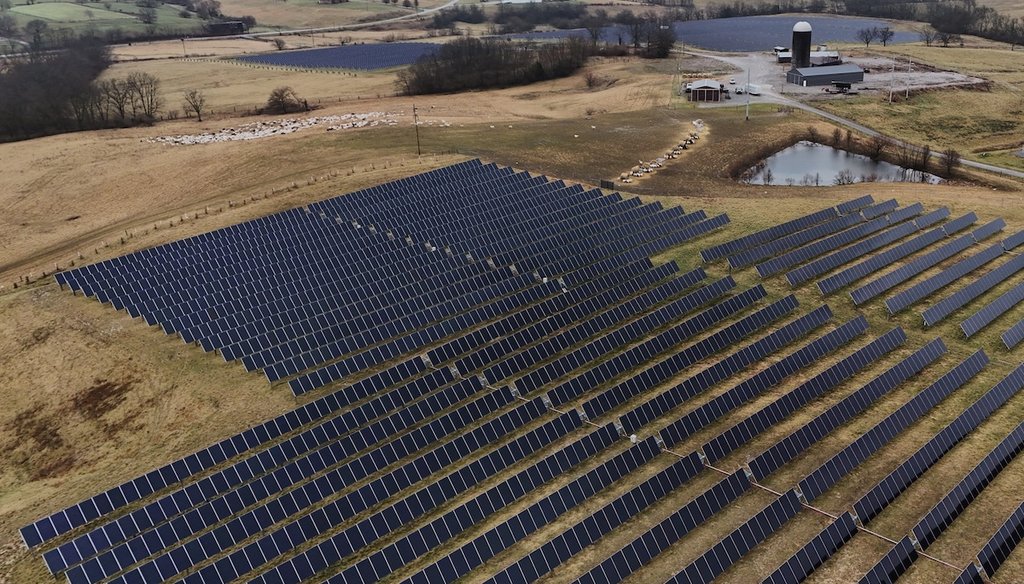


Solar panels at a farm on Jan. 14, 2026, in Lancaster, Ky. (AP)

Together, solar and wind account for about 3% of global energy sources.
This 3% includes everything from powering factories to fueling transportation to generating electricity.
One of these categories — electricity generation — has seen solar and wind grow worldwide from almost zero in the early 2000s to 13% in 2023, and more than 14% in the U.S. That outpaced growth of any other energy source.
As the United States grappled with Iran’s closure of the Strait of Hormuz — a choke point for one-fifth of the world’s crude oil — CNN’s Jake Tapper asked Energy Secretary Chris Wright whether the U.S. should rely less on oil and more on renewable sources of energy, such as solar and wind power.
"We have gone through two months when the entire global energy system is in chaos just because of one shipping lane," Tapper said April 19 on "State of the Union." "Doesn't that make an argument for alternative kinds of energy, so that the U.S. is less reliant on oil?"
Wright, whose private-sector career was in natural gas and oil, said the U.S. produces more oil than it consumes, making it a net exporter of oil; we’ve rated a similar claim Half True.
Wright said that "we definitely want energy from everywhere we can get it" — including nuclear energy — but gave the impression that progress in renewable energy has been disappointing.
"In the last 20 years, the world spent $10 trillion on wind, solar, and batteries. It hasn't made it to 3% of global energy, and it's just driven up prices," Wright said.
Is it correct that solar and wind haven’t reached "3% of global energy"?
There’s data supporting Wright’s statement that wind and solar account for a small percentage of global energy, about 3.3%. However, wind and solar have become significant sources for an important subset of energy — electricity generation for homes and businesses — both in the U.S. and the world over the past 20 years.
In a statement to PolitiFact, the Energy Department said, "If wind and solar only perform at low-demand periods" — which is the case if they are not paired with supplemental storage methods like batteries — "then their value is inherently less." The Department also pointed to research showing that states that require a minimum level of renewable energy in electricity generation have experienced higher prices for consumers.
International Energy Agency data shows global investment in wind and solar energy from 2015 to 2025 reached $5.7 trillion. That’s consistent with about $10 trillion over 20 years.
Wright’s 3% figure is on target based on total energy use worldwide. This is a catchall category that includes everything from transportation fuels to industrial heating for cement or steel plants.
Fossil fuels such as coal, oil and natural gas remain the dominant sources of energy worldwide. Solar and wind energy trail each of these sources, and they also trail biomass (the burning of organic matter or waste) and nuclear energy.
The small share represented by solar and wind shows their limits for industrial purposes, energy experts said.
In these contexts, fossil fuels have an advantage because their energy is always available. By contrast, wind and solar are variable, depending on meteorological conditions. A company seeking to use wind or solar to power a factory would need to invest in storage, such as batteries or reservoirs, which add to the cost.
Solar and wind have made significant strides in electricity generation — a key subset of energy that provides power for homes and many commercial properties.
Wright’s statement "is misleading in suggesting that lots of money has gone into solar, wind and batteries that hasn’t amounted to much," said Kenneth Gillingham, a Yale University economist specializing in energy. "That is not true — solar and wind are among the most cost-effective technologies right now" based on standard estimates "and are growing very rapidly."
The International Renewable Energy Agency found that technological advances, more competitive supply chains and economies of scale have left solar energy 41% cheaper than the lowest-cost fossil fuel alternatives, including fossil fuels, and onshore wind projects were 53% cheaper. Some required infrastructure costs, such as new transmission lines, may not be included in these comparisons.
Such advances have meant that, globally, electricity generation from solar and wind has grown from almost zero in the early 2000s to 13% of the total in 2023, the most recent year available, according to the International Energy Agency. The amount of solar and wind generation was about 120 times bigger in 2023 than 2000. That rate of growth outpaced any other energy source.
In the U.S., solar and wind accounted for about 14% of U.S. electricity generation in 2023. That’s behind natural gas (43%) but closing in on nuclear (19%) and coal (16%). Collectively in the U.S., solar and wind provide more than twice as much electricity generation as hydropower (think of massive, electricity-producing dams, such as the Grand Coulee Dam or the Hoover Dam).
The growth of solar "is impressive and a very different way of seeing it," Gillingham said.
The Energy Department said Wright focused on global energy use because "generation sources like nuclear, oil, gas and coal can do more than just generate electricity," including running transportation and factories.
But Clark Williams-Derry, an energy finance analyst at the Institute for Energy Economics and Financial Analysis, said this viewpoint doesn’t consider energy "losses" from wasted heat.
An example, Williams-Derry said, would be coal burned in a power plant, where about two-thirds of the energy from burning coal is lost, sent up the smokestack or dissipated in a cooling tower. Similarly, for gasoline used in cars, much of the energy is used to heat up the engine and brake pads, he said.
By contrast, solar and wind are significantly more efficient than fossil fuels, Williams-Derry said.
"Renewables punch above their weight, producing much than 3% of the ‘useful’ energy consumed globally, because solar and wind have only a fraction of the energy losses," he said.
Long term, the difference between solar and wind’s share of global energy and global electricity generation are likely to converge, said Hugh Daigle, a professor of petroleum and geosystems engineering at the University of Texas-Austin.
"There is a trend towards electrification in a lot of sectors, so over time, the difference between energy produced by renewables and electricity produced by renewables should shrink," Daigle said.
Wright said solar and wind haven’t reached "3% of global energy."
Solar and wind power account for about 3.3% of overall global energy, which is a broad category that includes powering transportation and factories. However, electricity generation — a key subset that supports consumers and many businesses — has seen solar and wind increase significantly during the past 20 years, outpacing the growth rate of any other energy source.
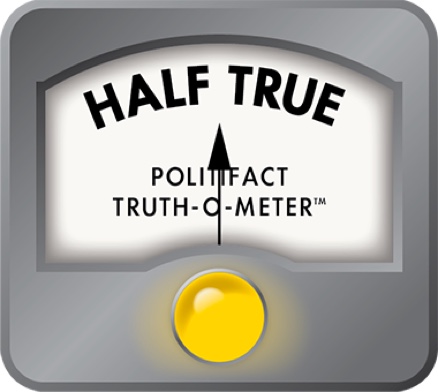
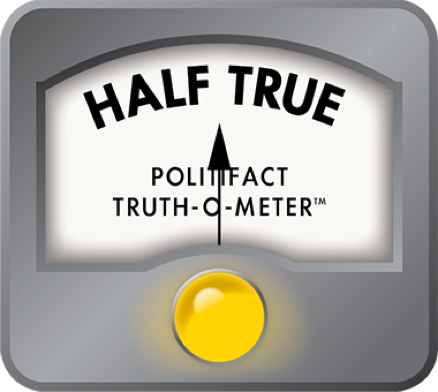
The statement is partially accurate but leaves out important details about the growth of solar and wind energy, so we rate it Half True.
Chris Wright, remarks on CNN’s "State of the Union," April 19, 2026
International Energy Agency, "Global investment in clean energy and fossil fuels, 2015-2025," May 30, 2025
International Energy Agency, "Where does the world get its energy?" accessed April 21, 2026
International Renewable Energy Agency, "91% of New Renewable Projects Now Cheaper Than Fossil Fuels Alternatives," July 22, 2025
U.S. Energy Information Administration, "What is U.S. electricity generation by energy source?" accessed April 23, 2026
Certrec, "Largest Hydro Plants Ranked by Installed Capacity," accessed April 21, 2026
PolitiFact, "No, wind and solar power aren’t ‘worthless’ when there’s no wind or sun," Sept. 9, 2025
PolitiFact, "Is the US a net exporter of oil? And does that matter for Iran war crude oil price spikes?" March 13, 2026
Email interview with Hugh Daigle, professor of petroleum and geosystems engineering at the University of Texas-Austin, April 21, 2026
Email interview with Kenneth Gillingham, Yale University economist specializing in energy, April 21, 2026
Email interview with Clark Williams-Derry, an energy finance analyst at the Institute for Energy Economics and Financial Analysis, April 22, 2026
Email interview with Ben Dietderich, spokesman for the Energy Department, April 22, 2026














In a world of wild talk and fake news, help us stand up for the facts.