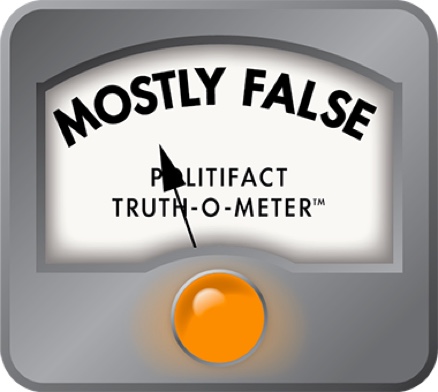

“If you live near one of these large data centers, your electricity bills over the last five years have gone up by as much as 267%."

Our only agenda is to publish the truth so you can be an informed participant in democracy.
We need your help.

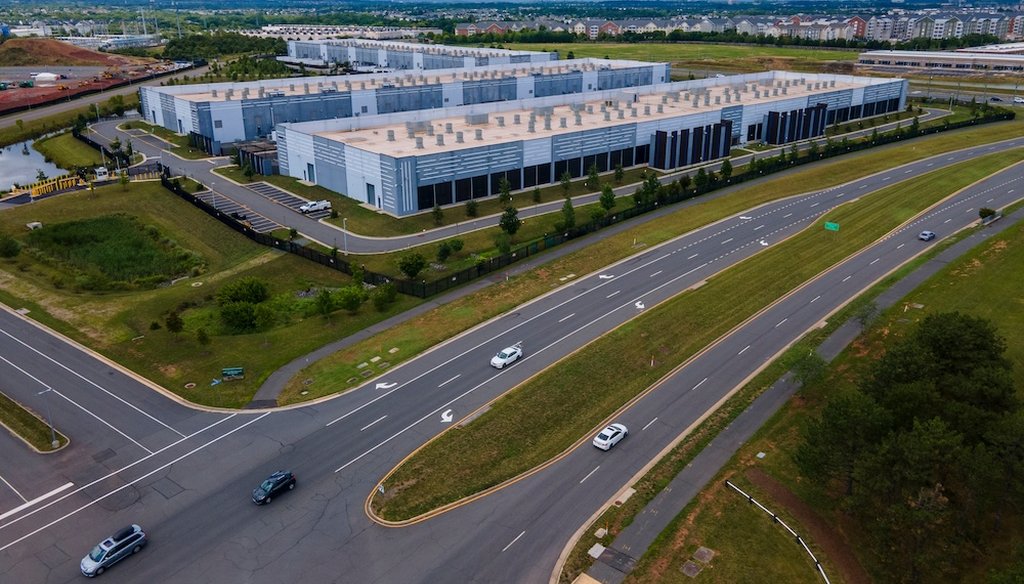
Cars drive past data centers that house computer servers and hardware required to support modern internet use, such as artificial intelligence, in Ashburn, Virginia, July 16, 2023. (AP)

Data center demand, both current and anticipated, has driven up operating costs for utility companies. That cost has been passed on to consumers, especially in areas with high data center activity.
The 267% figure that Sen. Elizabeth Warren referenced is for wholesale costs rather than residential bills. Regional residential bills have risen significantly in some areas, but not by the number she cited.
Rising artificial intelligence demand has led to a nationwide construction boom of power-hungry data centers in recent years, driving concern about rising utility costs. Sen. Elizabeth Warren, D-Mass., recently called for raising taxes on companies building data centers and said they’ve increased electricity bills for Americans.
"If you live near one of these large data centers, your electricity bills over the last five years have gone up by as much as 267%," Warren said in a June 5 X post.
Warren used that same figure in a December 2025 letter she and other senators sent to tech firms when announcing an investigation into their effect on utilities costs. The letter cited a September 2025 Bloomberg article analyzing data centers’ effects on electricity prices.
That article found that wholesale prices in locations near data centers have risen, in some places, by "as much as 267%" compared with five years ago. But that figure was referring to the rate utility companies pay producers, not the rates people pay to the utility companies for their monthly residential electric bills.
Warren’s office pointed us to reporting from CBS News and Fortune that also mischaracterized the Bloomberg analysis as an increase in consumer bills.
Warren’s office also provided examples of reporting on residents’ energy bills in states like Virginia and Maryland with sizable month-over-month increases last winter, in some cases doubling or tripling compared with the previous year or months. Some articles cited data center demand, along with abnormally cold weather, as causes of the increases.
Residential electricity prices have risen in the last five years, and data center demand is a big driver in some areas. But Warren’s specific figure misrepresented the data.
The Bloomberg article analyzed local pricing points, called nodes, on the power grid, and found wholesale prices at some nodes near data centers increased by 267% between April 2020 and April 2025. Looking at the broader market, wholesale prices have more than doubled in some markets since 2020, the article said, while prices elsewhere have risen less sharply.
That local wholesale price is not the same rate residents pay, Kenneth Gillingham, an economist at Yale School of the Environment, said.
"There are other parts of the electricity bills, and the wholesale nodal electricity prices only raise the ‘supply’ component of electricity bills," he said in an email to PolitiFact.
The supply cost makes up about 30% to 50% of a consumer’s electricity bill, Gillingham said. Other components include the cost of transmission, distribution and taxes.
Wholesale prices are often passed on to all the grid’s customers, including businesses. Utility companies often need to get rate increases approved by state regulators before passing that cost on, Gillingham said.
Data centers have increased electricity bills
On average, residential electricity costs across the U.S. have risen by 42% in the last five years, according to data from the U.S. Energy Information Administration. Data centers aren’t the sole reason, but they’ve been a major driver in some places where costs have risen the most.
Between March 2021 and March 2026, average residential retail electricity prices rose 94% in Washington, D.C., 74% in Maryland, 73% in Maine, and 58% in New York, according to the federal energy data.
In some regions, wholesale capacity markets — in which power plants are paid to be available based on expected demand — have been a contributor to price increases. PJM Interconnection, the grid operator for all or parts of 13 states and the District of Columbia, has seen record-high capacity prices three years in a row.
The Independent Market Monitor for PJM reported in 2025 that "data center load growth is the primary reason for recent and expected capacity market conditions, including total forecast load growth, the tight supply and demand balance, and high prices."
The report found that current and projected data center demand increased capacity costs by $9.3 billion, or 174% for the 2025-26 delivery year, compared with a scenario with no data center demand.
Reports from the Maryland Office of People’s Counsel and the District of Columbia Public Service Commission pointed to data center load as one cause of rising electric bills.
Ari Peskoe, director of the Electricity Law Initiative at Harvard Law School, said Warren has a broader point that consumers could be subsidizing the data centers.
"Data centers are causing tens of billions of dollars of price increases in wholesale power markets and driving utilities to spend tens of billions of dollars on delivery infrastructure," Peskoe said. "In general, these cost increases are spread to all ratepayers by the utility."
Costs are likely to continue increasing without policy changes. One 2024 study found that data center demand increases without investment in generation and transmission capacity could increase electricity rates in Virginia by as much as 70% in the next decade.
Data centers aren’t the sole cause of rising electricity prices. Other factors include equipment costs, an aging energy grid and clean energy requirements, according to a 2026 report from the Lawrence Berkeley National Laboratory, a federally funded research center.
Our ruling
Warren said, "If you live near one of these large data centers, your electricity bills over the last five years have gone up by as much as 267%."
The figure she cited referred to wholesale prices, not the prices residential consumers pay every month. Wholesale prices are part of just one component of a residential electricity bill — the "supply" component, which makes up about 30% to 50% of a consumer’s electricity bill.
Warren’s statement has an element of truth because data centers have driven up electricity costs, and average consumer prices have nearly doubled in areas such as the District of Columbia.
But her statement gives the wrong impression about the precise effect on consumers’ utility bills so far. We rate it Mostly False.
Email interview with Kenneth Gillingham, economist at Yale School of the Environment, June 9, 2026
Email interview with Ari Peskoe, director of the Electricity Law Initiative at Harvard Law School, June 9, 2026
Email exchange with Elizabeth Warren’s Senate Office, June 9 and 10, 2026
Elizabeth Warren, X post, June 5, 2026
Elizabeth Warren, Letters to data center companies regarding utility costs, Dec. 15, 2025
Bloomberg, AI Data Centers Are Sending Power Bills Soaring, Sept. 29, 2025
CBS News, How the AI-driven data center boom is leading to skyrocketing energy bills for many Americans, April 25, 2026
Fortune, Electricity prices are up 40% since 2021, but data centers shouldn't get all the blame, May 20, 2026
WAVY, 'This is extreme,' Customers receive higher than usual Dominion Energy bills, Feb. 21, 2026
Consumer Reports, AI Data Centers: Big Tech's Impact on Electric Bills, Water, and More, March 20, 2026
DC News Now, Prince George's County leader pushes for investigation into utility bill surge, offers senior assistance, Feb. 24, 2026
U.S. Energy Information Administration, Electricity Data Browser, accessed June 10, 2026
Monitoring Analytics, Analysis of the 2025/2026 RPM Base Residual Auction - Part G - Revised, June 3, 2025
Maryland Office of People's Counsel, Rising Fall Electricity Rates, accessed June 10, 2026
District of Columbia Public Service Commission, Electricity Standard Offer Service (SOS) Rates, accessed June 10, 2026
Lawrence Berkeley National Laboratory, Retail Electricity Price Trends and Drivers, April 2026
SSRN, The Impact of Data Centers on Energy Demand and Market Prices, Nov. 20, 2024














In a world of wild talk and fake news, help us stand up for the facts.