
Sen. Susan Collins votes “with Donald Trump 95% of the time.”


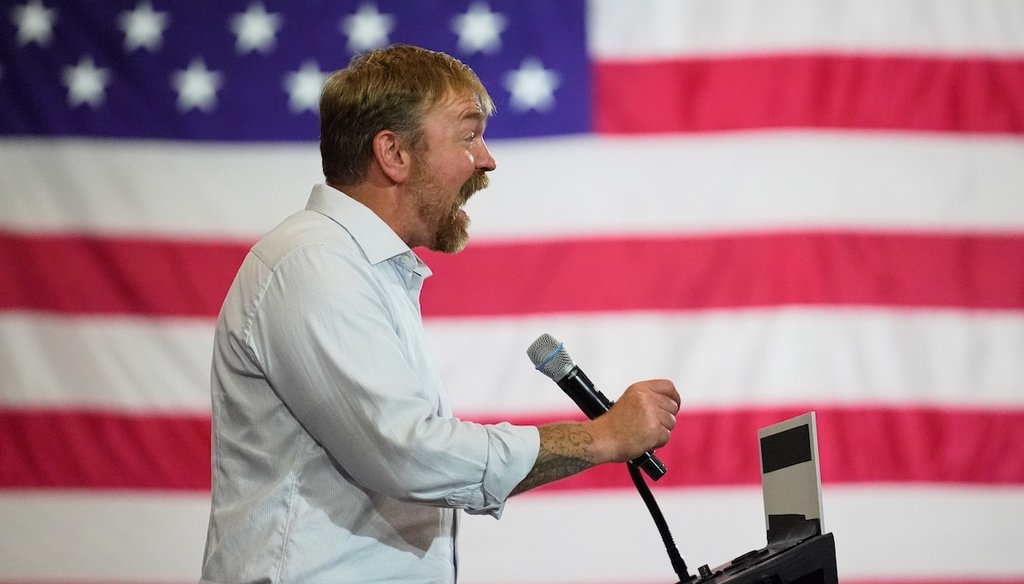
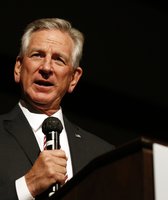
Democratic U.S. Senate candidate Graham Platner speaks during a primary election night watch party after winning the Democratic nomination June 9, 2026, in Blue Hill, Maine. (AP)

Sen. Susan Collins, R-Maine, supported President Donald Trump’s position about 95% of the time in 2025, according to CQ Roll Call, a nonpartisan source that analyzes congressional votes.
The same source found that Collins supported Trump about 90% during his first term.
Sen. Susan Collins, R-Maine, often touts bipartisanship and moderation. The word "bipartisan" appears 2,635 times on her official website. But her Democratic rival, Graham Platner, said she is a rubber stamp for the Republican president.
"If you are an independent voice, why do you vote with Donald Trump 95% of the time?" Platner said, addressing Collins during his June 9 Senate primary victory speech.
That number matches a respected analysis of senators’ votes in 2025, although Collins sided with Trump at a slightly lower rate during his first term. However, a percentage in isolation disregards that Collins has opposed Trump on some key issues.
Collins' 2025 votes supported Trump’s position 94.6% of the time. Among Republicans, only Rand Paul of Kentucky and Lisa Murkowski of Alaska supported Trump less frequently than Collins. Republican senators supported Trump at record levels; most Republicans voted 100% with Trump.
The percentage comes from CQ Roll Call, a nonpartisan source that has examined congressional votes and presidential support since 1953.
Members’ scores reflect how often they vote in agreement with the president’s position. The analyzed votes are a fraction of all votes that Congress takes.
During Trump's first term, Collins sided with Trump about 90% of the time.
Congressional experts said the percentage doesn’t tell the full story about a lawmaker’s record.
Mark D. Brewer, a University of Maine political science professor, said the CQ metrics are legitimate measures and useful to voters, but they have two drawbacks.
"First, they do not register if a member fails to vote on a bill (obviously not a problem for Collins)," Brewer wrote in an email to PolitiFact, a nod to the senator reaching her historic 10,000th vote without missing a roll call vote. "Second, and more important, they treat all measures that the president has taken a position on the same. Obviously some bills matter more to a president than do others, but that is not accounted for here."
Collins has taken some high-profile votes against Trump. In 2026, she sided with Democrats to block a nearly $1.8 billion weaponization fund for Trump allies. In April, she voted in support of a resolution directing the removal of U.S. armed forces from hostilities against Iran.
In 2025, Collins was one of three Republican senators who voted against Trump’s One Big Beautiful Bill. Collins said she supported extending tax relief for families and small businesses, but primarily opposed the legislation because of "the harmful impact it will have on Medicaid, affecting low-income families and rural health care providers like our hospitals and nursing homes."
Weeks later, Trump said on Truth Social: "Republicans, when in doubt, vote the exact opposite of Senator Susan Collins. Generally speaking, you can’t go wrong."
She opposed Trump during his first term on some major votes. After the Jan. 6, 2021, attack on the U.S. Capitol, Collins voted to convict Trump on an impeachment charge. She said his actions interfered with the peaceful transition of power and were an abuse of power.
As Senate Appropriations Committee chair, Collins has the power to shape federal spending. During Trump’s current term, Collins opposed $1 billion in White House ballroom funding and objected to the administration's proposed cuts for biomedical research.
Another useful metric is the Bipartisan Index Rankings, a partnership of the Lugar Center and Georgetown University McCourt School of Public Policy. The index measures the frequency with which a lawmaker co-sponsors bills offered by the other party and how often they attract or recruit co-sponsors from the other party for their own bills. The more often lawmakers collaborate with members of the other party on bills, the higher their score.
Over the last 13 years, Collins has ranked first on the index among Republicans.
These analyses don’t capture other ways senators can influence outcomes on measures that never reach a vote.
In 2025, the White House withdrew its nomination of Dave Weldon as director of the Centers for Disease Control and Prevention hours before his Senate hearing. In a statement to The New York Times, Weldon, a former Florida congressman, blamed Collins and Sen. Bill Cassidy, R-La.
Collins said she "had some reservations, but I certainly had not reached a final judgment."
Platner said Collins votes with Trump "95% of the time."
That was a reference to CQ’s analysis of her votes in 2025. During Trump’s first term, she sided with Trump on about 90% of votes.
Focusing on this percentage alone omits that Collins has opposed Trump on some key measures.
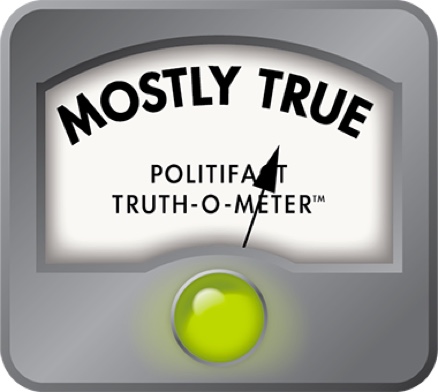
We rate this statement Mostly True.
Graham Platner, primary victory speech, June 9, 2026
CQ Roll Call, Collins' 2025 votes supported Trump 94.6%, 2026
CQ Roll Call, Vote Studies 2025: Republicans power Trump to record success, February 24, 2026
New York Times, Casting Her 10,000th Vote in a Row, Collins Sets a Senate Record, June 5, 2026
Associated Press via KTVB, Collins isn’t Trump’s ‘best friend’ but he’s on her side in Maine Senate matchup with Platner, June 10, 2026
Sen. Susan Collins, Senator Collins statement on her vote to end hostilities in Iran ahead of 60-day deadline, April 30, 2026
WMTW, Sen. Susan Collins, of Maine, explains why she voted against 'Big Beautiful Bill' July 1, 2025
Sen. Susan Collins, Collins statement on the Senate reconciliation bill, July 1, 2025
President Donald Trump, Truth Social post, July 31, 2025
Sen. Susan Collins, Senator Collins delivers remarks impeachment article, Feb. 13, 2021
PolitiFact, Ohio senator Sherrod Brown votes Elizabeth Warren, July 31, 2018
PolitiFact, Yup Obama votes with the Ds, October 2, 2008
Portland Press-Herald, Susan Collins opposes Donald Trump’s $1B ballroom request, May 28, 2026
Sen. Susan Collins, Sen Collins calls proposed cuts to biomedical research funding inexplicable,May 21, 2026
The Lugar Center, Bipartisan Index, Accessed June 10, 2026
CQ Press, 2020 Presidential Support Tables, 2020
CQ Press, 2019 Presidential Support Tables, 2019
CQ Press, 2017 Presidential Support Tables, 2017
Sen. Susan Collins, Website, Accessed June 10, 2026
CQ support team, June 10, 2026
Interview, Mark D. Brewer, professor and political science department chair, University of Maine, June 10, 2026
Interview, James Melcher, political science professor, University of Maine-Farmington, June 10, 2026
Interview, Steven S. Smith, Washington University political science professor, June 10, 2026
Interview, Dan Diller, policy director, The Lugar Center, June 10, 2026













In a world of wild talk and fake news, help us stand up for the facts.