Stand up for the facts!
Our only agenda is to publish the truth so you can be an informed participant in democracy.
We need your help.
I would like to contribute

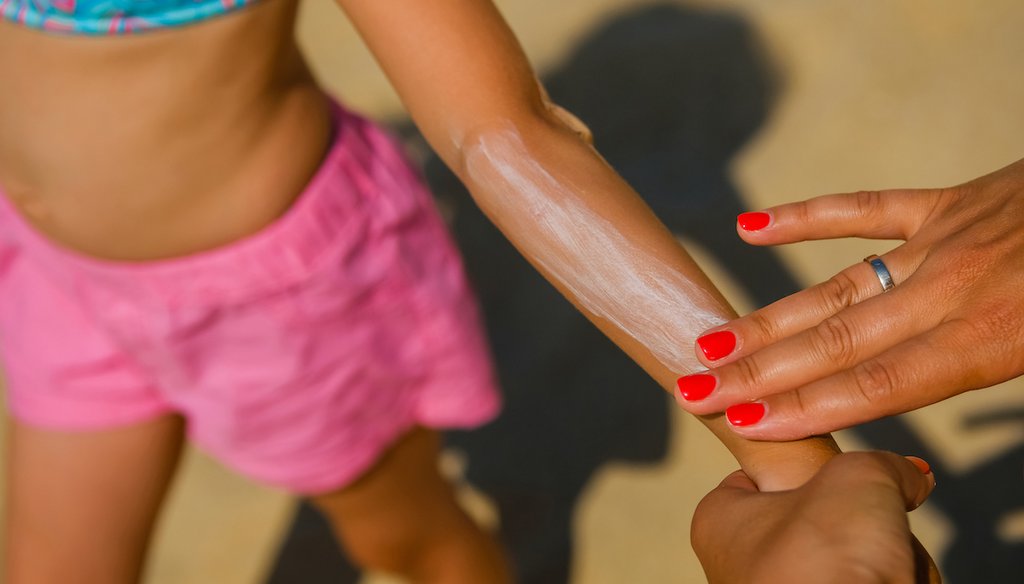
SPF numbers tell you how well a sunscreen protects your skin against ultraviolet B, or UVB, rays — the type of ultraviolet radiation most responsible for causing sunburns. The higher the SPF, the more these rays are blocked. (Shutterstock)

If Your Time is short
-
Sun protection factor — better known as SPF — tells you how well a sunscreen protects your skin against ultraviolet B radiation, the type of UV rays that are most responsible for causing sunburns.
-
When it comes to sunscreen, two dermatologists said they recommend people use broad-spectrum sunscreen that’s SPF 30 or higher and reapply at least every two hours.
-
Higher SPF means stronger protection, but no sunscreen can block 100% of the sun’s UVB rays.
The numbers that signal summer’s approach are here: The countdown to the last day of school. A 90-degree forecast. And, of course, SPF 30. Or 50? Or maybe it’s time to break out SPF 100?
SPF stands for sun protection factor. That sounds simple enough, but what these ubiquitous figures mean in practice can be complicated.
We asked two board-certified dermatologists to answer our burning SPF questions.
What do different SPF numbers actually mean?
The numbers tell you how well a sunscreen protects your skin against ultraviolet B, or UVB, rays — the type of ultraviolet radiation most responsible for causing sunburns.
The higher the SPF, the more these UVB rays are blocked, said Dr. Adewole Adamson, a dermatologist and internal medicine professor at the University of Texas at Austin.
Doubling the SPF doesn’t mean the sunscreen protects twice as well, however.
SPF 30 sunscreen filters about 97% of UVB rays, for example, and SPF 50 filters about 98%, said Dr. Marisa Garshick, a dermatologist based in New York and clinical dermatology professor at New York Presbyterian-Weill Cornell Medicine.
You can think of SPF as a measure of how much solar energy it takes to burn skin with sunscreen compared to the solar energy needed to burn skin without sunscreen, according to the U.S. Food and Drug Administration.
What SPF is high enough?
Use at least SPF 30, but even higher is better.
That’s partly because most people don’t apply enough sunscreen, which means they get less protection than what the label advertises.
"Lower SPF sunscreens may feel lighter or be easier to wear, but they provide less protection," Adamson said. "The higher the number, the more margin of error you may have if you under apply."
What else should I look for when selecting sunscreen?
Buy sunscreen with a "broad spectrum" label, which means it protects against UVA and UVB rays, dermatologists said.
SPF can tell you only how well a sunscreen blocks UVB rays, not ultraviolet A or UVA rays that are also harmful. Much like UVB rays, UVA rays have been linked to sunburns, wrinkles and some skin cancers.
If you’ll be sweating or spending time in the water, you should use sunscreen that is also labeled "water resistant."
"Most of all, find a sunscreen that feels good on your skin because sunscreen will only work if you use it," Adamson said.
Does SPF 100 block 100% of UVB rays?
No. In fact, the FDA banned the term "sunblock" in 2011 in part because no sunscreen can block all UVB rays.
SPF 100 filters about 99% of the sun’s UVB rays, Garshick said.
It provides slightly more UVB protection than lower SPF options, but the added protection gets smaller as the numbers go up. Plus, higher SPF sunscreen might cost more, UC Davis Health reported.
If sunscreen is applied correctly — and remember, that’s a big qualifier — the increase in UVB protection from SPF 50 to SPF 100 might be underwhelming.
Higher SPF sunscreens can also create a false sense of security, Garshick said. "Someone wearing SPF 100 may think they can stay in the sun significantly longer without reapplying, which is not the case."
Whether you’re reaching for SPF 50 or SPF 80, it’s important to use enough sunscreen and reapply frequently, she said. Slather on another coat at least every two hours or right after getting out of the pool, participating in water activities or doing anything that makes you sweat a lot.
What else is important when it comes to sun protection?
While properly and repeatedly applying at least SPF 30 sunscreen is important, it’s just one part of what should be a multi-pronged approach to protecting yourself from the sun’s harmful rays.
It’s best to stay out of the sun during peak UV hours — 10 a.m. and 4 p.m.
And when you are outside, experts said, try wearing wide-brimmed hats, sunglasses and sun-protective clothing.
RELATED FACT-CHECK: Wear your sunscreen. The sun does not prevent skin cancer.
Our Sources
Email interview with Dr. Adewole Adamson, a board-certified dermatologist and an internal medicine professor at The University of Texas at Austin’s Dell Medical School, May 12, 2026
Email interview with Dr. Marisa Garshick, a board-certified dermatologist based in New York and a clinical dermatology professor at New York Presbyterian-Weill Cornell Medicine, May 12, 2026
UT News, How Much SPF Do You Need In Your Sunscreen? June 6, 2018
UC Davis Health, What you should know about sunscreen, SPF, and protecting your family | Cultivating Health, June 8, 2022
Skin Cancer Foundation, Ask the Expert: Does a High SPF Protect My Skin Better? Nov. 7, 2025
Food and Drug Administration, Sun Protection Factor (SPF) | FDA, July 14, 2017
Healthline, What's the Difference Between UVA and UVB Rays?, May 23, 2024
Dermatology Physicians of Connecticut, Understanding SPF: What Do Those Numbers Actually Mean? May 14, 2025
The New York Times, F.D.A. Unveils New Rules About Sunscreen Claims, May 12, 2026
Harvard Health Publishing, How to choose and use sunscreen, accessed May 12, 2026
Journal of the American Academy of Dermatology, SPF 100+ sunscreen is more protective against sunburn than SPF 50+ in actual use: Results of a randomized, double-blind, split-face, natural sunlight exposure clinical trial, May 2018
The Skin Cancer Foundation, Ask the Expert: How Often Do I Need to Reapply Sunscreen If I’m Indoors All Day?, July 14, 2021
United States Environmental Protection Agency, Ultraviolet (UV) Radiation and Sun Exposure, May 12, 2026
Cleveland Clinic, How Often Should You Reapply Sunscreen?, March 25, 2025
Verywell Health, What Does the SPF Number Mean?, April 6, 2026
American Cancer Society, How to Use Sunscreen | Sun Safety, accessed May 13, 2026
American Cancer Society, Does UV Radiation Cause Cancer?, accessed May 13, 2026