Stand up for the facts!
Our only agenda is to publish the truth so you can be an informed participant in democracy.
We need your help.
I would like to contribute

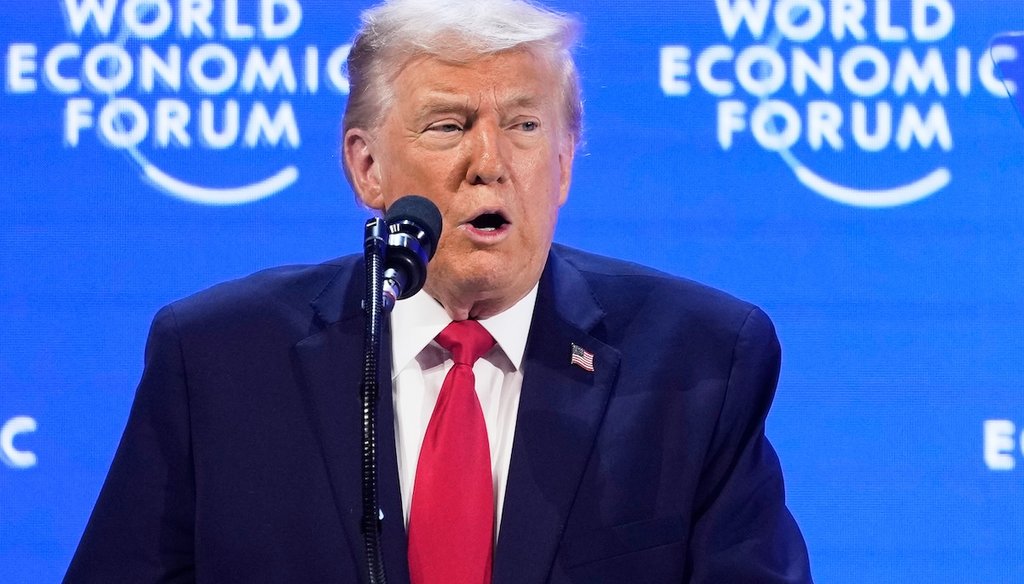
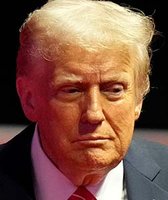
President Donald Trump speaks during the Annual Meeting of the World Economic Forum in Davos, Switzerland, Wednesday, Jan. 21, 2026. (AP)



As he prodded European leaders to let the U.S. take Greenland, President Donald Trump made several false or misleading statements about NATO, Greenland’s history with Denmark and the U.S. housing market.
Trump told World Economic Forum attendees he would not use force to acquire Greenland, while talking up his ability to negotiate through tariff threats.
"You can say yes, and we will be very appreciative, or you can say no and we will remember," Trump said in the hourlong Jan. 21 speech.
Hours later, Trump said on Truth Social that he met with Secretary General of NATOMark Rutte and "formed the framework of a future deal with respect to Greenland" and therefore will not impose the tariffs. The post did not provide details.
At an already tense moment for European leaders, amid comments dismissive of NATO, Trump on four occasions referred to "Iceland" as he mused about the reaction to his Greenland push.
Here is a fact-check of his remarks.
"We've never gotten anything" from NATO.
That’s wrong. Trump overlooked that NATO invoked Article 5 after the Sept. 11, 2001, attacks on the U.S.
The article’s key text says that "an armed attack against one or more" NATO members is considered an attack on all members and leads to assistance including the use of armed forces. According to historian David Murphy of Ireland’s Maynooth University, Danish troops were among the NATO nations supporting the U.S. effort in Afghanistan. Forty-four Danish troops died in combat, Murphy said — the highest per capita death rate among coalition members. Another eight Danish soldiers died in the U.S. war against Iraq, he said.
Non-NATO members, including Russia, also supported the U.S. after Sept. 11, said Marc Trachtenberg, a UCLA political scientist who studies international relations.
The benefit of NATO for the U.S. during the Cold War was that the Soviets were prevented from "harnessing its vast resources to their war machine" and that was accomplished without West Germany arming itself with nuclear weapons, Trachtenberg said. "What we ‘got’ was a political system both sides could live with — an extraordinary accomplishment."
"I've done more to help NATO than any other president, by far, than any other person."
Experts said Trump gets some credit for allies agreeing in 2025 to increase their NATO spending. But they also said that Russia President Vladimir Putin’s 2014 and 2022 invasions of Ukraine spurred European defense spending increases.
RELATED: Fact-checking Trump's text message to Norway’s prime minister about Nobel Peace Prize, NATO
"We gave Greenland back to Denmark."
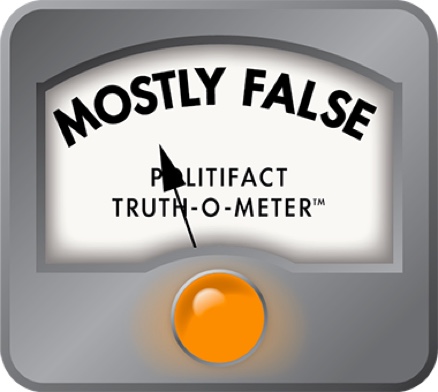
This is misleading.
After Germany invaded Denmark, the U.S. assumed responsibility for Greenland’s defense and established a military presence on the island that remains today, albeit in diminished scope. The U.S. never possessed the nation — so it could not have given it back.
Trump was more accurate when he said that during World War II, "We saved Greenland and successfully prevented our enemies from gaining a foothold in our hemisphere."
"In 2019 Denmark said that they would spend over $200 million to strengthen Greenland's defenses. But as you know, they spent less than 1% of that amount."
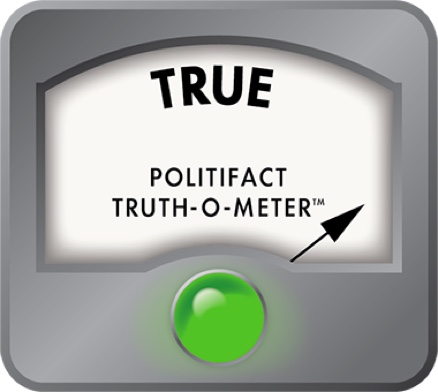
This is accurate, according to news reports.
In 2019, Denmark pledged to invest around $200 million on military spending in Greenland. At the time, Trump had talked about wanting to buy the territory. However, in 2024, a Danish news outlet reported that Denmark had only spent about 1% of the money.
In 2025, amid renewed threats from Trump to take over Greenland, Reuters reported that Denmark Defense Minister Troels Lund Poulsen said: "We have neglected for many years to make the necessary investments in ships and in aircraft that will help monitor our kingdom, and that is what we are now trying to do something about."
In October, the Danish government pledged to invest around $4 billion in military spending in Greenland, Reuters reported.
"In 2025, for the first time in 50 years, the United States had reverse migration."
A Jan. 13 analysis from the Brookings Institute estimated that net migration — how the number of people immigrating to the U.S. compares with the number moving out of the country — was close to zero or negative in 2025, citing Trump’s immigration policies. The analysis also estimated the trend will remain in 2026 while cautioning that "recent reductions in data transparency make the estimates more uncertain."
The last time the U.S. experienced negative net migration was more than 85 years ago, in the period from 1931 to 1940, during the Great Depression.
"Grocery prices, energy prices, airfares, mortgage rates, rent and car payments are all coming down, and they're coming down fast."
The accuracy of this statement is mixed.
Mortgage rates have fallen from just over 7% when he took office to a bit above 6% as of mid-January, and airfare and the price of new and used cars have also experienced price declines.
The picture is more nuanced for grocery and energy prices.
The price of groceries has risen at rates similar to their increase during President Joe Biden’s final year in office. While prices for some specific items — including eggs, bacon, dairy products and bread — have gone down, the prices for many other staples are up, including ground beef, steak, chicken breasts, coffee, fruits and vegetables, and sugar and sweets.
On energy, the cost of electricity is up significantly, almost 7% higher than a year ago. But gasoline prices have seen a notable decline. After spending the first 10 months of 2025 in a holding pattern around $3.10 a gallon, gasoline prices have fallen below $2.80 a gallon nationally since November.
A "major factor in driving up housing costs was the mass invasion of our borders."
Evidence doesn’t support the connection between immigrants in the country illegally and high housing costs. Instead, experts point to a shortage of millions of homes caused by years of underbuilding. An interest rate surge and increased demand for homes during the pandemic exacerbated the problem.
"China makes almost all of the windmills, and yet, I haven't been able to find any wind farms in China."
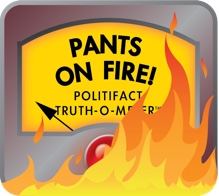
That’s Pants on Fire!
China has about 44% of the world’s wind farm capacity, ranking No. 1 globally and almost triple what the U.S. has. China is also planning or building more wind farm capacity than any other country.
PolitiFact Staff Writer Maria Briceño contributed to this story.
RELATED: Fact-checking Donald Trump’s marathon press briefing at one-year mark of second term
Our Sources
U.S. Department of Defense, U.S. Officials Agree NATO's Worth is Unquestionable, July 8, 2024
Maynooth University, How did the US become the main threat to the future of NATO? Accessed Jan. 21, 2026
Email interview, Marc Trachtenberg, UCLA political scientist, Jan. 21, 2026
See links in story for additional sources
Browse the Truth-O-Meter
More by Louis Jacobson