Stand up for the facts!
Our only agenda is to publish the truth so you can be an informed participant in democracy.
We need your help.
I would like to contribute

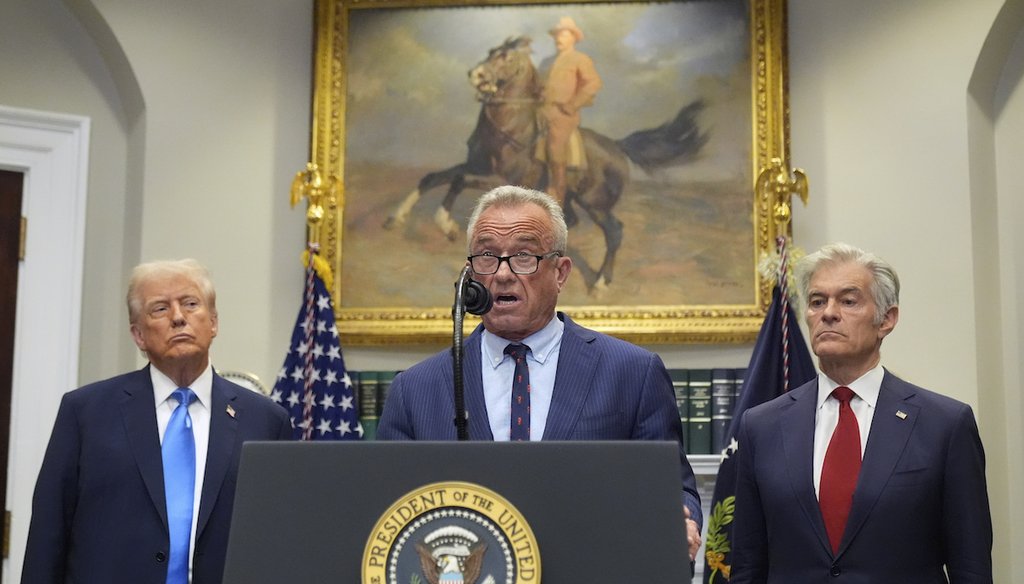
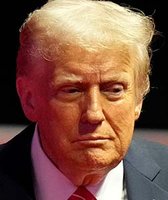
President Donald Trump and Centers for Medicare & Medicaid Services administrator Dr. Mehmet Oz listen as Health and Human Services Secretary Robert F. Kennedy Jr. speaks in the White House, Sept. 22, 2025, in Washington. (AP)

President Donald Trump warned U.S. women to stop taking Tylenol in pregnancy or risk giving their children autism. The advice came with no clear scientific basis during an hourlong press conference as he stood beside the nation’s top health officials, including the anti-vaccine activist he appointed to lead U.S. health policy.
"Taking Tylenol is not good," Trump said Sept. 22 at the White House with U.S. Health and Human Services Secretary Robert F. Kennedy Jr. beside him.
Pregnant women have relied on acetaminophen — the active ingredient in Tylenol and other medications — for decades to relieve pain and reduce fever. It’s often the only medication OB-GYNs recommend to their patients experiencing high fevers. Untreated fevers can pose health risks for pregnant women and their developing babies.
As PolitiFact has reported, research so far does not provide conclusive support for Trump’s warning. Some studies have found an association between acetaminophen use during pregnancy and autism prevalence, while others have found none. None of the research has proven it causes autism in children. Autism was first identified in 1943, more than a decade before the U.S. Food and Drug Administration approved Tylenol for use over-the-counter.
Trump touted the promise of leucovorin in treating autism. The drug is a form of vitamin B9, also known as folate, traditionally used to combat the toxic effects of certain cancer drugs. He also repeated a number of other wrong or misleading statements about autism and vaccines.
Trump: "Since 2000, autism rates have surged by much more than 400%."
Autism prevalence among children has increased over the years, but Trump’s statement misses important context about the reasons behind the rise, including the increase in autism screening, diagnosis and awareness.
In 2000, the U.S. Centers for Disease Control and Prevention estimated 1-in-150 8-year-olds had autism. In April, the CDC announced that prevalence had risen to 1-in-31. This represents a roughly 383% increase.
Scientists, including the CDC, have largely attributed the rise to better screening, changes in diagnostic requirements, wider access to services and increased public awareness.
The CDC based its most recent finding on 2022 surveillance data from 16 sites across 15 states and territories. Autism’s prevalence varied widely by location. The report’s 52 authors attributed those inconsistencies to different ways autism is evaluated and identified, the availability of screenings and financial barriers that can limit families’ access to services.
In the mid-1990s, researchers began to see autism as a condition that presents in a broad spectrum of symptoms with varying degrees of severity. By 2013, clinicians formally adopted a single autism spectrum disorder diagnosis that includes people with a range of treatment needs.
Autism advocates have raised awareness of the condition. As more services have become available to autistic children, families increasingly seek out formal testing. A child’s autism spectrum disorder diagnosis makes special education services more accessible and insurance coverage more likely.
Trump: "There are certain groups of people that don't take vaccines and don't take any pills that have no autism," including the Amish and Cubans.
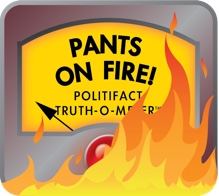
We rated a similar claim about the Amish Pants on Fire in 2023. Studies have documented cases of autism among Amish children.
The Amish, a Christian group known for rejecting modern conveniences and technological innovation, tend to have lower-than-average vaccination rates. However, some still vaccinate their children, with rates varying among settlements and different vaccines.
University of Maryland genetic epidemiologist Braxton Mitchell, who has studied Lancaster, Pennsylvania’s large Amish communities, previously told PolitiFact that childhood vaccines, which include shots for rotavirus, polio, tetanus and whooping cough, are more accepted among Amish people than other vaccines.
Trump also said "there’s a rumor" that Cubans don’t have Tylenol and "have virtually no autism."
Acetaminophen is sold in Cuba under the name "paracetamol," although shortages of the drug sometimes arise, according to The Latin Times.
Cuba also has documented cases of autism. A 2017 report in a peer-reviewed journal focused on Cuban health included a government estimate that 1-in-2,500 Cuban children have autism. That’s likely an undercount because of poor data and surveillance, it said.
Trump: "Hepatitis B is sexually transmitted. There's no reason to give a baby that's almost just born hepatitis B."
That’s misleading.
Hepatitis B can be transmitted sexually, but it’s not the only way. It can be spread through direct contact with blood or from a mother to child during delivery. More mundane household contact can also result in transmission. Small amounts of dried blood on innocuous household items such as nail clippers, razors or toothbrushes could be enough.
Around half of people with hepatitis B are unaware they are infected and contagious. The vaccine dose is given to newborns within 24 hours of delivery because hepatitis B infections are extra dangerous for babies. Infected infants have a 90% chance of developing the disease’s more dangerous chronic form, which can cause cirrhosis and liver cancer. A quarter of those babies will go on to die prematurely from the disease when they become adults.
Trump: "Don't take Tylenol. There's no downside…don't take it if you're pregnant."
We rated this Pants on Fire! Acetaminophen reduces fever, and fever during pregnancy has been linked to birth defects and other health problems.
Untreated fever and pain during pregnancy has significant maternal and infant health risks, including miscarriage and preterm birth, according to the Society for Maternal-Fetal Medicine and the American College of Obstetricians and Gynecologists.
Doctors have also said that abstaining from needed medication could leave pregnant women in a negative emotional and mental state with worsening underlying conditions.
Trump: "Now, you know what mercury is, you know what aluminum is. Who the hell wants that pumped into a body?"
Vaccine critics often cite aluminum and mercury as problematic vaccine ingredients. But these blanket statements leave out important details about the chemistry and the quantity used. Health officials warn pregnant and breastfeeding women against consuming too much mercury, which can be found in seafood in safe and hazardous levels. But those warnings are about methylmercury, which is different from the kind of mercury used in vaccines.
Thimerosal, a preservative that prevents bacteria and fungal growth in multi-dose influenza vaccine vials, contains ethylmercury. Unlike methylmercury, which can accumulate and cause harm, ethylmercury is broken down by the body and excreted quickly making it less likely to cause harm.
Thimerosal was removed from most vaccines, including all childhood vaccines, as of 2001, according to the CDC. Numerous scientific studies have found no link between thimerosal and autism.
Some vaccines contain a small amount of aluminium to enhance the body’s immune response. Although large amounts of aluminum can be harmful, vaccines contain less aluminum than infants get from their natural surroundings.
According to the Children’s Hospital of Philadelphia, babies get about 4.4 mg of aluminum from vaccines in their first six months; they get around 7 mg from breastmilk and around 38 mg from formula in the same time.
Trump: Questioning how vaccines are administered to children, "Maybe it’s the doctors they get, maybe more money."
Trump advocated for childhood vaccines to be split up into multiple doses — a practice that exists for most childhood vaccines. As he spoke, he questioned if doctors have a financial incentive when it comes to administering vaccines.
A close look at the process by which vaccines are administered shows pediatric practices make little profit — and sometimes lose money — on vaccines.
Pediatric practices might make money providing vaccines to privately-insured children, but many also participate in a program that vaccinates children for free. Overall, most practices likely break even or lose money.
Doctors told us that evidence-based science and medicine and a desire to keep kids healthy drives doctors’ childhood vaccination recommendations.
Staff Writer Madison Czopek contributed to this report.
RELATED: Trump is wrong: There are downsides to avoiding Tylenol, not treating fever while pregnant
Our Sources
See sources in story.
Browse the Truth-O-Meter
More by Grace Abels