Stand up for the facts!
Our only agenda is to publish the truth so you can be an informed participant in democracy.
We need your help.
I would like to contribute

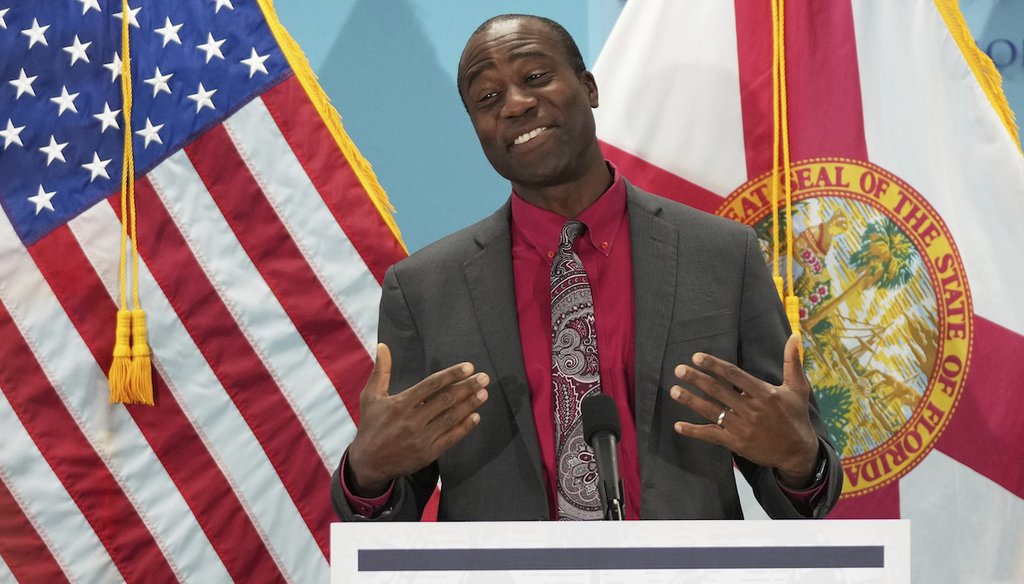
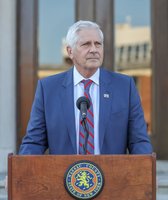
Florida Department of Health Surgeon General Dr. Joseph Ladapo speaks during a public event where Gov. Ron DeSantis announced he would sign a bill banning the use of fluoride in public water systems, May 6, 2025, in Miami. (AP)

If Your Time is short
-
Some countries without school vaccination requirements have vaccination rates similar to the United States, where vaccines are generally required to attend school.
-
Research shows an association between mandatory vaccination policies and increased vaccination rates. But that association could be explained by other factors, including increased documentation and vaccine education. Association is not the same as causation.
-
Vaccine experts say more limited health care access, cultural factors and anti-vaccine activists’ influence set the United States apart from some countries that maintain high vaccination rates without mandates.
U.S. states have relied on vaccine mandates since the 1800s, when a smallpox vaccine offered the first successful protection against a disease that had killed millions.
More than a century later, Florida’s top public health official said vaccine requirements are unethical and unnecessary for high vaccination rates.
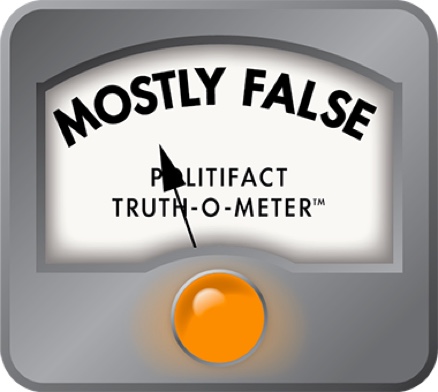
"You can still have high vaccination numbers, just like the other countries who don’t do any mandates like Sweden, Norway, Denmark, the (United Kingdom), most of Canada," Florida Surgeon General Dr. Joseph Ladapo said Oct. 16. "No mandates, really comparable vaccine uptake."
It’s true that some countries without vaccine requirements have high vaccination rates, on par with the U.S. But experts say that fact alone does not make it a given that the U.S. would follow the same pattern if it eliminates school vaccination requirements.
Florida state law currently requires students in public and private schools from daycare through 12th grade to have specific immunizations. Families can opt out for religious or medical reasons. About 11% of Florida kindergarteners are not immunized, recent data shows. With Florida Gov. Ron DeSantis’ backing, Ladapo is pushing to end the state’s school vaccine requirements.
The countries Ladapo cited — Sweden, Norway, Denmark, the U.K. and parts of Canada — don’t have broad vaccine requirements, research shows. Their governments recommend such protections, though, and their health care systems offer conveniently accessible vaccines, for example.
UNICEF, a United Nations agency which calls itself the "global go-to for data on children," measures how well countries provide routine childhood immunizations by looking at infant access to the third dose in a DTaP vaccine series that protects against diphtheria, tetanus and pertussis or whooping cough.
In 2024, UNICEF and the World Health Organization reported that 94% of 1-year-olds in the United States had received three doses of the DTaP vaccine. That’s compared with Canada at 92%, Denmark at 96%, Norway at 97%, Sweden at 96% and the U.K. at 92%.
Universal, government-provided health care and high trust in government likely influence those countries’ vaccine uptake, experts said. In the United States, many people can’t afford time off work or the cost of a doctor’s visit. There’s also less trust in the government. These factors could prevent the U.S. from having similar participation rates should the government eliminate school vaccine mandates.
Universal health care, stronger government trust increase vaccination
Multiple studies have linked vaccine mandates and increased vaccination rates. Although these studies found associations between the two, the research does not prove that mandates alone cause increased vaccination rates. Association is not the same as causation.
Other factors that can affect vaccination rates often accompany mandates, including local efforts to improve vaccination access, increase documentation and combat vaccine hesitancy and refusal.
The countries Ladapo highlighted are high-income countries with policies that encourage vaccination and make vaccines accessible.
In Sweden, for example, where all vaccination is voluntary, the vaccines included in national programs are offered for free, according to the Public Health Agency of Sweden.
Preventative care is more accessible and routine for everyone in countries such as Canada, Denmark, Norway, Sweden and the U.K. with universal healthcare systems, said Dr. Megan Berman of the University of Texas Medical Branch’s Sealy Institute for Vaccine Sciences.
"In the U.S., our healthcare system is more fragmented, and access to care can depend on insurance or cost," she said.
More limited health care access, decreased institutional trust and anti-vaccine activists’ influence set the United States apart from those other countries, experts said.
Some of these other countries’ cultural norms favor the collective welfare of others, which means people are more likely to get vaccinated to support the community, Berman said.
Anders Hviid, an epidemiologist at Statens Serum Institut in Copenhagen, told The Atlantic that it’s misguided to compare Denmark’s health situation with the U.S. — in part because Danish citizens strongly trust the government to enact policies in the public interest.
By contrast, as of 2024, fewer than 1 in 3 people in the U.S. over age 15 reported having confidence in the national government, according to data from Organisation for Economic Co-operation and Development, a group of advanced, industrialized nations. That’s the lowest percentage of any of the countries Ladapo mentioned.
"The effectiveness of recommendations depends on faith in the government and scientific body that is making the recommendations," said Dr. Richard Rupp, of the University of Texas Medical Branch’s Sealy Institute for Vaccine Sciences.
Without mandates, vaccine education would be even more important, experts say
Experts said they believe U.S. vaccination rates would fall if states ended school vaccine mandates.
Maintaining high vaccination rates without mandates would require health officials to focus on other policies, interventions and messaging, said Samantha Vanderslott, the leader of the Oxford Vaccine Group’s Vaccines and Society Unit, which researches attitudes and behavior toward vaccines.
That could be especially difficult given that the United States’ top health official, Health and Human Services Secretary Robert F. Kennedy Jr., has a long history of anti-vaccine activism and skepticism about vaccines.
That makes the U.S. an outlier, Vanderslott said.
"Governments tend to promote/support vaccination as a public health good," she said. It is unusual for someone with Kennedy’s background to hold a position where he has the power to spread misinformation, encourage vaccine hesitancy and reduce mainstream vaccine research funding and access, Vanderslott said.
Most people decide to follow recommendations based on their beliefs about a vaccine’s benefits and their child’s vulnerability to disease, Rupp said. That means countries that educate the public about vaccines and illnesses will have better success with recommendations, he said.
Ultimately, experts said that just because something worked elsewhere doesn’t mean it will work in the United States.
Matt Hitchings, a biostatistics professor at the University of Florida’s College of Public Health and Health Professions, said a vaccine policy’s viability could differ from country to country. Vaccination rates are influenced by a host of factors.
"If I said that people in the U.K. drink more tea than in the U.S. and have lower rates of certain cancers, would that be convincing evidence that drinking tea reduces cancer risk?" Hitchings said.
Editor’s note: Google Translate was used throughout the research of this story to translate websites and statements into English.
RELATED: Why is metal used in vaccines? Is it safe? Here’s what to know about aluminum in vaccines.
RELATED: Hepatitis B vaccine Q&A: Why do babies need the shot?
Our Sources
MAHA Action’s YouTube channel, Ep11 - Sen. Rand Paul, Russell Brand, Dr. Joseph Ladapo, Laura Delano & More, Oct. 16, 2025
Dr. Joseph Ladapo’s X post, Oct. 15, 2025
Politico, Amid Florida’s push against vaccine mandates, fears grow of increased risks - POLITICO, Sept. 14, 2025
Email interview with Matt Hitchings, a biostatistics professor at the University of Florida College of Public Health and Health Professions, Oct 21, 2025
Email interview with Samantha Vanderslott, leader of the Oxford Vaccine Group’s Vaccines and Society Unit and a health sociologist and professor at the University of Oxford, Oct. 22, 2025
Email interview with Dr. Richard Rupp, a professor of pediatrics and Sealy Institute for Vaccine Sciences faculty member at the University of Texas Medical Branch, Oct. 23, 2025
Email interview with Dr. Megan Berman, a professor of internal medicine and Sealy Institute for Vaccine Sciences faculty member at the University of Texas Medical Branch, Oct. 23, 2025
Science, Florida plans to nix vaccine mandates. How well do they work?, Sept. 5, 2025
Our World In Data, Which countries have mandatory childhood vaccination policies?, June 11, 2021
Vaccines, Childhood Mandatory Vaccinations: Current Situation in European Countries and Changes Occurred from 2014 to 2024, Oct. 18, 2024
Vaccine, Global assessment of national mandatory vaccination policies and consequences of non-compliance, Nov. 17, 2020
CMAJ, Mandatory vaccinations: The Canadian picture, Nov. 8, 2011
Eurosurveillance, Mandatory and recommended vaccination in the EU, Iceland and Norway: results of the VENICE 2010 survey on the ways of implementing national vaccination programmes, Oct. 18, 2011
American Medical Association Journal of Ethics, When Are Vaccine Mandates Appropriate? January 2020
UNICEF, Vaccination and Immunization Statistics - UNICEF DATA, July 2025
World Health Organization, Diphtheria-tetanus-pertussis (DTP3) immunization coverage among 1 year olds (%), July 15, 2025
CMAJ Open, Impact of school vaccination mandates on pediatric vaccination coverage: a systematic review, Aug. 6, 2019
Immunize Canada, Is immunization mandatory in Canada?, accessed Oct. 22, 2025
Vaccines, Effectiveness of Mandatory and Incentive-Based Routine Childhood Immunization Programs in Europe: A Systematic Review of the Literature, Oct. 13, 2021
National Conference of State Legislatures, State Non-Medical Exemptions From School Immunization Requirements, updated July 24, 2025
Open Forum Infectious Diseases, Immunization Mandates, Vaccination Coverage, and Exemption Rates in the United States, June 2, 2018
Vaccine, Addressing logistical barriers to childhood vaccination using an automated reminder system and online resource intervention: A randomized controlled trial, June 29, 2021
Barron’s, Thousands Protest In Sweden Against Vaccine Pass - Barron's, Jan. 22, 2022
Justia, Jacobson v. Massachusetts | 197 U.S. 11 (1905), accessed Oct. 23, 2025
Florida Statues, 1003.22, Accessed Oct. 23, 2025
PolitiFact, School vaccine rules are not like slavery. Fact-checking Florida's Surgeon General Joseph Ladapo, Sept. 4, 2025
Pediatrics, Mandatory Vaccination in Europe, March 23, 2020
Pediatrics, Let’s Not Make Conclusions About Mandatory Vaccination From Imperfect Regression Analysis Available to Purchase, Aug. 1, 2020
UK Parliament, Covid-19: Vaccination as a Condition of Deployment - Hansard, accessed Oct. 27, 2025
The Guardian, Mandatory Covid jabs for healthcare workers in England to be scrapped | Health policy, March 1, 2022
House of Commons Library, UK vaccination policy, March 8, 2022
NHS, NHS vaccinations and when to have them, accessed Oct. 27, 2025
The Public Health Agency of Sweden, Vaccinations - The Public Health Agency of Sweden, accessed Oct. 24, 2025
The Public Health Agency of Sweden, Vaccination programmes, accessed Oct. 27, 2025
NIPH, Childhood Immunisation Programme, accessed Oct. 27, 2025
The Danish Health Authority, Children, accessed Oct. 27, 2025
Government of Canada, Recommended immunization schedules: Canadian Immunization Guide, accessed Oct. 27, 2025
The Atlantic, The Obvious Reason the U.S. Should Not Vaccinate Like Denmark, July 24, 2025
OECD, Trust in government, accessed Oct. 24, 2025
Global News, B.C. planning on mandatory vaccination registration at schools by September, says health minister, Feb. 26, 2019
Health Link BC, Vaccination Status Reporting Regulation, accessed Oct. 24, 2025
Helse Norge, Vaccination of children in Norway - Helsenorge, accessed Oct. 24, 2025
KFF Health News, Doctors Muffled as Florida Moves To End Decades of Childhood Vaccination Mandates, Oct. 27, 2025
Mayo Clinic, Vaccine requirements and vaccine research highlights, accessed Oct. 27, 2025
History of Vaccines, Timeline of Vaccination Mandates, Aug. 9, 2021
Pew, Americans' Deepening Mistrust of Institutions, Oct. 17, 2024