Stand up for the facts!
Our only agenda is to publish the truth so you can be an informed participant in democracy.
We need your help.
I would like to contribute

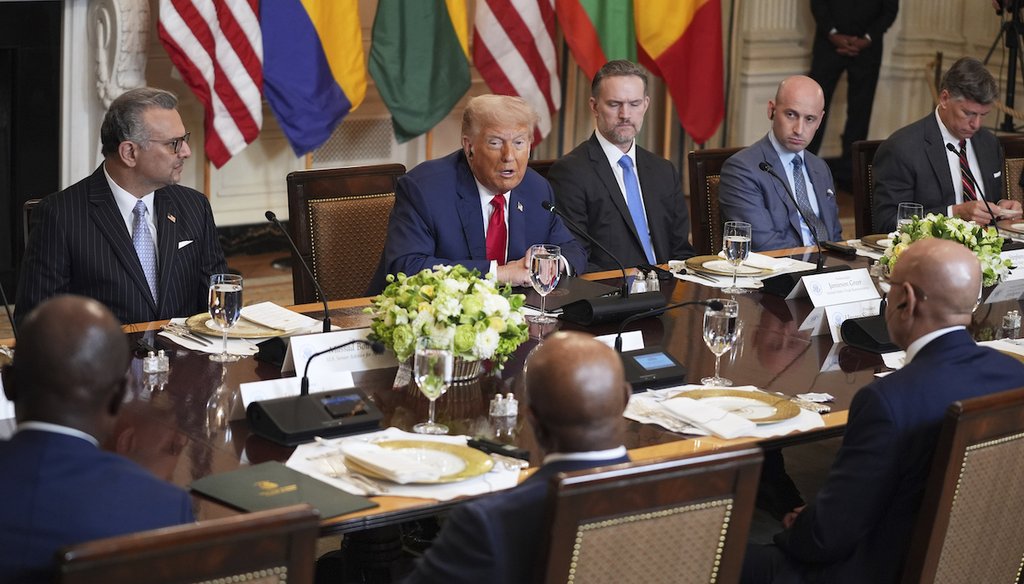
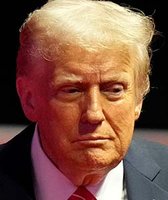
President Donald Trump speaks during a lunch with African leaders includingLiberian President Joseph Nyuma Boakai in the State Dining Room of the White House, Wednesday, July 9, 2025, in Washington. (AP)

If Your Time is short
-
Liberia was founded in the 1820s as part of the American "colonization" movement, which sought to resettle free Black Americans on the African continent.
-
English is the official language of Liberia. Over 20 indigenous languages are also still spoken.
-
Americo-Liberians are a minority of the population but held political power until a military coup in 1980.
During a meeting with several African leaders, President Donald Trump made news with a compliment to the Liberian president, Joseph Boakai.
"In such good English, it's beautiful. Where did you learn to speak so beautifully? Where were you educated?" asked Trump. "In Liberia? That's very interesting. It's beautiful English. I have people at this table that can't speak nearly as well."
Nervous chuckles and sideways glances ensued.
What Trump didn’t seem to know was that English is Liberia’s official language.
Liberia was founded in the 1820s as part of the American "colonization" movement, which sought to resettle free black Americans on the African continent rather than pursue emancipation in the U.S.
The American ‘colonization’ movement
The African nation of Liberia started as an idea on American soil in the early 1800s. Prominent white Americans, including then-President James Madison, were growing concerned about an increasing number of freed Black people who they saw as inferior and unable to integrate with white people. Others feared that Black people who had their freedom would encourage the enslaved population to rebel or assist in their flight to freedom up north.
In 1816, a group of white elites started the American Colonization Society with a mission to send freed Black people to the African continent. The organization was supported by a mixed coalition of both abolitionists and slaveholders. Among slaveholders, the endeavor was a way to consolidate and strengthen the institution of slavery. Abolitionists saw it as a way to grant freedom to the enslaved population without integration.
Some Black Americans, though much smaller in number, supported the effort, seeing the return to the African continent as a way to escape violent racism and govern themselves with political and economic agency.
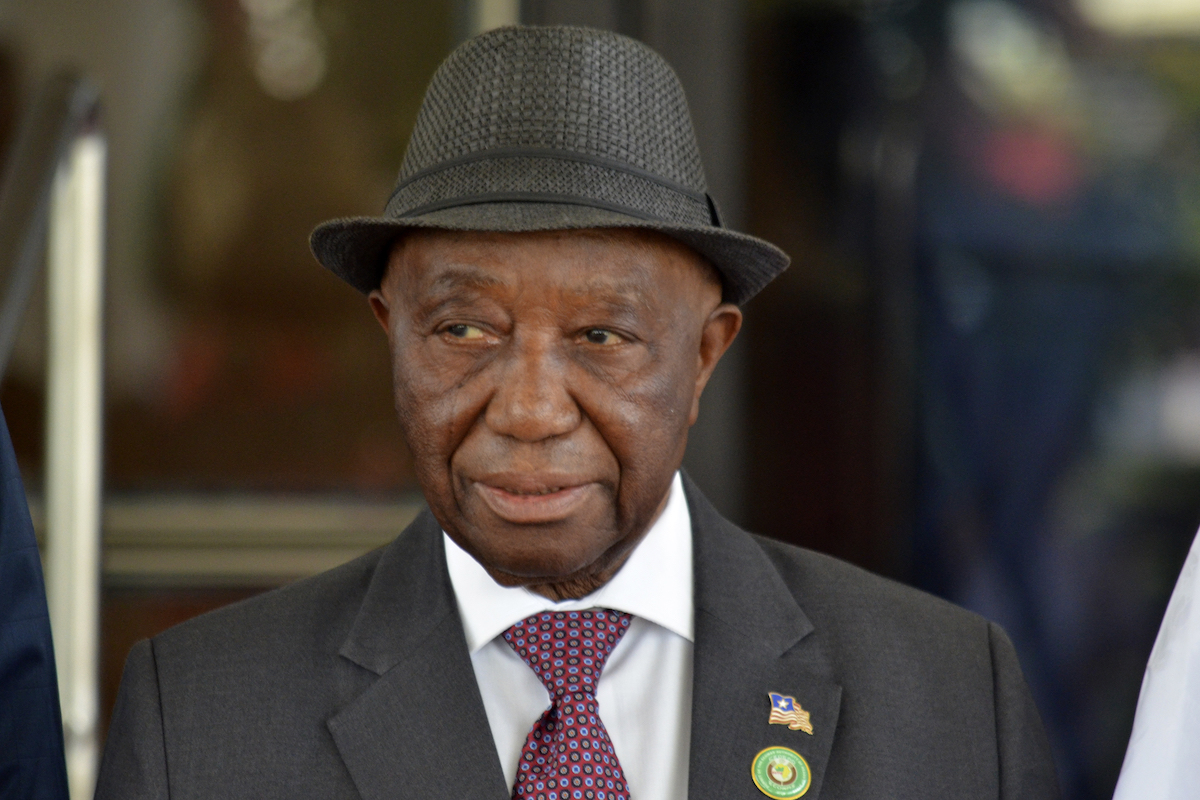
Liberia's President Joseph Boakai in Nigeria on Dec 15, 2024. (AP)
The founding of Liberia
The American Colonization Society’s first voyage to West Africa took place in 1820, carrying about 90 immigrants who landed on Sherbro Island in Sierra Leone. Many died from disease.
During another trip in 1821, society member Eli Ayres and U.S. Navy Lt. Robert Stockton purchased land along the coast for a settlement. There are mixed reports as to whether this transaction involved violent coercion of the native population.
In 1822, the remaining immigrants from Sherbo Island and more Black Americans arrived and began their settlement, which expanded over the years. Violent conflicts between the indigenous population and the settlers erupted.
In 1824, the settlement earned its name Liberia. The capital city was named Monrovia for U.S. President James Monroe, a major supporter of the effort.
"The achievements of the Colonization Society were meager," wrote historian Nicholas Guyatt in an article for the African American Intellectual History Society, "Its colony of Liberia, founded in 1821, recruited only ten thousand migrants from the United States over the four decades before the Civil War."
Liberia was also populated by Africans recaptured from illegal slave ships by the U.S. Navy that patrolled the West African coast.
In 1847, Liberian residents declared independence from the American Colonization Society’s governance.
By the end of the 1800s, about 15,000 African Americans, 300 Afro-Caribbeans, and 6,000 Africans rescued from slave ships had migrated to Liberia, historian C. Patrick Burrowes told The Washington Post.
Americo-Liberians, descendents of the Black American immigrants, make up about 5% of the country, but controlled the government for much of Liberia's history. Indigenous Liberians weren’t granted citizenship until 1904 and didn’t have the right to vote in Liberian elections until 1946. Americo-Liberians’ political dominance ended after a violent military coup in 1980, led by indigenous soldiers. Civil unrest lasted until a peace agreement in 2003.
Today, Liberia is a democracy currently led by President Boakai, who is from the Kissi ethnic group and speaks both native languages of Kissi and Mendi as well as English.
English is the official language of Liberia, but over 20 indigenous languages are also still spoken. The nation’s flag, created in 1827, was based on the U.S. flag.
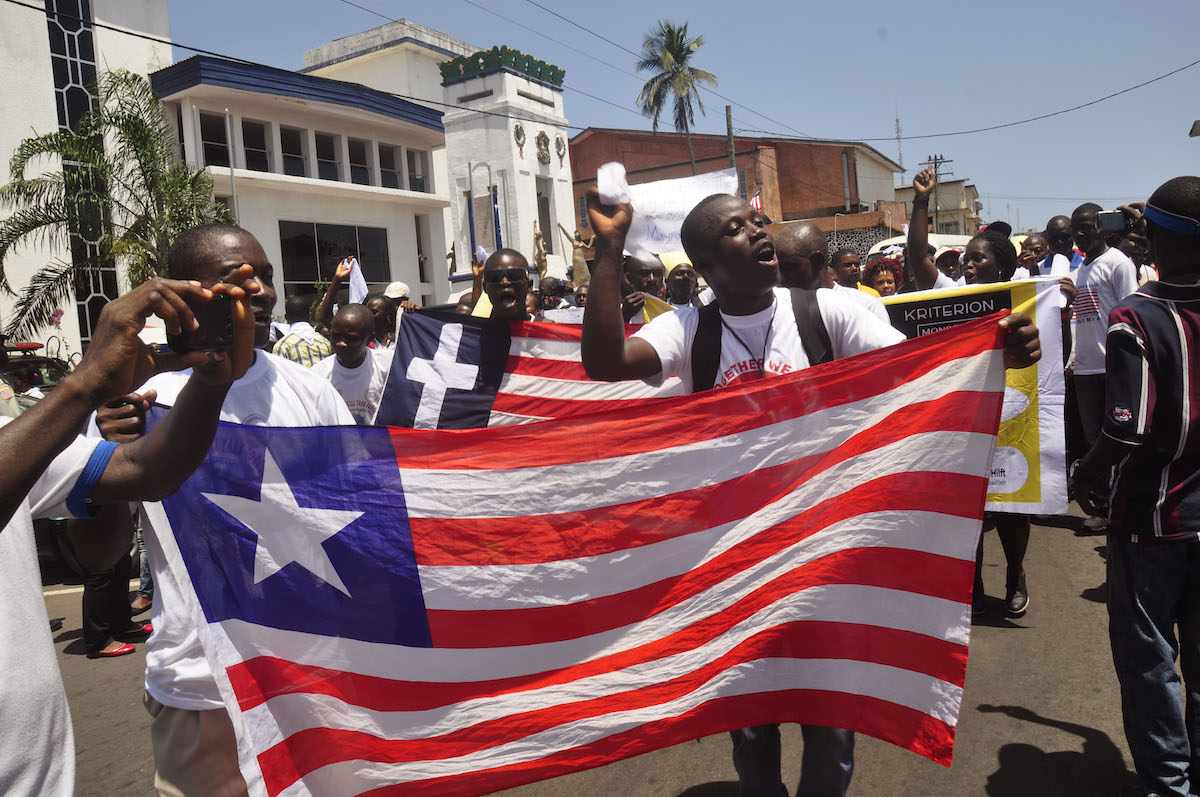
People display a representation of the Liberian flag as they celebrate Liberia being an Ebola free nation in Monrovia, Liberia, May 11, 2015. (AP)
Our Sources
U.S. State Department, "Founding of Liberia, 1847," accessed July 10, 2025
African American Intellectual History Society, "The American Colonization Society: 200 Years of the "Colonizing Trick"" Dec. 22, 2016
The White House Historical Association, "The American Colonization Society," June 22, 2020
PBS, "Africans in America/Part 3/American Colonization Society," accessed July 10, 2025
PBS, "Paul Cuffee and the First Back-to-Africa Effort," accessed July 10, 2025
Encyclopedia of Greater Philadelphia, "Colonization Movement (Africa) - Encyclopedia of Greater Philadelphia," accessed July 10, 2025
The Washington Post, "Two hundred years later, a long-lost document sheds light on the purchase of Liberia," Nov. 20, 2021
YouTube, "Repatriates, Recaptives and African Abolitionists: The Untold Story of Liberia's Founding in 1822," March 4, 2022
Library of Congress, "Maps of Liberia Timeline - 1820 to 1847 (archived version), Nov. 12, 2024
Library of Congress, "Maps of Liberia Timeline - 1900 to 1997 (archived version)," Nov. 12, 2024
The Journal of African History, "Recaptured Africans: Surviving Slave Ships, Detention, and Dislocation in the Final Years of the Slave Trade," Aug. 20, 2019
The Advocates for Human Rights, "The Liberian Truth and Reconciliation Commission Powerpoint," Jan. 1, 2008
Archived Department of State (2001-2009), "Liberia (09/08)," accessed July 10, 2025
BBC News, "William Tolbert: Liberian president killed in coup to get state funeral after 45 years," July 1, 2025
The Washington Post, "Liberian Soldiers Taunt, Shoot 13 Former Leaders," April 23, 1980
Library of Congress, "Colonization - The African-American Mosaic Exhibition," accessed July 10, 2025
Britannica, "American Colonization Society," accessed July 10, 2025
Britannica, "History of Liberia," accessed July 10, 2025
Britannica, "Liberia - Ethnic Groups, Migration, Diaspora," accessed July 10, 2025
The New York Times, "Trump Asks Liberian President Where He Learned English, the Country’s Official Language," July 10, 2025
Britannica, "Flag of Liberia," accessed July 10, 2025
Browse the Truth-O-Meter
More by Grace Abels