Stand up for the facts!
Our only agenda is to publish the truth so you can be an informed participant in democracy.
We need your help.
I would like to contribute

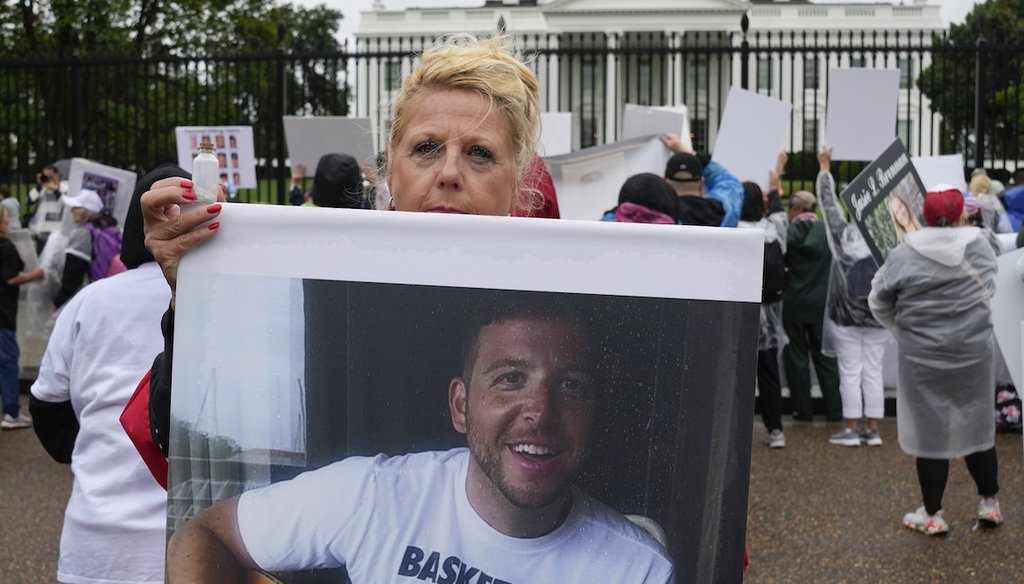
Diane Marsh holds a bottle containing the ashes of her son Peyton Marsh as she joins others protesting in front of the White House to raise awareness of opioid-related deaths on Sept. 23, 2023, in Washington. (AP)


When federal agencies recognize an "awareness day" for something, that’s code for: "Take this seriously. Please."
Deaths from fentanyl — the synthetic, often deadly opioid frequently present in illicit street drugs — have contributed to the United States’ soaring opioid overdose deaths in the last decade.
In 2022, the advocacy group Facing Fentanyl designated Aug. 21 "National Fentanyl Prevention and Awareness Day," to honor the people who have died from fentanyl and to increase public awareness of its toll. Today, a number of federal agencies mark the day as well.
Fentanyl overdose deaths have recently dropped. From April 2024 to March 2025, the CDC reported 43,000 synthetic opioid deaths, most of which are from fentanyl, down from nearly 70,000 in the previous similar period.
You probably already know this part: Even tiny amounts of fentanyl can be lethal. But we’ve come across a fair number of myths about fentanyl over the years. Knowing the facts about this potent drug can help save lives. Here’s some quick must-knows and common myths.
Two milligrams of fentanyl can be deadly: The U.S. Drug Enforcement Administration says that ingesting as little as 2 milligrams of fentanyl can be deadly for an adult. The drug is similar to morphine, but up to 100 times more potent, which is what makes it so lethal.
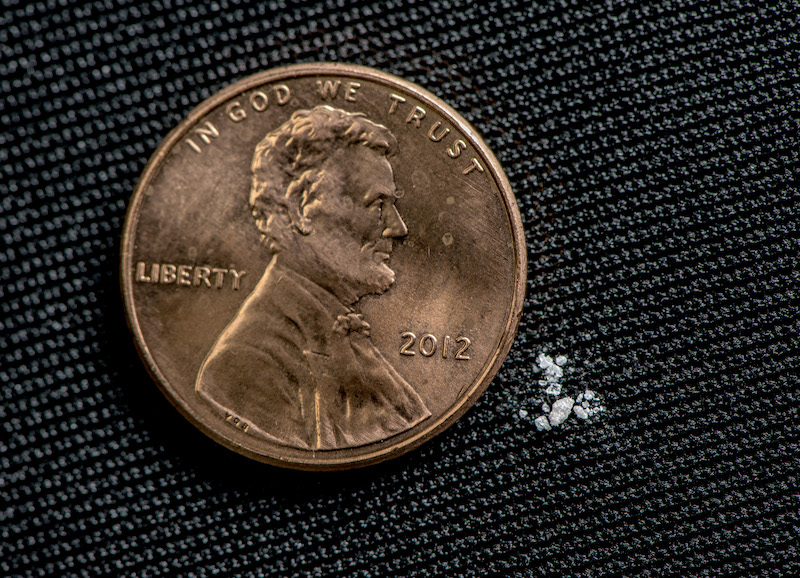
Photo shows how a potentially lethal 2-milligram dose of fentanyl compares in size to a penny. (U.S. Drug Enforcement Administration)
Different people can tolerate different doses, but it’s hard to know how much is in a pill: A dose’s lethality can vary based on height, weight and tolerance from past exposure. So a frequent opioid user may tolerate a higher dose than a first time user. A DEA analysis found dosages can vary widely from one pill to another.
Fentanyl can be added to other illicit drugs such as heroin and cocaine: Because of its potency and low cost, fentanyl is frequently used to "cut" other illicit drugs, including heroin, cocaine and methamphetamines. As a result, people may unknowingly take a drug that contains fentanyl in potentially lethal amounts.
Medical fentanyl can be prescribed by a doctor: A pharmaceutical form of fentanyl can be safely prescribed by doctors to treat severe pain after surgery or in the late stages of cancer. It is used similarly to morphine but in smaller doses. It can be administered through a shot, a patch on the skin or a lozenge.
Street fentanyl is not the same as medical fentanyl: Illicit fentanyl, the kind sold illegally on the street, is not regulated like the kind that doctors give. It is made in clandestine labs and the exact dosage is not always reliable. Illicit fentanyl is most closely associated with overdose deaths. According to the DEA, illicit fentanyl can be sold as a powder, pill or nasal spray.
Fentanyl test strips can show if a drug has been laced: But they cannot tell you how much of the opioid is present. Read about how to use fentanyl test strips here.
Naloxone or Narcan can reverse an opioid overdose: Naloxone, also known by the brand name Narcan, is administered via nasal spray or injection and can be bought over the counter. Friends, family members and bystanders can give a person naloxone in the case of an overdose, according to the National Institute on Drug Abuse. Sometimes multiple doses are needed, depending on the strength of the opioid.
People who use Narcan should still go to the hospital: Naloxone reverses an opioid overdose for 30 to 90 minutes, so it is possible overdose symptoms can return once the treatment wears off.
You can’t overdose by touching an item containing fentanyl. In 2017, the American College of Medical Toxicology and the American Academy of Clinical Toxicology released a joint statement saying "it is very unlikely" that skin exposure to fentanyl powder or tablets "would cause significant opioid toxicity." Fentanyl isn’t absorbed well by the skin; for fentanyl to have a physical effect on the body, it must enter the bloodstream. Some medical fentanyl is delivered through skin patches, but it is absorbed slowly over the course of hours. These patches can’t quickly deliver a high dose of fentanyl.
Breathing air in a room with fentanyl can’t make you sick. Medical experts said fentanyl isn’t volatile, meaning it doesn’t easily become a vapor, which means you’re not going to become sick from breathing near it. Experts said fentanyl doesn’t just float up into the air and unintentionally expose people nearby.
Fentanyl does not smell like popcorn when it burns. The Centers for Disease Control and Prevention reports that fentanyl is odorless and tasteless, and there is no visible way of knowing if or how much fentanyl a pill contains. But those low-cost test strips can determine whether a drug contains traces of fentanyl.
RELATED: It’s physically impossible to overdose from touching a dollar bill laced with fentanyl
RELATED: Following your nose won’t find fentanyl, experts say, but using test strips will
RELATED: Misinformation about fentanyl exposure threatens to undermine overdose response
Our Sources
Facing Fentanyl, "Facing Fentanyl," accessed Aug. 21, 2025
UC Davis, "Fentanyl facts, overdose signs to look for, and how you can help save a life," Jan. 11, 2023
University of Colorado, "Fentanyl and Counterfeit Prescription Drugs: Facts and Myths," Nov. 1, 2022
National Institute on Drug Abuse, "Fentanyl," June 2025
National Institute on Drug Abuse, "Naloxone DrugFacts," Jan. 2022
American Medical Association, "Dispelling Myths of Bystander Opioid Overdose," 2019
Centers for Disease Control and Prevention, "Understanding the Opioid Overdose Epidemic," June 9, 2025
Centers for Disease Control and Prevention, "National Fentanyl Prevention and Awareness Day™ Toolkit," Aug. 20, 2025
Centers for Disease Control and Prevention, "Fentanyl Facts," April 2, 2024
Centers for Disease Control and Prevention, "What You Can Do to Test for Fentanyl," April 2, 2024
U.S. Drug Enforcement Administration, "Fentanyl," accessed Aug. 21, 2025
U.S. Drug Enforcement Administration, "DEA Recognizes National Fentanyl Prevention and Awareness Day with Extended Museum Hours," Aug. 20, 2025
U.S. Drug Enforcement Administration, "Facts about Fentanyl," accessed Aug. 21, 2025
Wisconsin Department of Health Services, "Fentanyl Test Strip Instructions, One-Pager," June 2025
U.S. Food and Drug Administration, "FDA Approves First Over-the-Counter Naloxone Nasal Spray," March 29, 2023
Department of Justice, "DOJ, DEA message on Fentanyl Prevention and Awareness Day," Aug. 21, 2025
International Journal of Drug Policy, "The spread of misinformation about overdose risk from casual contact with fentanyl in mainstream and social media," Sept. 16 2020
PolitiFact, "Common myths about fentanyl debunked: No, you can’t accidentally overdose by touching fentanyl," Sept. 4, 2023
PolitiFact, "It’s physically impossible to overdose from touching a dollar bill laced with fentanyl," July 29, 2022
PolitiFact, "Following your nose won’t find fentanyl, experts say, but using test strips will," April 28, 2023
PolitiFact, "Misinformation about fentanyl exposure threatens to undermine overdose response," April 10, 2025
PolitiFact, "What are fentanyl patches? Does Narcan work for fentanyl overdoses? Here's what to know," Sept. 8, 2025
PolitiFact, "Dispelling a common myth about fentanyl as election workers get letters with traces of the substance," Nov. 20, 2023
PolitiFact, "Is fentanyl the leading cause of death among American adults?" Oct. 3, 2022
Browse the Truth-O-Meter
More by Grace Abels