Stand up for the facts!
Our only agenda is to publish the truth so you can be an informed participant in democracy.
We need your help.
I would like to contribute

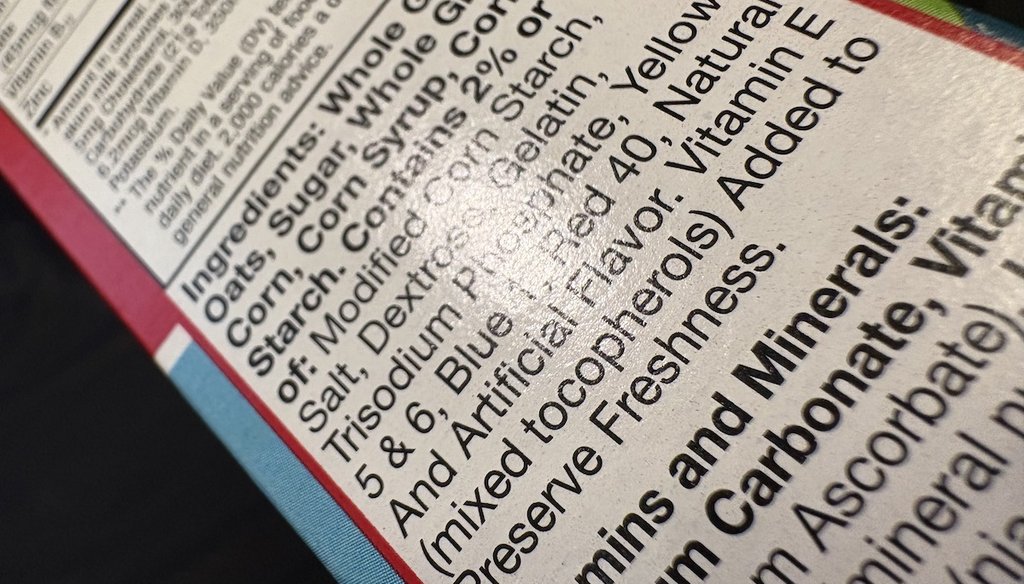
Some ingredients used in food are also used in cleaning products, cosmetics, and medication, but that doesn't necessarily make them dangerous. The amount you consume matters. (Grace Abels)

"Too much of anything is bad for you."
That’s what my mom would say when I asked to eat an entire watermelon for dinner. "But fruit is healthy," I would beg.
At that moment, my mom was passing on age-old wisdom — that it doesn’t just matter if something is "good for you" or "bad for you," the amount you consume matters, too.
A candy bar with lunch can be OK. Eating all my Halloween candy in one night: a haunting tummyache. A glass of wine with dinner? Fun! A whole bottle? Head-splitting.
The same principle often applies to the kinds of food additives that appear on product labels with tongue-twisting names that sound like they were pulled from chemistry textbooks or sci-fi movies. They can be perfectly safe to consume — in certain quantities.
Take trisodium phosphate. Google it, and you’ll get ads for heavy-duty cleaning products used to prep walls before painting. Warning labels say that direct contact with trisodium phosphate powder can be irritating to eyes and skin and even poisonous if exposed in large amounts.
But it is also an ingredient in cereals and many other processed foods including cheeses, soda and baked goods. In small amounts, the U.S. Food and Drug Administration and the European Food Safety Authority say it’s fine in food. It controls pH levels and acts as a leavening agent to make food fluffier.
Initially, I was skeptical, too — could something that works as a heavy-duty cleaner really be OK in food, even in small amounts? But it turns out my mom was right: How much you consume makes a big difference.
"Many food-grade additives share names with industrial products, but concentration makes all the difference," said Jessica Steier, a public health expert, podcaster and CEO of the science communication organization Unbiased Science. "The food-grade versions are highly purified, used in tiny amounts, and serve specific functions like pH regulation or preservation."
As I reported on trisodium phosphate and other chemicals used in food, experts consistently said, "the dose makes the poison." In other words, the toxicity of a substance in large amounts doesn’t necessarily translate to it being dangerous in small amounts.
Here’s another example: sodium bicarbonate. It can be used to clean ovens, unclog drains and extinguish fires. When consumed in large amounts, it can be poisonous.
Sounds like it might be bad to ingest, right? Well, sodium bicarbonate goes by another name: baking soda. Perfectly safe in chocolate chip cookies!
This applies to so many ingredients in our pantries. Table salt, or sodium chloride, is essential for the human body, but too much sodium can lead to health problems like cardiovascular issues and hypertension. Even too much water can be bad for you.
"The same chemical at different concentrations can be either beneficial or harmful (that's toxicology in a nutshell)" Steier wrote in an email to PolitiFact.
The way you are exposed also makes a difference – something might be safe to put on your skin, but not good to eat. Or, something may be safe to eat, but not safe to inhale. "The route of exposure is very important when considering toxicity," said Norbert Kaminski, toxicologist and director of the Center for Research on Ingredient Safety at Michigan State University.
But with so many ingredients to parse through, online influencers often point to scary warning labels that apply to chemicals in high doses. And they don’t mention that those warnings don’t apply to the way they usually appear in food: in very small quantities.
A few examples:
-
Calcium disodium ethylene-diaminetetraacetate, or calcium disodium EDTA, is used in food to preserve the flavor, color and texture of foods like canned soda, canned beans and vegetables, dressings and sauces. The U.S. Food and Drug Administration and other global food authorities have deemed it safe for consumption in small amounts. It is also used in cosmetics, cleaning supplies, dental procedures, and to treat heavy metal poisoning. But online, warnings about side effects of medical calcium disodium EDTA, which is administered in higher doses, were used to raise concerns about the use of the additive in fast food sauces.
-
Propylene glycol is an approved food additive in products such as Pop-Tarts, ice cream and cake mix. It is also an ingredient in anti-freeze. But the FDA considers it generally safe to consume in the small quantities in food.
-
Some chemicals used to fluoridate water, like hydrofluorosilicic acid, can be corrosive in their pure form, but when a small amount is added to water at treatment plants, the acid breaks down its different parts and is safe to consume.
The FDA regulates safe levels of food additives. What is considered a "safe level" for a given ingredient is often "several magnitudes lower than what is typically found in animal studies," to be safe, said Kaminski.
Sometimes online influencers raise concerns about other environmental contaminants that can end up in food, even if they’re not on the ingredients list.
Trace amounts of heavy metals such as arsenic, lead, cadmium and mercury can be detected in some foods — even Girl Scout cookies — because they are in the soil, water or air where foods are grown, raised or processed. This is true for organic food as well.
"Total elimination isn't possible; these elements are part of the earth's crust, and attempting zero tolerance could eliminate nutritious foods from our diet without meaningful health benefit," Steier said. That’s where the FDA’s regulations come in.
So, Thin Mints are safe to eat despite small traces of these metals (but the whole box might give you a tummy ache).
Trace amounts of the herbicide glyphosate can sometimes be detected in food because it is used so widely in agriculture. The Environmental Protection Agency and the FDA monitor these levels and consider small amounts safe to consume.
In many cases, simply running water over fruits and vegetables will help reduce pesticide residues.
So, wash your produce. Eat the things you love as part of a balanced eating plan. And don’t believe every scary ingredient video you see in your social media feed. First ask: How much is there?
Our Sources
Email interview with Jessica Steier,public health expert and CEO of the science communication organization Unbiased Science, Aug. 13 2025
Interview with Norbert Kaminski, toxicologist and director of the Center for Research on Ingredient Safety at Michigan State University, Aug. 13, 2025
PolitiFact, "Unlucky Charms? No, your cereal isn’t poisonous,"
The Spruce, "What Is Trisodium Phosphate (TSP)?" March 27, 2024
Amazon, "Amazon.com: Savogran 10621 Trisodium Phosphate (TSP) 1LB (16oz)," accessed Aug. 12, 2025
Mount Sinai, "Trisodium phosphate poisoning Information," accessed Aug. 12, 2025
Level7 Chemical, "Trisodium phosphate," accessed Aug. 12, 2025
Healthline, "Is Trisodium Phosphate in Food Bad for You? Facts vs. Myths," June 13, 2023
European Commission, "Food and Feed Information Portal Database - sodium phosphates," accessed Aug. 12, 2025
U.S. Food and Drug Administration, "Substances Added to Food (formerly EAFUS)," accessed Aug. 12, 2025
Code of Federal Regulations Title 21, "Sodium phosphate," accessed Aug. 12, 2025
European Food Safety Authority, "Re-evaluation of the safety of phosphates (E 338–341, E 343, E 450–452) | EFSA," June 12, 2019
Mount Sinai, "Baking soda overdose Information," accessed Aug. 12, 2025
PolitiFact, "The sauce is safe: Experts say Chick-fil-A dip ingredient isn’t a health hazard," Feb. 9, 2023
Code of Federal Regulations Title 21, "Calcium disodium EDTA," accessed Aug. 12, 2025
European Commission, "Food and Feed Information Portal Database - Calcium disodium EDTA," accessed Aug. 12, 2025
Food and Agriculture Organization, "GSFA Online Food Additive Group Details for ETHYLENE DIAMINE TETRA ACETATES," accessed Aug. 13, 2025
Healthline, "Is Calcium Disodium EDTA a Safe Additive?," Feb. 9, 2023
DSI dental solutions, "DSI SDTA Solution," accessed Aug. 12, 2025
U.S. Food and Drug Administration, "Calcium Disodium Versenate," accessed Aug. 12, 2025
StatPearls, "Ethylenediaminetetraacetic Acid (EDTA)," June 26, 2023
PolitiFact, "PolitiFact | No, there isn’t antifreeze in your Pop-Tarts, ice cream or cake mix,"
Food and Agriculture Organization, "GSFA Online Food Additive Details for Propylene glycol," accessed Aug. 13, 2025
European Commission, "Food and Feed Information Portal Database | FIP
Medical News Today, "Antifreeze poisoning: Symptoms, treatment, and prevention
Code of Federal Regulations Title 21, "Propylene glycol," accessed Aug. 12, 2025
U.S. Centers for Disease Control and Prevention, "Toxic Substances Portal - Propylene Glycol," Feb. 10, 2021
PolitiFact, "Fluoride is safe in your toothpaste and drinking water, experts say," July 12, 2022
U.S. Centers for Disease Control and Prevention, "Community Water Fluoridation," (archived April 24, 2024)
New Jersey Department of Health, "Hydrofluorosilicic Acid," March 2009
Australian Drinking Water Guidelines, "Hydrofluorosilicic acid," 2005
U.S. Food and Drug Administration, "Environmental Contaminants in Food," Jan. 17, 2025
Environmental Protection Agency, "Glyphosate," May 9, 2025
PolitiFact, "Trace amounts of glyphosate are found in many foods, are not harmful," May 10, 2023
PolitFact, "Are Girl Scout cookies ‘toxic’? No, experts say study’s findings are misleading," March 14, 2025
U.S. Food and Drug Administration, "Questions and Answers on Glyphosate," March 5, 2024
Browse the Truth-O-Meter
More by Grace Abels