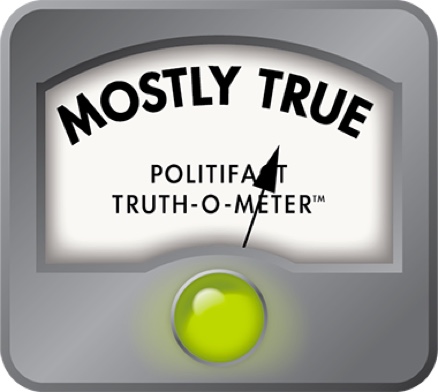

Artificial intelligence data centers "drive up electric bills by 30 or 40%" and "suck up 500,000 gallons of water a day.”

Our only agenda is to publish the truth so you can be an informed participant in democracy.
We need your help.

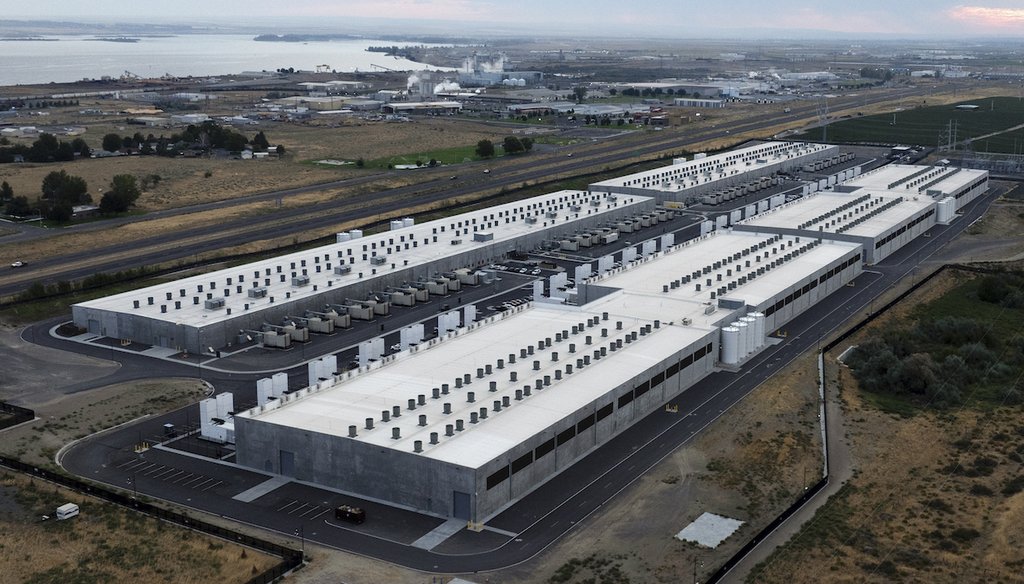
Amazon Web Services data center is seen on Aug. 22, 2024, in Boardman, Ore. (AP)

Large artificial intelligence data centers require massive amounts of electricity and are driving up electric bills. However, PolitiFact found no public data showing 30% or 40% electric bill increases.
A typical mid-sized data center uses 300,000 to 500,000 gallons of water a day, while larger AI data centers use up to 5 million gallons of water a day.
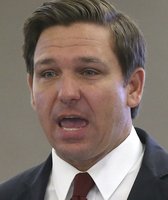
Florida gubernatorial candidate James Fishback is a critic of artificial intelligence data centers.
Fishback, who is among candidates competing against frontrunner U.S. Rep. Byron Donalds for the Republican nomination, says AI data centers offer few benefits for Floridians.
"What it actually does, is it drives up your electric bills by 30 or 40%. Anybody want to pay more on their electric bills? Or what it does is, it sucks up 500,000 gallons of water a day and then puts gray water back in the water supply," Fishback said during a Feb. 26 campaign stop in Pensacola.
AI data centers are typically used to train artificial intelligence models, run AI responses and process massive datasets.
Estimates show some facilities use at least 500,000 gallons of water a day to cool their equipment. AI data centers are also driving up consumers’ electricity rates. However, we found no public data showing they are responsible for 30% or 40% bill increases and Fishback didn’t respond to PolitiFact’s questions about his comments.
Gov. Ron DeSantis, a Republican, and state lawmakers from both political parties are pushing to regulate AI data centers. The Florida Senate unanimously passed a bill Feb. 26 with requirements related to moderating electricity rates and water management.
Data centers house critical software systems and data in rows of computer servers, storage systems and networking equipment.
Any time you send an email, watch a TikTok video or read an article online, you’re interacting with a data center.
Data centers have existed since the mid 1940s, but their recent expansion to support AI technologies has created mega facilities that consume far more power than previous buildings.
The newest AI data centers often span hundreds to over 1,000 acres, about the size of 750 American football fields.
Meta’s planned Hyperion AI data center site in the farming community of Richland Parish, Louisiana, could be four times the size of Manhattan’s Central Park.
Newer data centers can use as much electricity as a small city.
In 2024, U.S. data centers consumed about 4% of the country’s total electricity.
The International Energy Agency found that a typical AI data center consumes as much electricity as 100,000 homes annually, and that the largest ones under construction would likely consume 20 times as much.
Without legislative protections, consumers could see their electric bills increase to cover data centers’ energy demands, experts said. Consumers often foot the bill for equipment and power grid upgrades that data centers require.
"In general, data centers can raise power bills in Florida," said Ari Peskoe, director of Harvard Law School’s Electricity Law Initiative. Utility companies are spending "billions of dollars on new infrastructure to provide power to data centers," and utility rate structures allow these costs to be shared across the service territory, raising everyone’s bills.
Experts said it’s difficult to estimate how much AI data centers are driving up consumers’ electric bills.
Utilities and state regulatory commissions shield data center rates from public review, Peskoe said, making it difficult to measure the effect of new data center development.
"How much the impact of large industrial loads on power capacity buildout and wholesale markets is eventually passed down to residential customers is largely confidential and is affected by many factors," said Shaolei Ren, a University of California, Riverside, professor who researches AI’s environmental footprint.
PolitiFact found no news reports, government analyses or studies that corroborate Fishback’s figures of 30% to 40% electric bill increases. A few reports detail more modest rate increases because of data centers, and researchers project possible rate hikes in the future.
A June 2025 study, for example, found that data centers are poised to raise electric bills by 8% nationwide by 2030, and by 25% in places such as Virginia, which has a higher concentration of these facilities. One 2024 study estimated that Virginia electric bills could increase up to 70% to meet data center demand.
The New York Times reported in August 2025 that electric bills for a typical Ohio household increased at least $15 a month, which would be around an 11% increase based on back-of-the-envelope math, that summer because of data centers.
CNBC reported in November 2025 that electric bills in states with large numbers of AI data centers have climbed much faster than the national average year-over-year. August 2025 prices increased 13% in Virginia, 16% in Illinois and 12% in Ohio compared with the previous year, the outlet found. The national average increase was 6.1%.
Data centers require water to absorb heat from equipment, such as chips, servers and hard drives, to prevent overheating and maintain performance.
Nearly all data centers require significant water consumption, sometimes stressing local resources.
A typical mid-sized data center uses around the amount Fishback cited — 300,000 to 500,000 gallons per day — about as much as 1,000 U.S. households.
A larger AI data center can use up to 5 million gallons of water a day, as much as a 50,000-person city. And, according to recent water agreements, some state-of-the-art data centers can use up to 8 million gallons per day.
Approximately 80% of the water withdrawn for data centers evaporates. The remaining 20% is discharged to wastewater processing facilities, which must adhere to Clean Water Act guidelines for screening, treatment and disinfection.
Technological advances, such as air cooling and immersion cooling, have helped reduce water use. Data centers with closed-loop cooling systems, for example, can reduce their freshwater use up to 70%
"Generally, data centers are getting significantly more efficient than they were 10 years ago," said Ren. "On the other hand, the increasing scale of new data centers still drives up their total impacts," such as peak water demand during the hottest days of the year.
A study Ren co-authored found that data centers’ water use creates significant stress on local water systems. Many communities lack the infrastructure to meet peak-day withdrawals, which can lead the facilities to shift to less efficient cooling practices and increase the burden on the power grid.
If current trends continue, the study projected that by 2030, U.S. data centers will require 697 million to 1.451 billion gallons per day at peak capacity — comparable to the typical daily supply of New York City.
Fishback said AI data centers "drive up electric bills by 30 or 40%" and "suck up 500,000 gallons of water a day."
The facilities are raising consumers’ electric bills. Rate hike projections in states with high concentrations of data centers come close to Fishback’s estimate, but we found no public data showing the facilities are currently responsible for 30% or 40% bill increases.
Data centers consume as much as, if not more, than 500,000 gallons a day. Some hyperscale AI facilities are estimated to use 5 million to 8 million gallons a day.
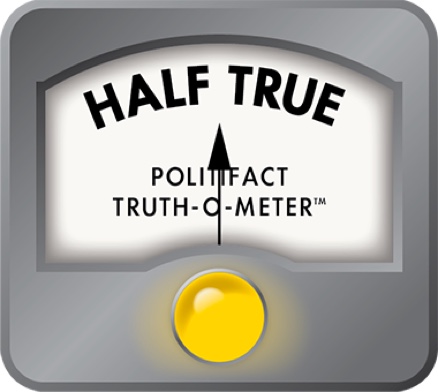
Fishback’s statement is partially accurate but leaves out important details. We rate it Half True.
X, James Fishback speech in Pensacola, Feb. 26, 2026
Environmental and Energy Study Institute, Data Centers and Water Consumption, June 25, 2025
Environmental and Energy Study Institute, Data Center Power Demands Are Contributing to Higher Energy Bills, Feb. 24, 2026
Stanford University, Thirsty for power and water, AI-crunching data centers sprout across the West, April 8, 2025
WUSF, Florida Senate unanimously passes restrictions for large-scale data centers, Feb. 26, 2026
Data Center Map, USA Data Centers, Accessed March 2, 2026
Data Center Dynamics, Microsoft given greenlight for 15 more data center buildings in Mount Pleasant, Wisconsin, Jan. 27, 2026
Fortune, Meta’s Hyperion AI data center will sprawl to four times the size of Manhattan’s Central Park, Feb. 4, 2026
Enconnex.com, The History of Data Centers: An Exponential Evolution, March 22, 2024
The International Energy Agency, Energy and AI, April 10, 2025
CNBC, Data centers are concentrated in these states. Here’s what’s happening to electricity prices, Nov. 14, 2025
National Energy Assistance Directors Association, Energy Price Update, Nov. 19, 2025
Bloomberg, AI is draining water from areas that need it most, May 8, 2025
Harvard Kennedy School Belfer Center for Science and International Affairs, AI, Data Centers, and the U.S. Electric Grid: A Watershed Moment, Feb. 10, 2026
Cornell University, Small Bottle, Big Pipe: Quantifying and Addressing the Impact of Data Centers on Public Water Systems, March 4, 2026
University of Michigan, What happens when data centers come to town? July 2025
Pew Research Center, What we know about energy use at U.S. data centers amid the AI boom, Oct. 24, 2025
Harvard Law Today, How data centers may lead to higher electricity bills, Sept. 3, 2025
The New York Times, Big Tech’s A.I. Data Centers Are Driving Up Electricity Bills for Everyone, Aug. 14, 2025
The New York Times, Their Water Taps Ran Dry When Meta Built Next Door, July 14, 2025
The Washington Post, A new front in the water wars: Your internet use, April 25, 2023
WATER AND WASTEWATER AGREEMENT, Nov. 3, 2025
DigitalRealty, A guide to data center cooling: Future innovations for sustainability, March 7, 2025
GRcooling.com, Forecasting Data Center Immersion Cooling Technology for the Year Ahead, March 12, 2024
World Economic Forum, Why circular water solutions are key to sustainable data centres, Nov. 7, 2024
Lincoln Institute of Land Policy, Data Drain: The Land and Water Impacts of the AI Boom, Oct. 17, 2025
Brookings Institute, AI, data centers, and water, Nov. 20, 2025
Email interview, Shaolei Ren, electrical and computer engineering professor at the University of California, Riverside, and leading researcher on the environmental footprint of AI, March 2, 2026
Email interview, Ari Peskoe, director of Harvard Law School’s Electricity Law Initiative, March 3, 2026














In a world of wild talk and fake news, help us stand up for the facts.