
The former U.S. childhood vaccine schedule called for babies to get “72 injections.”


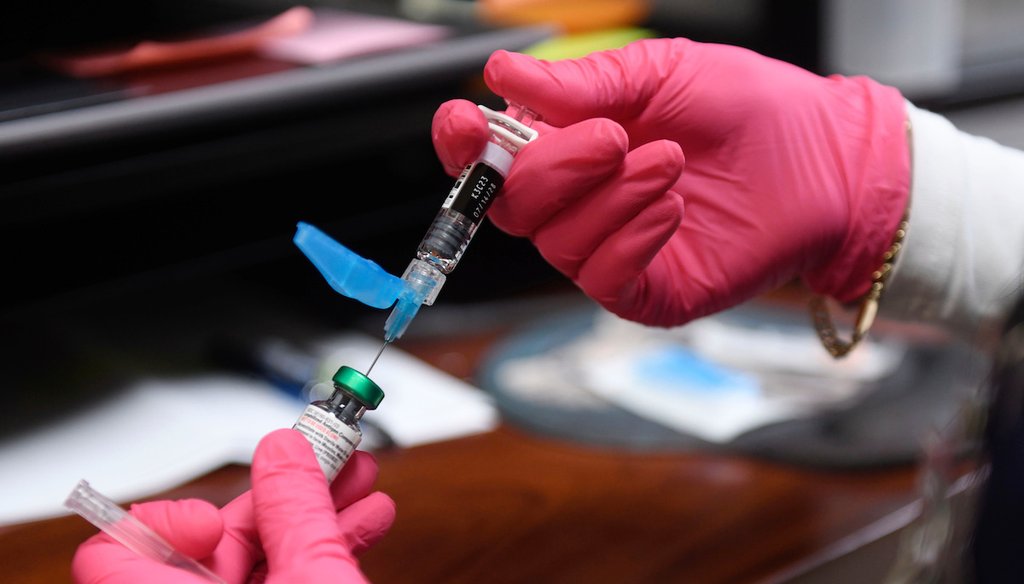
Anna Hicks prepares a measles, mumps and rubella vaccine at the Andrews County Health Department, April 8, 2025, in Andrews, Texas. (AP)


Under its former childhood vaccine schedule, the U.S. Centers for Disease Control and Prevention recommended that kids get 12 different vaccines protecting against 16 diseases before age 10.
It didn’t recommend "72 injections" for babies. That total takes into account 18 years of recommended vaccines, including an annual flu and COVID-19 shot, and assumes that each vaccine dose would be given as a separate injection, which is unlikely. Some are given in combination shots and others are given orally.
Under the 2024 schedule, which has been discontinued, babies could have received anywhere from 12 to 30 shots before their second birthday depending on the use of combination vaccines and annual COVID-19 and flu vaccines.
To defend recent changes to the childhood vaccine schedule, the Trump administration compared shots for American babies with babies in an unspecified "European Country."
The Jan. 5 White House graphic showed two babies, each surrounded by needles, with the text: "European Country: 11 injections. United States: 72 injections." It cited a recent U.S. Health and Human Services report on the 2024 U.S. childhood and adolescent immunization schedule, which shows Denmark is the graphic’s "European country."
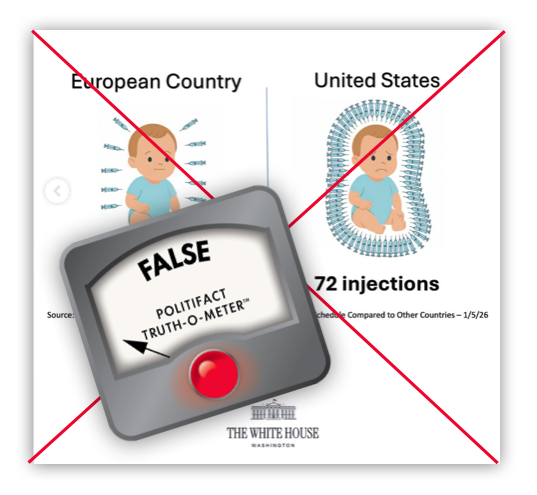
(Screenshot of Instagram post)
President Donald Trump posted the same count on Truth Social after the Centers for Disease Control and Prevention announced it was reducing the number of vaccines routinely recommended to children.
Federal vaccine recommendations vary according to a person’s age and health circumstances. But this graphic featuring an infant explicitly refers to injections, so we focused on how many shots babies could have received under the former recommendation.
It was not 72.
The comparison to Denmark is also faulty: It uses the most exaggerated count of "injections" for the U.S. while using the most conservative count for Denmark.
The CDC never recommended babies get 72 injections.
In 2024 and part of 2025, before the Trump administration’s changes, it recommended children up to age 2 get up to 12 different vaccines protecting against 16 diseases.
Some vaccines are administered in several doses. Seventy-two is around the number of routinely recommended doses — not injections — that could have been given over 18 years, beginning in infancy. Half of those doses are from annual flu and COVID-19 vaccines.
Doses rarely equal "injections." That’s because many childhood vaccine doses can be delivered in combination vaccines, in which one syringe contains several vaccines. Other times, vaccines can be given orally, like the rotavirus vaccine, or via nasal spray, like the flu vaccine.
Under the 2024 schedule, a baby at the two-month appointment could receive all six recommended vaccine doses in two injections and one oral administration of drops, for example.
And it was possible, with maximum use of combination vaccines, for a 2-year-old to be fully vaccinated with as few as 12 injections and some oral drops — or up to 19 or 20 injections if they got their first course of COVID-19 and flu vaccines and an RSV vaccine.
That said, not all clinics or providers carry every vaccine in their highest combination form. But even if a child got every vaccine dose separately under the former schedule, that would have resulted in 27 to 30 injections by age 2, plus some oral drops.
Still, that many injections is unlikely. Dr. William Schaffner, Vanderbilt University infectious diseases professor, said he’s never heard of a child who got every vaccine purely through single doses.
"Ideally, we want to use combination vaccines, because that reduces the number of shots," said Dr. Flor Muñoz, a Baylor College of Medicine pediatric infectious disease doctor, when she spoke to PolitiFact in September 2025.
Let’s assume the graphic was referencing more than just babies. It’s still inaccurate.
From birth to age 10, under the previous schedule, the CDC recommended up to 30 vaccine doses. With maximum reliance on combination shots those doses could be delivered in as few as 14 injections and some oral drops.
A child who got an annual COVID-19 and flu vaccines, but opted for the flu nasal spray, could turn 10 having gotten 28 shots in arms plus oral drops. Even if counting all possible vaccines from birth to age 18, "72 injections" would be a stretch. That would require every single vaccine dose over 18 years be given as a separate shot.
Before recent changes, an 18-year-old who got all of CDC’s universally recommended vaccines, including COVID-19 and flu vaccines, would be protected against 18 diseases.
By maximizing combination shots, and getting the shortest dosing series, it would have been possible to reach adulthood with 19 injections, and some oral drops.
If the same teen got annual COVID-19 and flu vaccines, but opted for the flu nasal spray, that could add up to 41 shots by age 18; fewer are possible, depending on what month the person was born.
The Trump administration's injection comparison uses apples and oranges to make the U.S. count look high and Denmark’s low.
Both account for 18 years of vaccines, not just for babies.
The White House did not respond to our query about how the number of "injections" was calculated, but HHS appears to have reached the total of "72 injections" in the U.S. by counting each dose as a separate injection and including vaccines given as oral drops as "injections."
For Denmark, HHS took combination vaccines into account, and counted several doses as a single injection, leading to the lowest possible total — "11 injections."
Those 11 shots include 18 total doses. Total doses are far lower in Denmark, which does not routinely vaccinate children against diseases like chickenpox, RSV, rotavirus, meningococcal disease or Hepatitis A or B. Denmark also does not recommend routine vaccination for children against influenza or COVID-19.
In short, the U.S. count assumes the highest possible number, while the Denmark count assumes the lowest.
The Trump White House shared a graphic showing a baby in the U.S. getting 72 vaccine injections under the previous CDC recommended schedule.
But babies don’t get that many shots. Under the 2024 schedule, children could get from 12 to 30 shots before their second birthday depending on the use of combination vaccines and COVID-19 and flu shots.
Before age 10, that schedule recommended 30 to 52 doses. By using combination vaccines and flu nasal spray, however, they could be delivered in 14 to 28 injections.
Even as doses rise to a potential 72 for an 18-year-old, it's unlikely a child would reach adulthood with every single dose given as a separate injection.
We rate the claim that the U.S. childhood vaccine schedule previously called for babies to get "72 injections" False.
Phone interview with William Schaffner, Vanderbilt University professor of infectious diseases, Jan. 6, 2026
Email interview with Richard Carpiano, University of California professor of public policy, Jan. 6, 2026
Email interview with Flor Muñoz-Rivas, Baylor College of Medicine associate professor of pediatrics-infectious diseases, Jan. 6, 2026, Sept 25, 2025
Health and Human Services Department, Assessment of the U.S. Childhood and Adolescent Immunization Schedule Compared to Other Countries, Jan. 2, 2026
Instagram post by The White House, Jan. 5, 2026
Truth Social post by Donald Trump, Jan. 5, 2026
PolitiFact, No, small children don’t receive ‘80 different vaccines,’ despite President Donald Trump’s statement, Sept. 26, 2025
CDC, Child and Adolescent Immunization Schedule by Age (Addendum updated August 7, 2025), Oct. 7, 2025
CDC, archived copy, Recommended Immunizations for Birth Through 6 Years Old, United States, 2024
CDC, archived copy, Recommended Immunizations for Children 7–18 Years Old, United States, 2024
Health and Human Services Department, CDC Immunization Schedule Adopts Individual-Based Decision-Making for COVID-19 and Standalone Vaccination for Chickenpox in Toddlers, Oct. 6, 2025
CDC, Combination Vaccines, July 2, 2024
Health and Human Services Department, Childhood Immunization Schedule by Recommendation Group, accessed Jan. 7, 2025
European Center for Disease Control and Prevention, "Denmark: Recommended vaccinations," accessed Jan. 15, 2025














In a world of wild talk and fake news, help us stand up for the facts.