
“We right now have more factories and plants being built in our country than we've ever had before.”

Our only agenda is to publish the truth so you can be an informed participant in democracy.
We need your help.

Land in Clay, N.Y., that is slated to be developed by Micron Technology into semiconductor factories on Oct. 15, 2024. (AP)

Factory construction remains at a high level compared with recent history, but most of the increase came under President Joe Biden, and there are signs that that boom has faded under President Donald Trump.
Analysts said some Trump policies have aided companies seeking to build factories, but others — including his tariffs — have offset some of those gains.
A key reason President Donald Trump cites for his tariff policy is boosting U.S. manufacturing.
On two recent occasions, Trump has touted a factory-building record on his watch.
"We right now have more factories and plants being built in our country than we've ever had before," Trump told diners at an Iowa restaurant before a Jan. 27 speech.
The data to support this point is mixed, at best. While some data suggests a growth in the biggest factories is continuing under Trump, overall spending rose significantly under Trump’s predecessor, President Joe Biden, but has eased since its Biden-era peak.
The White House pointed PolitiFact to data collected by Engineered Vision, a company that supplies machine technology, about $1 billion-plus projects. An archived version of a chart from the company’s website from March 11, 2025, shows 30 such projects, while the February 2026 chart shows 46 projects.
A closer look at the newly listed projects shows that some of them had been in the planning stages prior to Trump’s second term.
Federal data on the number of private U.S. manufacturing establishments also supports Trump’s statement. Preliminary 2025 figures show that the number of those facilities hit a new high in the second quarter of Trump’s second term.
Given the long turnaround time required for factory construction, it’s unclear whether the increases during the first six months of Trump’s second term can be attributed to his policies, or whether they reflect projects that were already in the pipeline when he took office.
Beyond these two data points, evidence from federal sources casts doubt on the notion that factory building continues to reach new heights under Trump.
Experts told PolitiFact the most reliable metric to use for judging Trump’s assertion is spending on manufacturing construction, because it’s produced by the federal government, has a long track record and covers expenditures on all sizes of facilities, not just the biggest.
Federal statistics for construction spending on manufacturing show a rapid rise under Biden, followed by a dip after Trump entered office in 2025.
Paul Donovan, the global chief economist at UBS Wealth Management, told The New York Times that spending on factory construction rose from about 3.5% of the manufacturing economy in 2021 to 8% in 2024, a 40-year high.
But this trajectory has sagged under Trump, experts say.
"The past four years have been the most significant peacetime period for manufacturing construction since the data was first gathered," said Scott Paul, president of the Alliance for American Manufacturing, an advocacy group. While the level remains elevated under Trump, he said, "the peak was around 14 months ago."
Tara Sinclair, a George Washington University economist who coauthored a paper on manufacturing construction while serving as deputy assistant treasury secretary for macroeconomics under Biden, said spending on factory construction "is still quite a bit higher than pre-2021, but it does look like the boom is over and has somewhat reversed."
Sinclair and other experts said a major reason for the rise under Biden was a pair of bipartisan bills he signed — the Infrastructure Investment and Jobs Act and the CHIPS and Science Act — plus one he signed that was backed only by Democrats, the Inflation Reduction Act. Provisions in each of these bills directed federal spending and other incentives toward manufacturing, especially for items such as semiconductors.
Scott Lincicome, vice president at the libertarian Cato Institute, said he’s not a fan of some aspects of the Biden legislation but they were effective in boosting manufacturing construction. Trump’s policies, he said, have sometimes worked at cross purposes.
Lincicome said Trump’s changes to the way companies expense construction costs have bolstered construction spending, as have the administration’s efforts to streamline permitting processes.
However, Lincicome said Trump’s on-again, off-again tariffs have fostered uncertainty among business decisionmakers. The tariffs also have raised costs for foreign-sourced materials needed to build factories, hurting the cost-benefit balance.
Trump said today’s factory boom exceeds anything else in U.S. history. But Lincicome said in addition to the boom under Biden, today’s level was likely exceeded by the 20-year period from World War II to the early 1960s when the U.S. was "the only game in town, because half the rest of the world was bombed out from the war and the other half was communist."
Trump said, "We right now have more factories and plants being built in our country than we've ever had before."
Factory construction remains at a high level compared with recent history, but most of the increase came under Biden, and there are signs that that boom has faded under Trump, particularly when measured by overall spending on construction of manufacturing facilities, which experts say is a key metric.
Analysts said some of Trump’s policies have aided companies seeking to build factories, but other policies — including his tariffs that have increased both uncertainty and prices for foreign materials needed for construction — have offset some of those gains.
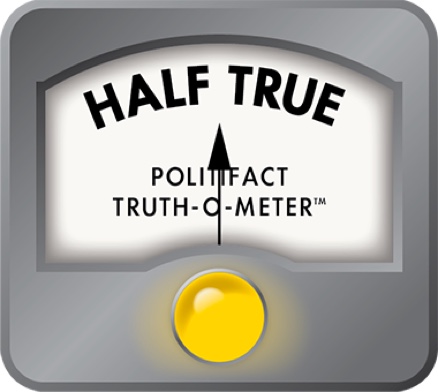
We rate the statement Half True.
Donald Trump, remarks to diners at a restaurant in Iowa, Jan. 27, 2026
Donald Trump, remarks at Mar-a-Lago, Jan. 16, 2026
Federal Reserve Bank of St. Louis, "Total Construction Spending: Manufacturing in the United States," accessed Feb. 6, 2026
Bureau of Labor Statistics, "Number of Establishments in Private NAICS 31-33 Manufacturing for All establishment sizes in U.S.," accessed Feb. 5, 2026
Engineered Vision, "U.S. Manufacturing Megaprojects," accessed Feb. 6, 2026
Engineered Vision, "U.S. Manufacturing Megaprojects," archived version from March 2025
U.S. Treasury Department, "Unpacking the Boom in U.S. Construction of Manufacturing Facilities," June 27, 2023
Scott Lincicome, "Made in America: The Boom in U.S. Manufacturing Investment," June 12, 2024
New York Times, "U.S. Manufacturing’s Mixed Picture in 4 Charts," Oct. 29, 2025
Email interview with Scott Paul, president of the Alliance for American Manufacturing, Feb. 4, 2026
Email interview with Tara Sinclair, George Washington University economist, Feb. 4, 2026
Interview with Scott Lincicome, vice president at the Cato Institute, Feb. 5, 2026
White House, statement to PolitiFact, Feb. 5, 2026


















In a world of wild talk and fake news, help us stand up for the facts.