
Our only agenda is to publish the truth so you can be an informed participant in democracy.
We need your help.

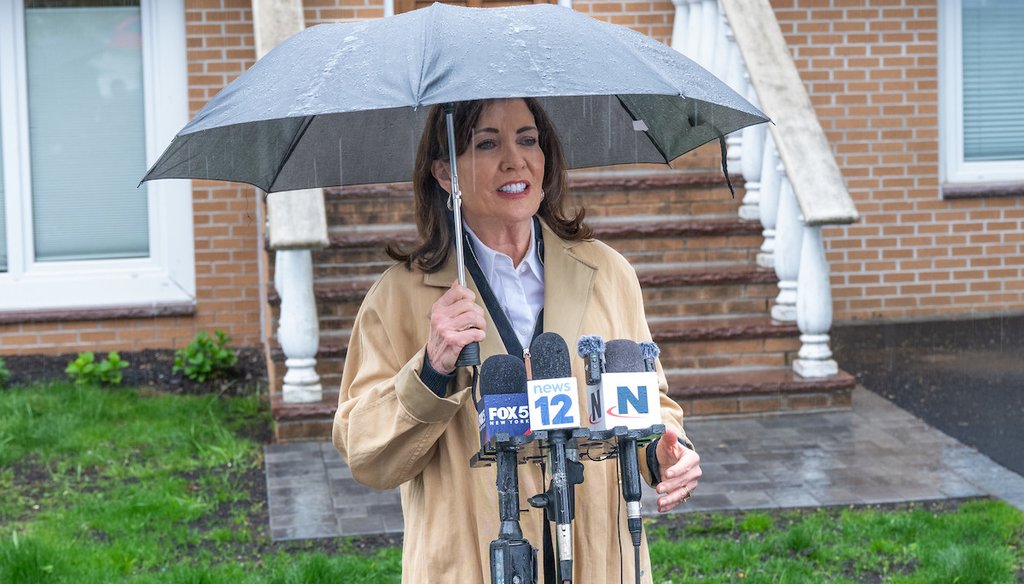
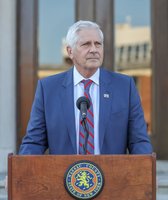
Gov. Kathy Hochul talks about the fiscal year 2026 budget during a visit on May 5, 2025, to Suffolk County, New York. (Office of Gov. Hochul)

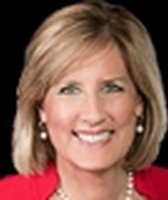
Rep. Elise Stefanik began her campaign to unseat Gov. Kathy Hochul by claiming the Democratic incumbent has raised taxes.
Stefanik, a Republican, said in a Fox News interview that Hochul is "open to raising taxes, on top of the taxes she’s already raised for New Yorkers."
Hochul says she will not raise personal income taxes in her next budget proposal, due in January, though she has not ruled out raising corporate taxes.
We checked Stefanik’s claim that Hochul has raised taxes.
Since Hochul’s swearing in as governor in August 2021, she has proposed and negotiated budgets in 2022, 2023, 2024 and 2025. She frequently talks about maintaining the lowest middle-class personal income tax rate in 70 years in the state, and while we have rated a similar claim Mostly True, PolitiFact has covered the problems with comparing tax rates across decades.
Going into her first budget, she benefitted from tax increases on high-income earners and businesses that took effect in 2021, before she became governor. These increases led to strong tax collections in her first year in office.
There have been some tax increases during her tenure, and extensions of existing taxes, though many of these actions affect only certain tax filers, such as high income earners, some corporations, New York City businesses with large payrolls, and smokers. An extension of a tax dating back to the mid-1990s is broader, affecting people who purchase health insurance.
The budget enacted in April included one of the more significant tax increase extensions. A tax increase for the state’s highest earners that had been enacted as a temporary measure in 2021 was extended for five years. This affects married couples who file jointly with taxable incomes above $2.2 million. But this increase was paired with a counter measure for people in the lowest five tax brackets. Personal income tax rates went down for married couples earning $323,000 or less, according to an analysis from the Empire Center, a conservative think tank.
The 2023-24 budget also included an extension of an increase in the corporate franchise tax rate until 2027. Businesses with incomes of more than $5 million began paying 7.25% in 2021, and that rate was extended in the budget passed in 2023. The budget also increased the top rate of a tax that funds public transportation, known as the Metropolitan Commuter Transportation Mobility Tax.. This top rate increased for employers and self-employed workers in the five counties of New York City, and it was meant to fund operations for the Metropolitan Transit Authority, which saw steep declines in ridership during the pandemic. Employers and individuals in the seven other downstate counties contained in the Metropolitan Commuter Transportation District were not affected by the change.
In the budget passed in 2023, there was an extension of a tax on health insurance, known as Health Care Reform Act taxes. These taxes have been extended routinely since 1996, and add hundreds of dollars per year to the cost of health insurance for the average family, according to the Empire Center. This is the state’s third-largest revenue source after income and sales taxes.
In 2025, taxes that fund public transportation, known as the payroll mobility tax, went up by less than 1 percentage point on downstate companies with payrolls of more than $10 million, but went down for smaller employers and were eliminated for self-employed workers making $150,000 or less. Revenue was reinvested in the Metropolitan Transportation Authority.
There were much narrower tax changes too, such as a $1 increase in excise taxes on packs of cigarettes and little cigars in 2023, which only affect smokers.
In 2025, the state levied a tax on group health plans, known as the managed care tax, which the conservative Empire Center called "a tactic for exploiting Medicaid’s financing system." The tax was intended to be revenue-neutral for managed care organizations, which receive other payments from the state, and were levied to draw in more federal revenue to the state. The federal government has told the state it must end the tax in March.
We approached Stefanik’s campaign for evidence of her claim, which provided some of the examples mentioned above.
Representatives from Hochul’s office maintain extensions of existing taxes are not tax increases, and that it’s standard for changes in the tax code to be subject to renewal.
Hochul’s office said that it’s not correct to call the increased rates for high income earners enacted in 2021 under Gov. Andrew Cuomo "temporary." However, in a review of the 2021-22 budget, the Office of the State Comptroller noted that the top rate will increase from 8.82% to as much as 10.9%: "The change will be in effect for tax years 2021 through 2027; in 2028 and thereafter, the rate will revert to 8.82 percent." The 2027 expiration was also described in Cuomo’s budget materials at the time.
E.J. McMahon, adjunct fellow at the conservative Manhattan Institute for Policy Research, called Hochul’s pre-emptive extension (it was passed in 2025 instead of 2027) "a tax increase by any standard."
"If she had done nothing, it would have ended two years from now," McMahon said.
Hochul’s spokespeople also point to actions that reduced taxes on New Yorkers, including accelerating middle-class tax cuts to fully implement them in 2023 instead of 2025, and child tax credits for low- to moderate-income families. They also noted inflation refund checks for low- to moderate-income filers.
It’s a toll, not a tax, and therefore does not affect the rating of this claim, but we will note that perhaps the most controversial fee enacted during Hochul’s administration is congestion pricing, in which vehicles are charged for entering areas of Manhattan south of 60th Street. Hochul has praised the program, which took effect in January, for reducing congestion, increasing transit ridership and raising money for regional transit improvements.
Hochul, backed by the State Legislature, has extended existing taxes for wealthy corporations and individuals, as well as health insurance companies. She has also cut taxes for the middle class. Other new increases, such as transit taxes on large businesses, were paired with cuts for smaller businesses.
Stefanik claimed Hochul has raised taxes on New Yorkers. That claim could lead every New Yorker to believe their taxes have gone up because of Hochul. But the new tax increases did not affect every New Yorker, and income taxes on the middle class went down. Extensions mostly affected select groups. A broad tax on health insurance was extended, but that has been in place since 1996.
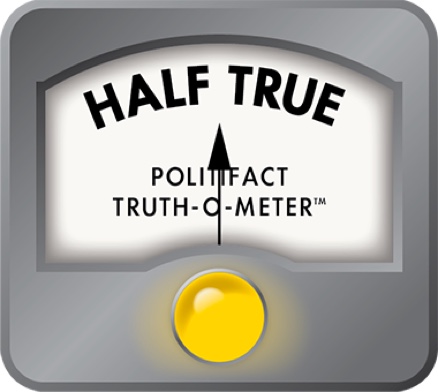
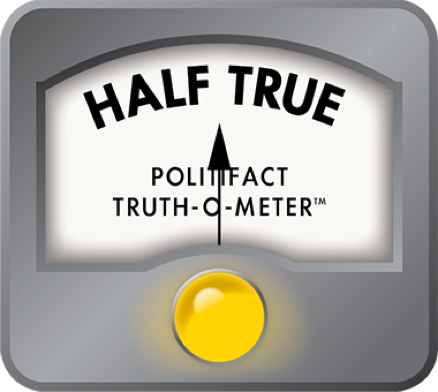
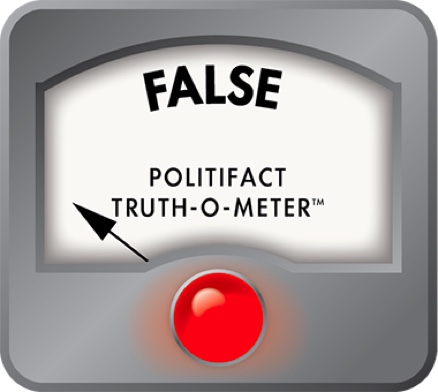
This claim has some truth to it, but it lacks important context. We rate this Half True.
Fox News, Interview with Rep. Elise Stefanik, Nov. 7, 2025.
Politico, "Hochul edges toward tax hikes after Mamdani win," Dec. 4, 2025.
PolitiFact, "No, New Yorkers are not getting the largest middle class tax cut in 70 years," June 1, 2025.
PolitiFact, "New tax rates will be the lowest in 70 years," July 15, 2016.
Email interview, spokesperson, Rep. Elise Stefanik gubernatorial campaign.
Office of the State Comptroller, Review of the Enacted Budget State Fiscal Year 2021-22, April 2021.
Office of the State Comptroller, State Fiscal Year 2022-23 Enacted Budget Analysis, May 2022.
Office of the State Comptroller, Report on the State Fiscal Year 2023-24 Enacted Budget Financial Plan, July 2023.
New York State Department of Taxation and Finance, notice, N-23-2, July 31, 2023.
New York State Department of Taxation and Finance, notice, N-23-3, July 31, 2023.
Thompson Reuters, New York’s Fiscal Budget Bill Adds a New Tax Credit, Amends the Cannabis Tax, and Makes Other Changes, April 23, 2024.
Empire Center, Highlights of Albany’s Bloated and Belated Budget, May 9, 2025.
City Journal, "Will Albany Let Zohran Mamdani Tax the Rich?," Nov. 17, 2025.
Professional Group Plans, "Important Notice: NYS MCO Tax Implementation," Aug. 12, 2025.
Empire Center, "Feds Move To Close Medicaid’s ‘MCO Tax’ Loophole, Spelling Trouble for New York," May 13, 2025.
Politico Pro, "New York receives three-month extension to MCO tax," Nov. 19, 2025.
McDermott+, "Budget reconciliation’s effect on New York’s Medicaid and Essential Plan funding," July 23, 2025.
PWC, "New York budget adopts various tax increases, other changes," May 2023.
Office of Gov. Kathy Hochul, "Six Months In, Governor Hochul Highlights Success of Congestion Pricing: Traffic Is Down, Business Is Up, and Critical Investments Are Being Made to Improve Transit," Dec. 3.
Office of Gov. Kathy Hochul, "Governor Hochul Signs Legislation to Fully Fund Improvements for Transit Riders as Part of FY 2026 Budget," May 9, 2025.
EY, "New York increases the Metropolitan Commuter Transportation Mobility Tax rate for large employers effective July 1, 2025," May 12, 2025.
Empire Center, "Budget deal increases state-share Medicaid spending by 13 percent," May 5, 2023.
New York State Department of Taxation and Finance, "Summary of 2023 corporation tax and personal income tax changes."
New York State Department of Taxation and Finance, "Summary of 2021 corporation tax and personal income tax changes."
Email interview, E.J. McMahon, adjunct fellow, Manhattan Institute, Dec. 5, 2025.
Email interview, Bill Hammond, director of health policy, the Empire Center, Dec. 5, 2025.
Email interview, Gov. Kathy Hochul’s press office, Dec. 5, 2025.
Empire Center, "Hooked on HCRA: New York’s 24-Year Health Tax Habit," March 11, 2020.
Citizens Budget Commission, "Six Things to Know About New York State Health Care Reform Act (HCRA) Taxes," March 5, 2020.
New York State Division of the Budget, news release, highlights of FY 2022 state budget, April 6, 2021.
Dermody, Burke & Brown, CPAs, LLC, newsletter, "New York State Tax Updates."












In a world of wild talk and fake news, help us stand up for the facts.