Stand up for the facts!
Our only agenda is to publish the truth so you can be an informed participant in democracy.
We need your help.
I would like to contribute

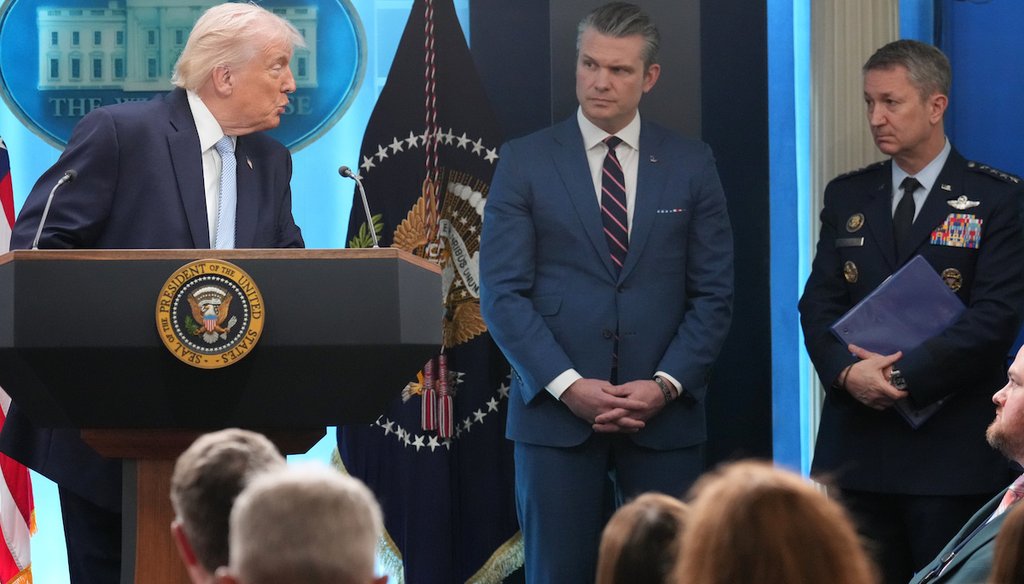
President Donald Trump looks to Defense Secretary Pete Hegseth and Chairman of the Joint Chiefs of Staff Gen. Dan Caine as he speaks with reporters during a news conference in the James Brady Press Briefing Room at the White House, April 6, 2026,


After announcing a ceasefire in the weekslong war with Iran, President Donald Trump and Defense Secretary Pete Hegseth declared that the U.S. had emerged victorious.
When Trump declared April 7 that the U.S. would suspend bombing Iran for two weeks to allow for negotiations, he said the U.S. had "already met and exceeded all military objectives."
"Total and complete victory. 100%. No question about it," Trump told Agence France-Presse.
Hegseth was similarly triumphant. "Operation Epic Fury was a historic and overwhelming victory on the battlefield, a capital-V military victory," he said during an April 8 Pentagon press conference. "Epic Fury decimated Iran's military and rendered it combat-ineffective for years to come. "
It will take time to fully assess what the U.S. achieved — as well as any shortcomings or failures. More details will emerge to answer key questions: Will commerce flow through the Strait of Hormuz at its previous levels? When will gas prices decline? How will Iran’s new leaders exercise their power? And how long will it take for the U.S. to restock its now-depleted military arsenal?
Trump administration officials cited numerous — sometimes contradictory — reasons for launching the war. They included supporting the Iranian people, preventing Iran from obtaining a nuclear weapon and regime change. But it was not clear that the U.S. had secured commitments from Iran to achieve those goals.
Details of the ceasefire negotiations are murky. Based on available information, the U.S. and its military partner, Israel, achieved significant battlefield wins, including nearly eliminating Iran’s naval, air force and air defense systems, experts said.
However, they said that calling it a "total victory" overlooks significant strategic setbacks for the U.S.
Despite losing many of its top leaders, Iran’s regime remains in charge, and the country now exercises an unprecedented degree of control over the Strait of Hormuz, a vital lane for oil and other goods.
In addition, stocks of highly enriched uranium — a cornerstone of Iran’s nuclear weapons ambitions — are still under Iranian control, said Aaron David Miller, a senior fellow at the Carnegie Endowment for International Peace and a former adviser on the Middle East to Republican and Democratic secretaries of state.
"If the war stopped tomorrow, this constitutes a historic strategic defeat for the U.S., especially when this was a war of choice," Miller said.
Thirteen U.S. military personnel also died in the conflict, and hundreds more were injured. A human rights group estimated 1,665 civilian casualties in Iran, including 248 children.
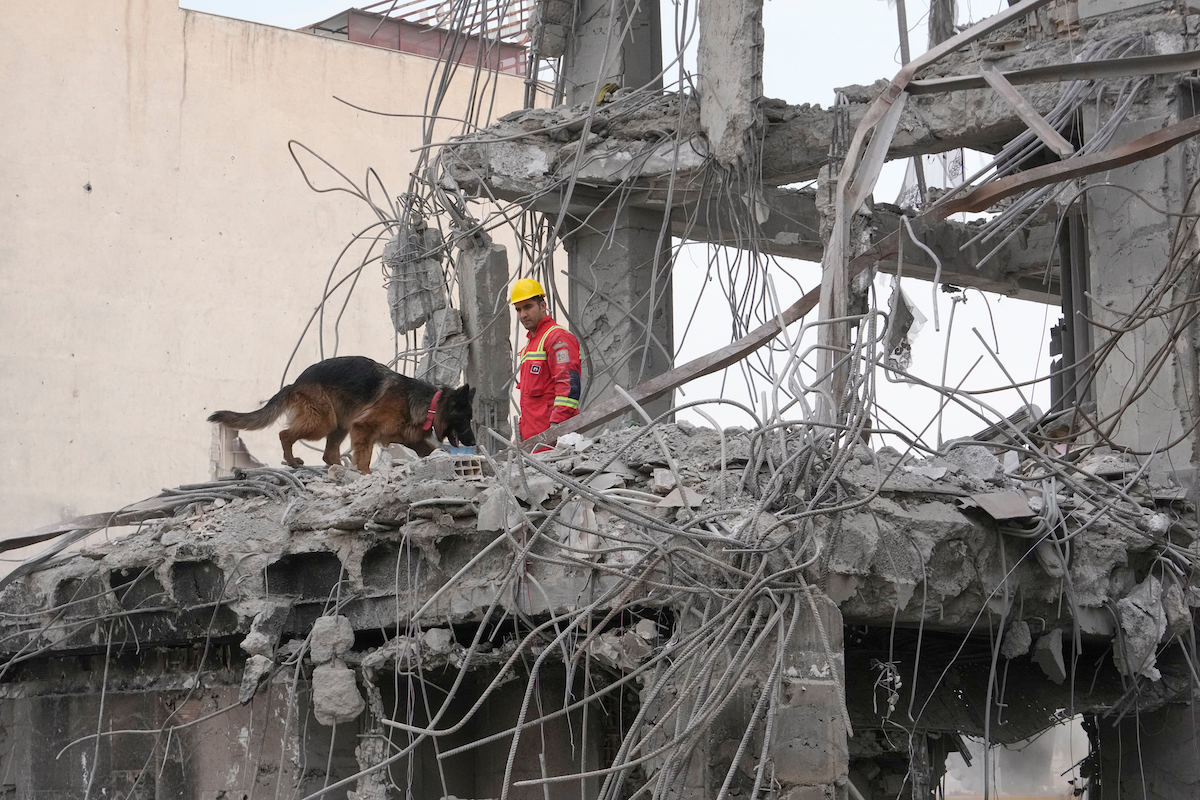
A rescue worker and dog search the rubble of a residential building damaged Sunday during the U.S.-Israeli air campaign, in Tehran, Iran, March 12, 2026. (AP)
U.S. victories from the war
In public remarks, Trump administration officials have focused on the extent to which U.S. and Israeli attacks weakened Iran’s military. Officials have said U.S. joint forces struck more than 13,000 targets before the ceasefire, sinking more than 90% of Iran’s regular naval fleet, hitting 90% of their weapons factories and destroying approximately 80% of Iran's air defense systems.
"It will take years for Iran to rebuild any major surface combatants, as more than 20 naval production and fabrication facilities have been damaged or destroyed, and nearly 80% of Iran's nuclear industrial base was hit, further degrading their attempts to attain a nuclear weapon," Joint Chiefs chairman Gen. Dan Caine said during a press conference.
Trump administration officials have also touted successful operations that killed top Iranian government and military leaders, including the supreme leader.
Military experts said the setbacks to Iran’s caches of drones, ballistic missiles, cruise missiles and launchers substantially weaken its capabilities.
The U.S. may one day be applauded for taking on Iran after nearly five decades of rising risks to the U.S. and its allies, said John Pike, director of globalsecurity.org, a Washington-based research group. Not directly striking the country for so long "left Iran more or less free to engage in mischief-making at lower rungs of the escalation ladder," he said.

A cargo ship carrying vehicles sails toward the Strait of Hormuz on March 22, 2026. (AP)
Ways in which the U.S. did not achieve total victory
Despite such gains, the U.S. has also suffered consequential losses, foreign policy experts said.
The war enabled Iran to use its geographic advantages to control and monetize traffic going through the Strait of Hormuz. Kelly A. Grieco, a senior fellow at The Stimson Center, a foreign policy think tank, called this the most meaningful setback for the U.S.
"Even with the ceasefire, Iran has effectively established itself as gatekeeper of the strait," Grieco said. "That’s a fundamentally different status quo than existed before the conflict. It also gives Tehran a durable form of economic leverage."
In addition to oil, the U.S. and other countries depend on commodities such as fertilizer, aluminum and helium that make that passage.
The strait’s status remains unclear in the ceasefire’s aftermath. Less than 24 hours after Trump announced the agreement, Iran’s state-run news agency reported that the country was closing the strait in response to Israeli attacks on Lebanon. During an April 8 news conference, White House press secretary Karoline Leavitt said Lebanon was not covered by the ceasefire. She said there had been an uptick in traffic in the strait, but she would not answer questions about who controlled it.
It’s also uncertain whether the U.S. will be able to remove or destroy Iran’s nuclear materials.
We asked the White House how it responds to critics who say these blows outweigh battlefield victories for the U.S. Spokesperson Anna Kelly did not answer the question but referred PolitiFact to Leavitt’s press conference and said the president would "exert maximum leverage over the Iranian regime" and was "optimistic that this will lead to long-term peace in the region."
Foreign policy specialists cited other strategic setbacks for the U.S.:
-
The killings of Iranian leaders could lead to a more radicalized regime.
-
The Iran war has strained the relationship between the U.S. and its NATO allies, who objected to not being consulted about the U.S.-Israeli attacks.
-
The strains within NATO may bolster Russia by distracting the West from Russia’s war against Ukraine and at least temporarily increasing prices for crude oil, a major Russian export and source of income.
-
The Iranian attacks on industrial and civilian targets in Persian Gulf states like the United Arab Emirates, Bahrain, Qatar and Kuwait might make other U.S. allies reconsider hosting U.S. forces because they could become targets in a future war.
The Iran war could also become "the most effective advertisement for nuclear weapons proliferation in decades," Grieco said. "Iran faced this war precisely because it didn't yet have a nuclear weapon. If it had, the attack almost certainly wouldn’t have happened. This is a concrete incentive structure that every government calculating its own security options is now weighing."
In a more mundane way, the U.S. and its allies have used up large amounts of offensive and defensive munitions, including interceptors and long-range missiles, Grieco said. This supply will need to be rebuilt, over time and at significant expense.
Staff writer Maria Ramirez Uribe contributed to this article.
RELATED: Trump, Hegseth say US has accomplished regime change in Iran. Has it?
RELATED: Not just oil: How the Strait of Hormuz blockage affects US consumers, from fertilizer to helium
RELATED: Supporting Iranians, then threatening to end civilization: How Trump contradicts himself on war
Our Sources
President Donald Trump, Truth Social, April 7, 2026
President Donald Trump, Truth Social, April 8, 2026
President Donald Trump, Truth Social, April 8, 2026
Defense Department, press conference, April 8, 2026
Karoline Leavitt, X post, April 7, 2026
Press Secretary Karoline Leavitt, Press conference, Apr. 8, 2026
White House, Peace Through Strength: Operation Epic Fury Crushes Iranian Threat as Ceasefire Takes Hold, April 8, 2026
AFP, Trump to AFP: Iran deal 'total and complete victory' for US, April 8, 2026
Associated Press, US and Iran agree to 2-week ceasefire as Trump pulls back on threats, April 7, 2026
New York Times, Iran Releases 10 Points It Says Are Basis for Cease-Fire Talks, April 8, 2026
New York Times, Trump Says He ‘Exceeded’ His Objectives in Iran. But What Did He Accomplish? April 8, 2026
Times of Israel, Iran’s 10-point plan for ending war calls for ‘acceptance’ of uranium enrichment, removing all US sanctions, April 8, 2026
Center for Strategic and International Studies, Who Is Winning the Iran War? April 2, 2026
Just Security, Continuing Crisis in Strait of Hormuz: Why Iran’s Hold is Illegal and U.S. Military Force Alone Fails, April 8, 2026
Richard Goldberg, senior adviser at Foundation for Defense of Democracies X post, April 7, 2026
Email interview with Kelly A. Grieco, a senior fellow at The Stimson Center,April 8, 2026
Email interview with John Pike, director of globalsecurity.org, April 8, 2026
Email interview with Mark Cancian, senior adviser with the CSIS Defense and Security Department, April 8, 2026
Email interview with Barbara Slavin, fellow at the Stimson Center, April 8, 2026
Email interview with Michael O’Hanlon, director of research in foreign policy at the Brookings Institution, April 8, 2026
Interview with Aaron David Miller, senior fellow at the Carnegie Endowment for International Peace, April 8, 2026
Browse the Truth-O-Meter
More by Louis Jacobson