Stand up for the facts!
Our only agenda is to publish the truth so you can be an informed participant in democracy.
We need your help.
I would like to contribute

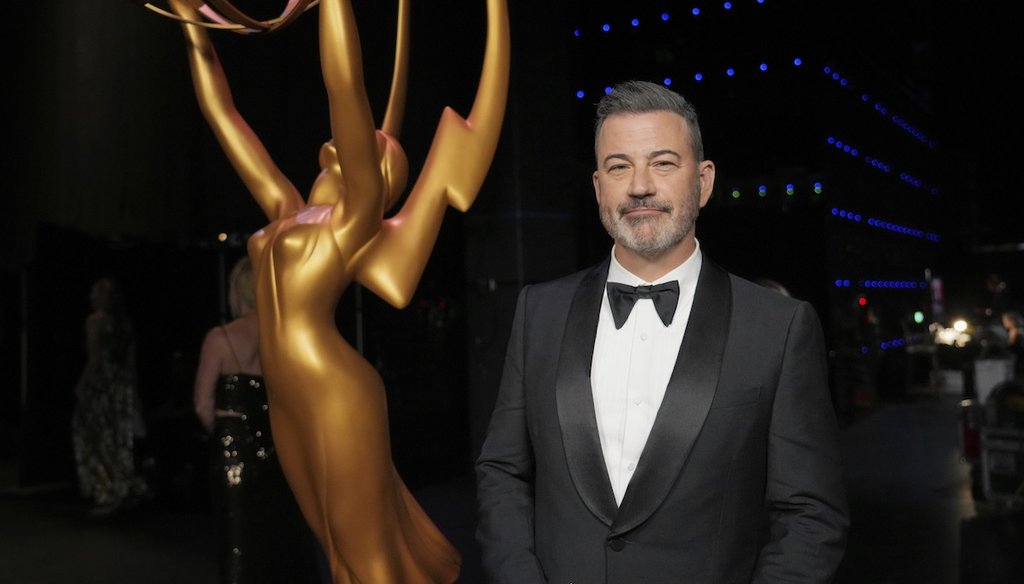
Jimmy Kimmel with Emmy for Outstanding Host for a Game Show during night two of the Television Academy's 2025 Creative Arts Emmy Awards on Sept. 7, 2025 in Los Angeles. (AP)


Did Federal Communications Commission Chairman Brendan Carr overstep the bounds of government oversight when he called for action against late-night talk show host Jimmy Kimmel?
Kimmel sparked conservative criticism when he spoke about the suspect in the Sept. 10 assassination of conservative activist Charlie Kirk on his show, "Jimmy Kimmel Live!"
In his Sept. 15 monologue, Kimmel said, "We hit some new lows over the weekend with the MAGA gang trying to characterize this kid who killed Charlie Kirk as anything other than one of them," Kimmel said.
He also aired a clip showing Trump’s brief response to a question about how he was handling Kirk’s death. It showed Trump quickly pivoting to discussing the ballroom he’s building at the White House. But the bigger controversy stemmed from another comment about Kirk’s suspected shooter.
Hours before ABC, which is owned by the Walt Disney Co., pulled Kimmel off the air, Carr appeared on conservative commentator Benny Johnson's podcast, saying that broadcasters are "entirely different than people that use other forms of communication."
"They have a license granted by us at the FCC that comes with it an obligation to operate in the public interest," Carr told Johnson. "I mean, look, we can do this the easy way or the hard way. These companies can find ways to change conduct to take actions, frankly on Kimmel, or there’s going to be additional work for the FCC ahead." Carr likened Kimmel’s comment to "news distortion," which is against FCC’s rules for broadcasters.
The commissioner's comments were widely interpreted as being addressed to ABC, Kimmel’s employer, and the network’s independently-owned affiliates. The independent stations, as well as ABC — because it’s a network that also owns stations — fall under the FCC’s purview.
Before ABC announced it was halting Kimmel’s show, two companies that own a range of ABC affiliates, Nexstar and Sinclair, said they would be preempting his show. Nexstar is seeking FCC approval for a merger with Tegna, while Nexstar and Sinclair are asking the FCC to repeal a rule that limits any broadcasting company from reaching more than 39% of U.S. households.
In an interview after Kimmel’s show was pulled, Carr again cited his agency’s public interest obligation. Speaking with Fox News’ Sean Hannity, Carr said: "We at the FCC are going to enforce the public interest obligation. If there’s broadcasters out there that don’t like it, they can turn their license in to the FCC. But that’s our job, and again we’re making some progress now."
Publications and legal experts say Carr overstepped his mandate, using the threat of government action to police what should qualify as free speech.
"When a network drops high-profile talent hours after the FCC chairman makes a barely veiled threat, then it’s no longer just a business decision. It’s government coercion," wrote the right-of-center publication The Free Press. "Is it now Trump administration policy to punish broadcasters for comedy that doesn’t conform to its politics? That is censorship."
At issue in the Kimmel case is how much influence the FCC can bring to bear under its statutory authority and First Amendment protections for free speech. First Amendment experts said the law allows the FCC to regulate certain aspects of broadcasters’ actions, but that leveraging its authority to persuade private media companies to punish speech by a comedian on public matters falls beyond those boundaries.
Ronnie London, general counsel with the Foundation for Individual Rights and Expression, a free-speech advocacy group, called Carr’s actions "a classic case of unconstitutional jawboning," meaning the improper use of threatened government action to pursue policy goals.
London and other experts pointed to a 2024 U.S. Supreme Court decision, National Rifle Association v. Vullo, in which the justices unanimously ruled that a New York regulator’s attempts to discourage companies from doing business with the NRA amounted to coercion and violated the First Amendment.
PolitiFact reached out to the FCC for comment but did not hear back by publication.
What is the FCC’s public interest authority?
In the Kimmel case, Carr acted on his own, without formal action by the five-member FCC board. Anna Gomez, the only Democrat on the FCC, spoke out against Carr’s actions on CNN.
London said that Carr’s words carried weight because of the implied force of the government agency he heads.
So where does the agency’s authority begin and end?
The Communications Act of 1934 that established the FCC authorized it to award broadcast licenses to broadcasters who abide by the "public interest, convenience, and necessity."
"This basically means that a licensee has the duty to air programs that are responsive to its local community's priorities and needs," Olivier Sylvain, a Fordham University law professor and senior policy research fellow at Columbia University’s Knight First Amendment Institute.
Nexstar preempted Kimmel’s show even before ABC announced it was pulled. (Preempting a show means not running it in an affiliate’s market.)
On its website, the FCC acknowledges that the First Amendment limits its power over speech, including in regard to the public interest.
"The FCC has long held that ‘the public interest is best served by permitting free expression of views,’" the FCC says. "Rather than suppress speech, communications law and policy seeks to encourage responsive ‘counter-speech’ from others. Following this principle ensures that the most diverse and opposing opinions will be expressed, even though some views or expressions may be highly offensive."
What are the public interest rules for broadcasters?
Over-the-air broadcasts by local TV and radio stations are subject to speech restraints in certain areas, but cable or satellite TV programs are generally not. The FCC does not regulate online content.
FCC-imposed constraints on broadcasters involve topics typically identified by Congress or adopted by the FCC through rulemaking or formal proceedings.
They include indecency and obscenity, commercial content in children's TV programming, sponsorship identification and the conduct of on-air contests,
"When it comes to regulating content, the public interest standard is pretty circumscribed," London said. The FCC’s regulatory powers "are not a blank check, and definitely not when it comes to regulating content on broadcast TV."
What is news distortion?
Carr cited something else as Kimmel’s violation — broadcast news distortion. But Kimmel’s role as a late-night comedian and the content of his words may complicate that.
The FCC says on its website that "news distortion must involve a significant event."
There is a distinction between "deliberate distortion" and inaccuracies and differences of opinion. Broadcasters are only subject to enforcement if it can be proven that they deliberately distorted a factual news report, the FCC says. "Expressions of opinion or errors stemming from mistakes are not actionable."
On Johnson’s podcast, Carr said licensed stations that carry a nationally-distributed program like Kimmel’s have a public interest standard that is relevant to FCC oversight.
"One thing that we’re trying to do is to empower those local stations to serve their own communities," Carr said. "And the public interest means you can't be running a narrow, partisan circus and still meeting your public interest obligations. That means you can't be engaging in a pattern of news distortion, we have a rule on the book that interprets the public interest standard that says news distortion is something that is prohibited."
Legal experts said Carr’s commentary overlooks a few important factors with Kimmel’s show.
"Jimmy Kimmel Live" runs out of ABC’s entertainment division, not its news division.
In addition, it’s complicated to argue that Kimmel was knowingly sharing inaccurate information. At the time of his monologue, some news reports had discussed the relationship of the alleged shooter, Tyler Robinson, to a gender-transitioning roommate, but the charging documents had not yet been released.
"I don't receive Kimmel's comments as a falsehood in the same way that a deceptive statement about a cryptocurrency or misdirection about a polling place is," Sylvain said. "Nor can we say that Kimmel, an entertainer, was advancing anything other than an opinion."
Our Sources
X, Brendan Carr post, Feb. 14, 2019
X, The Bulwark post, Sept. 17, 2025
YouTube, Benny Johnson podcast, Sept. 17, 2025
X, Brendan Carr post, May 2, 2022
Business Insider, A $6.2 billion deal looms over Jimmy Kimmel's suspension, Sept. 18, 2025
Nexstar, Nexstar ABC Affiliates To Preempt "Jimmy Kimmel Live!" Indefinitely Beginning Tonight, Sept. 17, 2025
The Free Press, Jawboning and Jimmy Kimmel, Sept. 18, 2025
Federal Communications Commission, FCC Broadcast Ownership Rules, Updated Jan. 17, 2020
Hannity.com, FCC CHAIR ON HANNITY: Something Has Gone ‘Seriously Awry’ With Late-Night Shows [WATCH], Sept. 17, 2025
CNN transcripts, CNN Newsroom, Sept. 18, 2025
Oyez.org, National Rifle Association of America v. Vullo, May 30, 2024
U.S. Department of Justice, The Communications Act of 1934, Accessed Sept. 18, 2025
Federal Communications Commission, What We Do, Accessed Sept. 18, 2025
Federal Communications Commission, The FCC and Speech, Updated Aug. 31, 2022
Federal Communications Commission, Broadcast News Distortion, Updated July 18, 2024
Federal Communications Commission, Hoaxes, Accessed Sept. 18, 2025
Interview with Ronnie London, general counsel with the Foundation for Individual Rights and Expression, Sept. 18, 2025
Email interview with Olivier Sylvain, Fordham University law professor and a senior policy research fellow at Columbia University’s Knight First Amendment Institute, Sept. 18, 2025
Browse the Truth-O-Meter
More by Louis Jacobson