Get PolitiFact in your inbox.

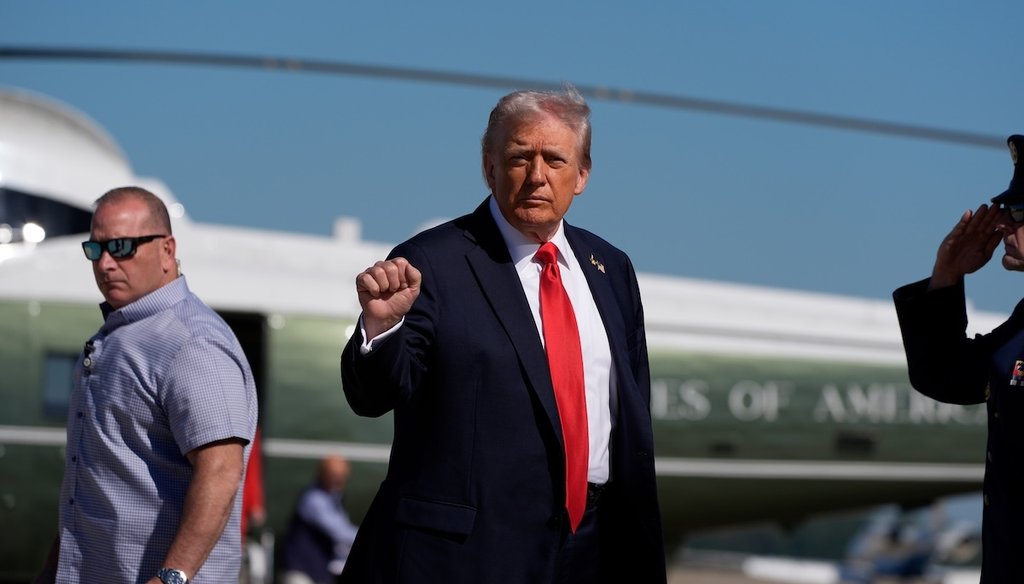
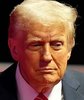
President Donald Trump gestures as he boards Air Force One on Oct. 5, 2025, at Joint Base Andrews, Md. (AP)

President Donald Trump appears poised to put his image on both sides of a commemorative $1 coin issued by the United States Mint.
On Oct. 3, the White House reshared an X post from U.S. Treasurer Brandon Beach confirming reports that the Trump administration was seeking to put the president’s image on the front and back of a dollar coin commemorating the nation’s 250th anniversary.
U.S. currency typically does not feature living people — or sitting presidents — but it’s not unprecedented.
"There have been times in the past where commemorative coins have been printed with the faces of living people," White House National Economic Council chair Kevin Hassett said on CNN’s "State of the Union" Oct. 5.
He’s right: Several living people have been featured on U.S. coins in both the recent and distant past, including one sitting president.
Although the concept of a Trump coin runs counter to a longstanding tradition, there are no unscalable legal obstacles to establishing a U.S. coin with Trump’s image on it.
What has the Trump administration proposed?
Beach’s X post showed the coin’s front, featuring Trump’s side profile, and its flip side — an illustration of Trump pumping his fist after a 2024 assassination attempt in Butler, Pennsylvania. The phrase, "Fight Fight Fight" lines the coin’s perimeter, referencing a Trump rallying cry repeated after the assassination attempt. Trump was not president at the time of the assassination attempt.
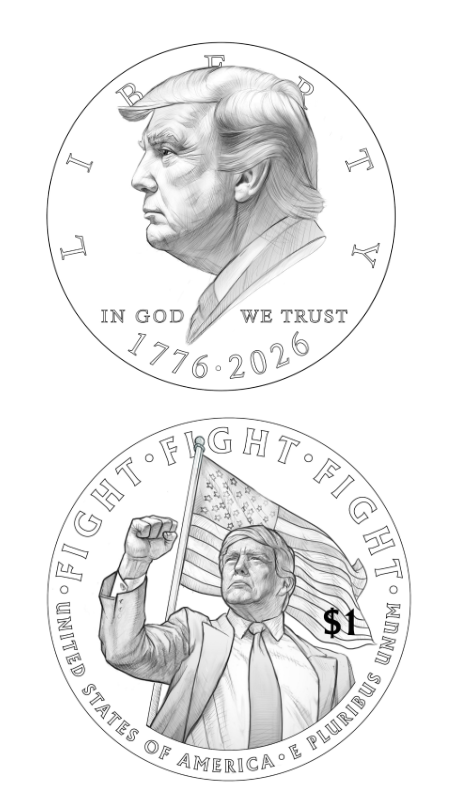
(Treasury Department)
At an Oct. 3 White House press briefing, White House Press Secretary Karoline Leavitt said, "I’m not sure if he’s seen it, but I’m sure he’ll love it."
Would this design be legal?
Multiple pieces of coinage legislation enacted over the past few decades have included specific language prohibiting living people from being portrayed on U.S.-minted coins. In one case — a series of coins launched in 2007 honoring every president — the law’s text goes further to specify that no coin in the series may "bear the image of a living former or current president, or of any deceased former president during the 2-year period following the date of the death of that president."
That barrier on living presidents was specific to that particular presidential coinage series, however — not to the series that would include the proposed Trump coin.
The guidance governing the series the Trump administration is considering comes from legislation authorizing a series of coins for the nation’s 250th anniversary, known as the Circulating Collectible Coin Redesign Act of 2020. Trump signed the measure into law in January 2021, during his first presidency, following unanimous passage by both chambers of Congress. It authorizes the redesigns of quarters, half dollars and $1 coins in several sequential series, one of which is a 250th anniversary series to be launched in 2026.
The law for the 250th series refers specifically to the reverse of the coin:"No head and shoulders portrait or bust of any person, living or dead, and no portrait of a living person may be included in the design on the reverse of any coin" in the series. But it doesn’t rule out a portrait on the front of the coin.
That may not be a high bar for Trump to jump if he wants to mint a coin with his image on it.
Unless Congress acts, the process from here would involve only administration officials, meaning the president could maintain direct control. Even if the courts were inclined to block the proposal, experts said it’s uncertain whether anyone would be able to cite a direct harm from producing a Trump coin — a requirement for filing a lawsuit.
"It's unclear who would have standing to sue here," said Gabriel Mathy, an associate professor economics at American University who has studied coinage issues.
Legal or not, history has not favored using living people on U.S. currency
Whether or not a Trump coin would be legal, numismatic experts — those who specialize in coins and related items — said there’s a longstanding tradition in the United States of not depicting living people on coins.
"Not featuring current presidents on coins is an important and enduring part of the United States’ history as a republic," Mathy said. "Going back thousands of years, coins traditionally carried the image of the current monarch. This is still the case in the United Kingdom, where coins are minted with the face of the reigning monarch, as well as in some other monarchies.
"The United States was founded as a republic, and the founders wanted to avoid making the president into a monarch," Mathy said. Putting a living president on a coin would be "inconsistent with a long tradition of American republicanism."
Despite the norm, living people have sometimes appeared on U.S. currency
President Abraham Lincoln, his Treasury Secretary Salmon P. Chase and U.S. Army Gen. Winfield Scott were among a small number of living figures to appear on U.S. paper currency.
During the Civil War, Spencer Clark, an official with the federal office responsible for printing paper money, put his own image on a five-cent note. He did it by leveraging a legal loophole: Congress had approved a note featuring an image of William Clark, the explorer from the Lewis & Clark expedition of the Louisiana Territory, but lawmakers neglected to specify William Clark’s first name in the legislation, journalist Blake Stilwell wrote in Military.com. So Spencer Clark, having the same surname, inserted his own image instead of William Clark’s. Clark also produced a separate note that featured then-U.S. Treasurer Francis E. Spinner.
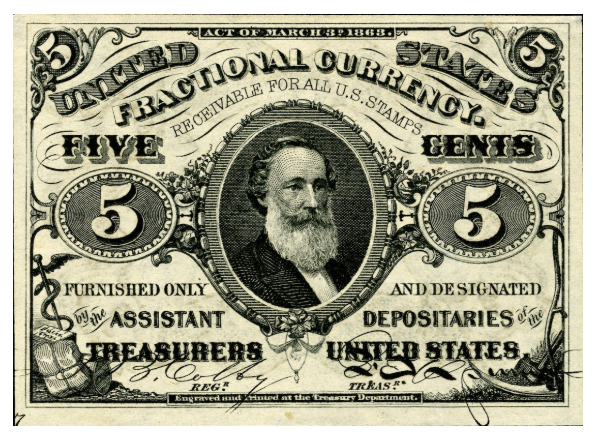
(Smithsonian Institution)
By the Civil War’s end, "Congress had time to pay attention to what the Bureau of Engraving and Printing was up to," Stilwell wrote.
So in 1866, Congress passed a law saying no portrait or likeness of a living person would appear on "bonds, securities, notes, fractional or postal currency of the United States."
The law doesn’t mention coins, however. Living figures — and even one living president, Calvin Coolidge — have occasionally been featured on coins, including some in recent years.
In 1921, the U.S. released a commemorative coin to mark Alabama’s centennial, featuring side views of William Bibb, the state’s first governor, and Thomas Kilby, its governor during the centennial. "This coin was the first ever created by the Mint to carry a living person's portrait," the Mint’s website says.
In 1926, during the nation’s sesquicentennial celebration, the Mint produced a congressionally authorized commemorative coin. The designers settled on a joint portrait of George Washington and Coolidge, who was president during the sesquicentennial.
The coin proved unpopular; of 1 million half dollars that were minted, more than 850,000 were returned to the Mint and melted.
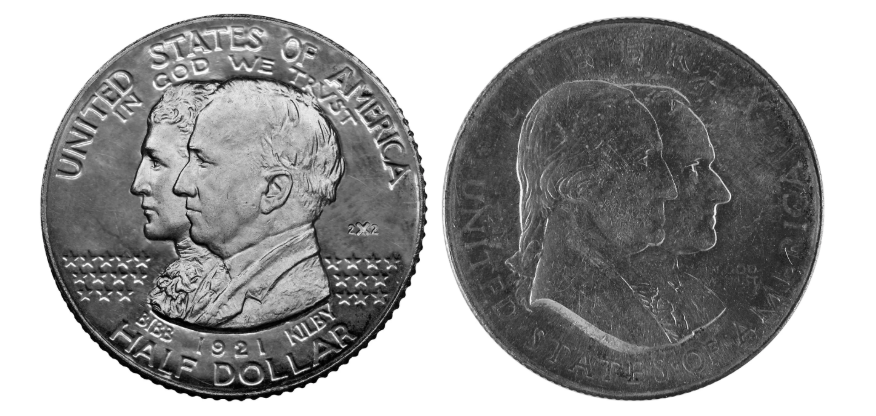
Alabama centennial coin, left, and U.S. sesquicentennial coin, right (U.S. Mint)
The other two examples we could find of living figures on coins are more recent.
The Mint created a congressionally authorized coin to commemorate the 1995 Special Olympics World Games. Congress didn’t dictate the design, but the front of the coin featured Eunice Kennedy Shriver, who founded the Special Olympics for people with intellectual disabilities. She died in 2009.
On Feb. 6, 2016, the Mint unveiled congressionally authorized coins for former President Ronald Reagan and former first lady Nancy Reagan, tied to the late president’s 105th birthday. Nancy Reagan died one month later, on March 6, 2016. Her minted coin was released in July.
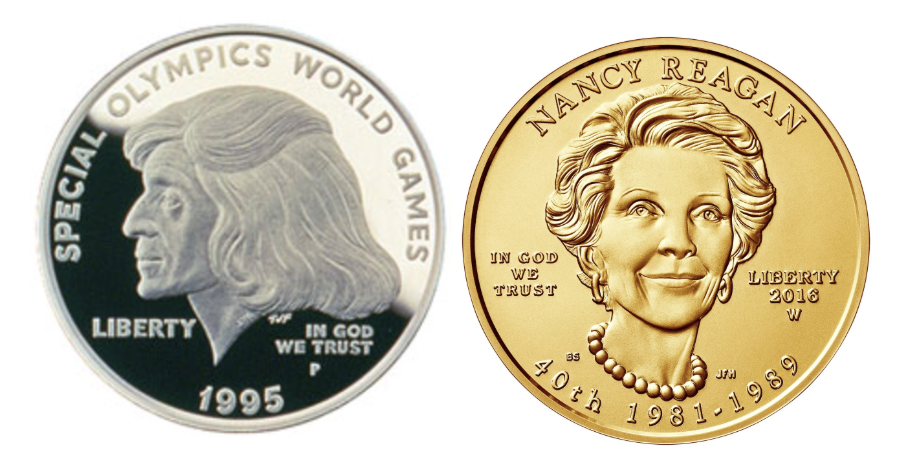
Special Olympics coin, left, and Nancy Reagan coin, right. (U.S. Mint)
A country has already minted a coin with Trump’s image on it
In 2025, the west African nation of Liberia produced a $1, one-ounce silver commemorative coin with Trump’s image on the front, crowned by a laurel leaf in gold as if he were a Roman emperor. The motto read, "In Don We Trust."
If you can find one in stock, it would cost about $150 to $200, according to Google searches.
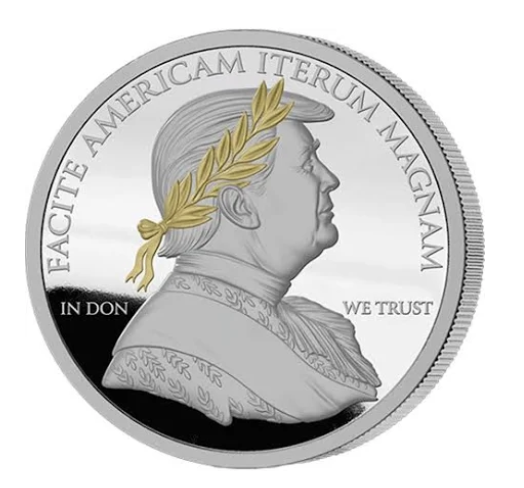
(GovMint.com)
CLARIFICATION, Oct. 8, 2025: This story has been updated to clarify the timing of the congressional authorization and minting of the coin featuring sitting President Calvin Coolidge, and that a design of a coin featuring former first lady Nancy Reagan was released, but not yet minted, shortly before she died.
Our Sources
Brandon Beach, X post, Oct. 3, 2025
White House, press briefing, Oct. 3, 2025
CNN, "$1 Trump coin draft is ‘real,’ US Treasurer says," Oct. 3, 2025
Axios, "$1 Trump coin: Treasury shares draft design for America's 250th," Oct. 3, 2025
Congress.gov, "H.R. 1923 - Circulating Collectible Coin Redesign Act of 2020"
Congressional Research Service, "Redesigning Circulating Quarters, Half Dollars, and Dollar Coins: Current and Future Designs," Jan. 4, 2023
Military.com, "Why American Currency Can Only Feature Images of Dead People," Oct. 3, 2023
Federal Reserve Bank of St. Louis, "Full text of Laws of the United States Concerning Money, Banking, and Loans, 1778-1909 : Laws of the United States Concerning Money, Banking, and Loans, 1778-1909, 61st Congress, 2d Session, Senate Document No. 580," accessed Oct. 6, 2023
American Numismatic Association, "1926 Sesquicentennial of American Independence Half Dollar," accessed Oct. 6, 2025
GovInfo, "Public Law 103-328—Sept. 29, 1994"
U.S. Mint, "Alabama Centennial Half Dollar," accessed Oct. 6, 2025
U.S. Mint, "Sesquicentennial of American Independence Half Dollar," accessed Oct. 6, 2025
U.S. Mint, "Special Olympics World Games Silver Dollar," accessed Oct. 6, 2025
U.S. Mint, "Presidential $1 Coin Program," accessed Oct. 6, 2025
National Museum of American History, "Eunice Kennedy Shriver Silver Dollar," accessed Oct. 6, 2025
GovInfo, "Public Law 109–145—Dec.. 22, 2005"
Coin World, "Reagans unveiling of dollar First Spouse designs," Feb. 8, 2016
U.S. Mint, "Nancy Reagan First Spouse Gold Coin First Lady, 1981–1989," accessed Oct. 6, 2025
GovMint, "2025 Liberia $1 1-oz Silver Trump Caesar Proof w/Gold Gilding," accessed Oct. 6, 2025
Email interview with Michael Gerhardt, University of North Carolina law professor, Oct. 7, 2025
Email interview with Gabriel Mathy, associate professor economics at American University, Oct. 7, 2025
Browse the Truth-O-Meter
More by Louis Jacobson