Stand up for the facts!
Our only agenda is to publish the truth so you can be an informed participant in democracy.
We need your help.
I would like to contribute

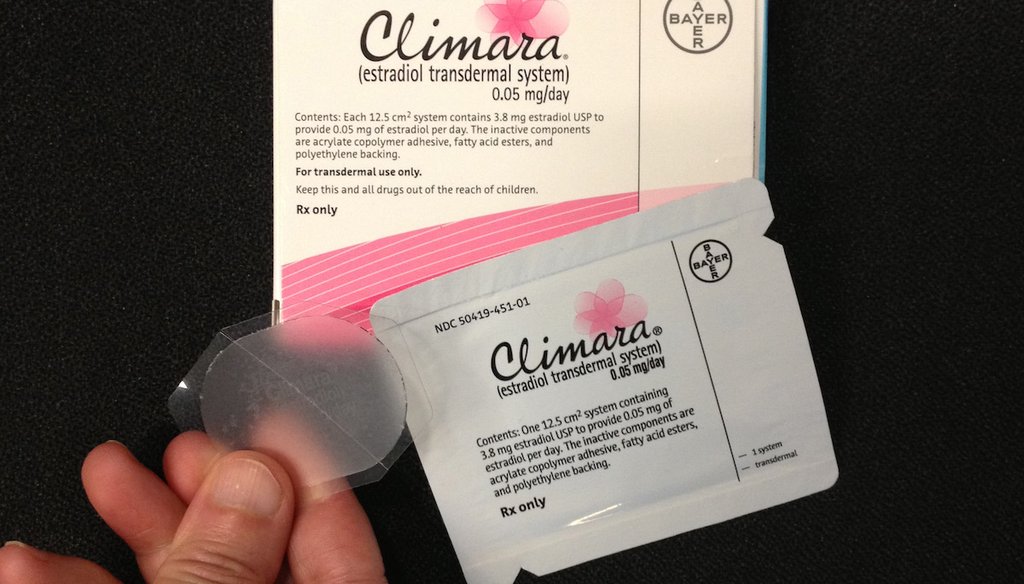
This photo shows Bayer's Climara low-dose estrogen skin patch, one of several hormone treatments for menopause symptoms. Oct. 2, 2012 (AP)

If Your Time is short
-
The FDA said it will remove most "black box" safety warnings from hormone drugs used to treat menopause symptoms. Newer research shows these medications are safer than previously believed, especially for women younger than 60.
-
Local forms of hormone therapy treat vaginal and urinary symptoms and are very low risk. Systemic therapies treat the whole body and can come with a small increased risk of certain health conditions such as breast cancer.
-
The main benefit of menopause hormone therapy, sometimes called hormone replacement therapy or HRT, is relief from menopause symptoms such as hot flashes, vaginal dryness and night sweats. A conversation with your doctor can help determine if you are a good candidate for these medications.
What does it mean when a warning label is removed from a medication after two decades?
On Nov. 10, the U.S. Food and Drug Administration said it will ask companies to remove most "black box" safety warnings — used on medications to warn patients of serious health risks — from hormone drugs commonly used to treat menopause symptoms. The change comes after years of advocacy from gynecologists, patients and professional medical organizations.
The FDA began requiring the warnings in 2003 after results from a large study raised concerns the medications could increase the risk of breast cancer, stroke and heart attack. Patients became hesitant to take the medications, and prescriptions decreased.
But the science wasn’t so clear cut. The study that drove the change included mostly women older than 60, and hormone formulations and delivery methods different from what’s often used today. More recent scientific research has shown the medications to be much safer than previously believed, especially for women under 60. Some types of hormone therapy slightly increase a woman's risk for certain health conditions, but the increased risk is small.
We spoke with four OB/GYNs who specialize in menopause management to find out what you need to know before your next doctor’s appointment.
What are the types of menopause hormone therapies?
Menopause hormone therapy, sometimes called hormone replacement therapy or HRT, refers to medications prescribed to treat menopause symptoms, including hot flashes, night sweats, mood swings and vaginal dryness. They work by replenishing hormones, such as estrogen and progesterone, that naturally diminish during the transition to menopause.
The medications take several forms.
Local estrogen therapy comes in creams, rings and tablets. These treatments are called "local" because their impact is limited to the area where they are applied, such as the vagina. These therapies address symptoms including vaginal dryness, itching, urinary tract infections and the sudden urge to urinate.
With local therapies, the hormones are absorbed into the bloodstream only in trace amounts, making them a low-risk option. However, it also means they can’t treat broader symptoms, such as hot flashes or mood swings.
Systemic hormone therapy, on the other hand, is designed to circulate the hormones throughout the bloodstream. It offers whole-body benefits but also carries more risk as a result. These therapies are administered orally or absorbed through the skin via patches, sprays or gels.
Systemic therapies include estrogen-only therapy, progesterone-only therapy or a combination of estrogen and progesterone. Women who have had their uterus removed only need to take estrogen. Women who still have their uterus must also take progesterone, often in combination with estrogen, to protect against endometrial cancer. The FDA said black-box warnings for endometrial cancer will remain on estrogen-only systemic medications.
Different versions of estrogen and progesterone carry different risks and benefits.
"The treatments are highly individualized," Dr. Marcy Nagpal, an OB/GYN at the Medical University of South Carolina, said in an email to PolitiFact. Talking with your doctor is the best way to know which therapy might be right for you.
Which patients are the best candidates for these meds?
Women with menopausal symptoms who are under 60, or women who had their last menstrual period within the last 10 years, doctors told us.
But others can be candidates, too.
"At this time, it’s reasonable for anyone who feels that they are experiencing symptoms related to menopause to consider evaluation and treatment options," Nagpal said.
If you don’t have symptoms, you do not need to take menopausal hormone therapy, said Dr. Jennifer Howell, a Duke University OB/GYN. It's "not generally recommended for health promotion."
Some people might be less suited for systemic therapies. Among them: Women who have or had breast cancer; who suffered a heart attack or stroke; who have had blood clots in their legs, lungs or brain; or who have active liver or gallbladder disease. Alternative medications and non-hormonal options to manage the menopause symptoms also are available, doctors said.
What are the benefits?
Doctors we talked to overwhelmingly pointed to symptom relief.
"Hot flashes and night sweats stop, sleep improves, mood is stabilized, joint pain often improves, and vaginal dryness and pain with vaginal penetration resolves," said Dr. Karen Adams, OB/GYN and director of the menopause program at Stanford Medicine. She said recurrent urinary tract infections and frequent urination can stop.
Dr. Nanette Santoro, an OB/GYN and professor at the University of Colorado, said, "Depending on just how annoying and disruptive those symptoms are, (the medications) can be a godsend."
While taken, systemic therapy can also prevent the rapid loss of bone density that typically accompanies menopause.
"Women can lose up to 20% of bone mass in the first five years after their final period," said Adams. Stronger bones can reduce the risk of fracture and osteoporosis.
But contrary to recent claims, data on whether hormone therapy can prevent heart attacks or dementia are not conclusive, Howell and Santoro said.
During the FDA announcement about the removal of black box warnings, assertions made about significantly improved cardiovascular health and lower Alzheimer's risk are not supported by evidence, Adams said. "We absolutely do not have that data."
Likewise, the statement that these menopause therapies are life-extending "goes very far beyond the data and is in exactly no clinical guidelines," Santoro said.
What are the risks of menopause hormone therapy?
With few exceptions, most symptomatic women can use local low-dose estrogen without risk, Howell said.
"The local forms should never have had this labeling at all," Adams said. "The black box was placed on all estrogen products without regard to whether they were local or systemic, and a correction of that was long overdue."
Systemic hormone therapies carry more risk and can be navigated with a more in-depth conversation with a doctor.
Research shows that women who take a combination of estrogen and progesterone have an increased risk of breast cancer, but it’s "very small," Howell said, and mainly pertains to prolonged use among older women.
"This risk increases slowly and incrementally over time," Santoro said, and applies to those who take hormones for longer periods, usually more than four to five years.
The risk profile also depends on the type of hormones a patient takes. Newer formulas appear to be more neutral for breast cancer risk than the formulas used in the 2002 study that led to the warnings, Adams said. And some estrogen-only therapies have been found to reduce breast cancer risk.
With some hormones, the risk varies depending on how they are taken. For example, some oral medications increase the risk for developing blood clots, but when the same medication is absorbed through the skin, it doesn’t appear to have that risk.
"Sorting out the risks and benefits for hormone therapy is a task for a patient and her doctor," Santoro said, to determine the best type of hormones, how long to take them, and how to manage any risks.
Will this change impact insurance coverage?
Doctors said it’s unlikely.
Most generic hormone therapy treatments are covered by insurance, Howell said, but specialized formulations that can be more convenient, safe or less messy can be challenging to get covered.
Tips for discussing HRT with your doctor
If you are approaching menopause, or already in the throes of it, here are some pointers about discussing hormone therapy with your doctor.
First, make sure you and your doctor are compatible.
"This is a topic that can require a deep well of knowledge," Nagpal said. "It’s reasonable to ask your doctor if they are comfortable with menopause medicine and, if not, to recommend someone who is."
The Menopause Society, a nonprofit for healthcare professionals focused on improving menopause care, offers a search function to find certified providers in your area who have passed a test about menopausal management.
When scheduling, consider making an appointment specifically to address treatment options, rather than trying to combine the discussion with other concerns, Nagpal said.
On the day of your appointment, Santoro recommended bringing a list of your symptoms, ordered by which you would most like addressed.
"It’s not always possible to take care of everything with hormones alone, and knowing the bothersomeness is very helpful to me as the doctor, so I make my best recommendation," she said.
Knowing your own health history — current medications, past health events, how long since your last period — and your family health history can also help.
Nagpal advises keeping an open mind.
"Therapies that are appropriate for one person may not be indicated or appropriate for someone else," she said. Getting the right dose and regimen might take some trial and error, doctors said. So don’t be alarmed if it takes a few visits and changes to get the most appropriate treatment.
Our Sources
Email interview with Dr. Jennifer Howell, an OB/GYN at Duke University, Nov. 12, 2025
Email interview with Dr. Marcy Nagpal, an OB/GYN at the Medical University of South Carolina, Nov. 13, 2025
Email interview with Dr. Karen Adams, OB/GYN and director of the menopause program at Stanford Medicine, Nov. 11. 2025
Email interview with Dr. Nanette Santoro, an OB/GYN and professor at the University of Colorado, Nov. 11, 2025
The Journal of Clinical Endocrinology & Metabolism, Postmenopausal Hormone Therapy: An Endocrine Society Scientific Statement," July 2010
American College of Obstetrics and Gynecologists, "ACOG President Says Label Change on Estrogen Will Increase Access to Hormone Therapy," Nov. 10, 2025
Menopause Society, "The 2022 hormone therapy position statement of The North American Menopause Society," 2022
Cleveland Clinic, "Hormone Replacement Therapy (HRT) for Menopause," March 12, 2024
YouTube, "FDA announces removal of "black box" warnings on some hormone therapies for menopause," Nov. 10, 2025
Food and Drug Administration, "HHS Advances Women’s Health, Removes Misleading FDA Warnings on Hormone Replacement Therapy," Nov. 10, 2025
Vajenda, "The Black Box Warning on Vaginal Estrogen Might Be Wrong — and the Science Still Isn’t Complete," Aug. 10, 2025
National Health Service, "When to take hormone replacement therapy (HRT) - NHS," Jan. 4, 2023
Mayo Clinic, "Menopause hormone therapy: Is it right for you?," April 18, 2025
Centers for Disease Control and Prevention, "Hysterectomy Among Women Age 18 and Older: United States," Feb. 2024
StatPearls, "Box Warning," June 17, 2023
Facebook post, Nov. 10, 2025
Endocrine Society, "Postmenopausal Hormone Therapy," July 2010
The New York Times, "Women Have Been Misled About Menopause," June 15, 2023
New England Journal of Medicine, "Menopause Management — Getting Clinical Care Back on Track," March 3, 2016
StatPearls, "Hormone Replacement Therapy," Oct. 6, 2024
The Associated Press, "FDA removing warning from hormone-based menopause drugs," Nov. 10, 2025
Nature, "Is HRT in menopause healthy? US label change triggers debate," Nov. 11, 2025
CNN, "‘Black box’ safety warning to be removed from hormone therapy for menopause," Nov. 10, 2025
University of Michigan Health, "Vaginal Estrogen: Information and Instructions," Oct. 2022
Menopause Society, "The Menopause Society," Accessed Nov. 18, 2025
Royal Osteoporosis Society, "Hormone replacement therapy (HRT): osteoporosis," July 2025
Breast Cancer Research Foundation, "HRT and Breast Cancer Risk Explained," accessed Nov. 19. 2025
Browse the Truth-O-Meter
More by Grace Abels