Stand up for the facts!
Our only agenda is to publish the truth so you can be an informed participant in democracy.
We need your help.
I would like to contribute

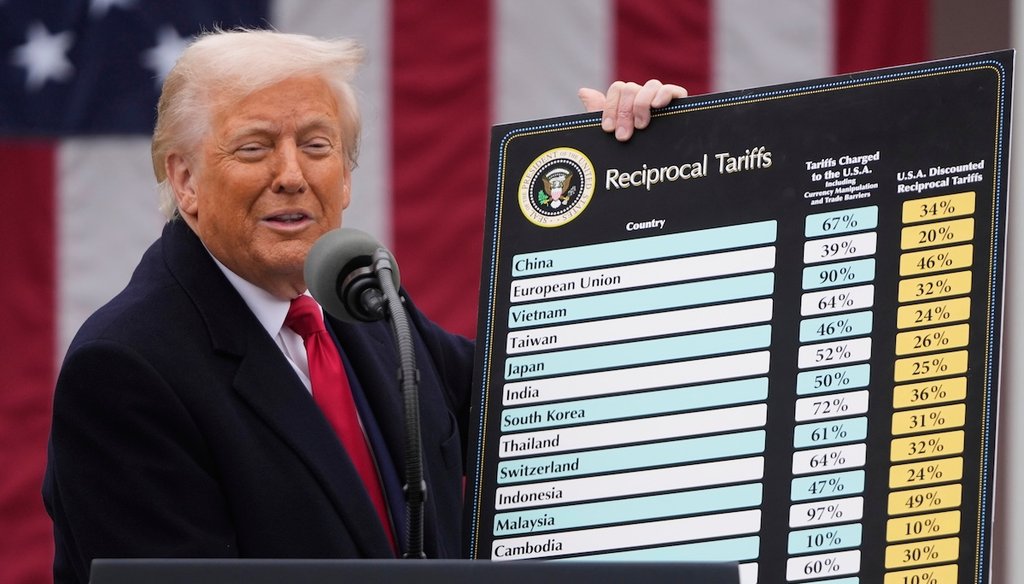
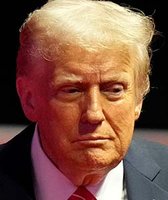
President Donald Trump speaks during an event to announce new tariffs in the Rose Garden at the White House, on April 2, 2025, in Washington. (AP)


Over the weekend, President Donald Trump promised Americans $2,000 each from the "trillions of dollars" in tariff revenue he said his administration has collected.
During his second term, Trump has imposed tariffs broadly on countries and on specific goods such as drugs, steel and cars.
"People that are against Tariffs are FOOLS!," Trump said in a Nov. 9 Truth Social post. "We are taking in Trillions of Dollars and will soon begin paying down our ENORMOUS DEBT, $37 Trillion. Record Investment in the USA, plants and factories going up all over the place. A dividend of at least $2000 a person (not including high income people!) will be paid to everyone."
How seriously should people take his pledge? Experts urged caution.
Tariffs are projected to generate well below "trillions" a year, making it harder to pay each person $2,000. And the administration already said it would use the tariff revenue to either pay for existing tax cuts or to reduce the federal debt.
Trump’s post came days after the U.S. Supreme Court heard arguments about the legality of his tariff policy. The justices are weighing whether Trump has the power to unilaterally impose tariffs under the International Emergency Economic Powers Act. If the justices rule against Trump, much of the expected future tariff revenue would not materialize.
What Trump proposed, and who would qualify
The administration has published no plans for the tariff dividends, and in a Nov. 9 ABC News interview, Treasury Secretary Scott Bessent said he hadn’t spoken to Trump about giving Americans a dividend payment.
Details about a potential payment have been limited to Truth Social posts.
Trump said "everyone" excluding "high income people" would get the money, but didn’t explain who qualifies as "high income." He also didn’t say whether children would receive the payment.
In a Nov. 10 Truth Social post, Trump said his administration would first pay $2,000 to "low and middle income USA Citizens," and then use the remaining tariff revenues to "substantially pay down national debt."
Trump hasn’t said what form the payments might take. Bessent said the dividend "could come in lots of forms, in lots of ways. You know, it could be just the tax decreases that we are seeing on the president's agenda. You know, no tax on tips, no tax on overtime, no tax on Social Security, deductibility of auto loans. So, you know, those are substantial deductions."
Analysts said it’s a stretch to rebrand an already promised tax cut as a new dividend.
Trump has previously discussed paying Americans with tariff revenue.
"We have so much money coming in, we're thinking about a little rebate but the big thing we want to do is pay down debt," he told reporters July 25. "We're thinking about a rebate."
Days later, Sen. Josh Hawley, R-Mo., introduced legislation that would give $600 tariff rebate checks to each American adult and child. Hawley’s bill has not advanced.
Tariff revenue collected versus cost of a "dividend" payment
Trump made the imposition of tariffs one of his signature 2024 campaign promises. Since taking office in January, he has enacted tariffs on a scale not seen in the U.S. in almost a century; the current overall average tariff rate is 18%, the highest since 1934, according to Yale Budget Lab.
Through the end of October, the federal government collected $309.2 billion in tariff revenue, compared with $165.4 billion through the same point in 2024, an increase of $143.8 billion.
The center-right Tax Foundation projects that tariff revenue will continue to increase to more than $200 billion a year if the tariffs remain in place.
Erica York, the Tax Foundation’s vice president of federal tax policy, estimated in a Nov. 9 X post that a $2,000 tariff dividend for each person earning under $100,000 would equal 150 million adult recipients. That would cost nearly $300 billion, York calculated, or more if children qualified. That’s more than the tariffs have raised so far, she said.
The Committee for a Responsible Federal Budget projected that Trump’s proposal could cost $600 billion, depending on how it is structured.
The administration previously detailed other uses for tariff revenue
The Trump administration already promised to use tariff revenue for other purposes, including reducing the country’s deficit and offsetting the cost of the GOP tax and spending bill Trump signed into law in July.
As Trump announced new tariffs April 2, he said he would "use trillions and trillions of dollars to reduce our taxes and pay down our national debt."
Bessent has made the same promise, falsely saying in July that tariffs were "going to pay off our deficit."
Bessent said in August that he and Trump were "laser focused on paying down the debt."
"I think we’re going to bring down the deficit-to-GDP," Bessent said in an Aug. 19 CNBC interview. "We’ll start paying down debt and then at a point that can be used as an offset to the American people."
Tariffs’ current cost to Americans
Tariffs are already costing Americans money, analysts say. Independent estimates range from about $1,600 to $2,600 a year per household. Given the similarity of these amounts to Trump’s proposed dividend, York said it would be more efficient to remove the tariffs.
Joseph Rosenberg, Urban Institute-Brookings Institution Tax Policy Center senior fellow, said a $2,000 dividend in the form of a check would require congressional approval — and lawmakers have already declined to act on that idea once.
When members of Congress approved the One Big Beautiful Bill Act, "They had the ability to include a tariff dividend, but they didn’t," Rosenberg said.
Our Sources
BBC, What tariffs has Trump announced and why?, Nov. 5, 2025
President Donald Trump, Truth Social post, Nov. 9, 2025
ABC News, 'This Week' Transcript 11-09-25: Treasury Secretary Scott Bessent, Sen. Adam Schiff & David Miliband, Nov. 9, 2025
X, Post, July 25, 2025
U.S. Senate, American Worker Rebate Act of 2025, accessed Nov. 10, 2025
Erica York, X Post, Nov. 9, 2025
Roll Call, Speech: Donald Trump Announces New Tariffs at a Rose Garden Event, April 2, 2025
Urban Institute-Brookings Institution Tax Policy Center, "Tracking the Trump Tariffs," Oct. 24, 202
Tax Foundation, "Trump Tariffs: Tracking the Economic Impact of the Trump Trade War," Oct. 31, 2025
Yale Budget Lab, "State of U.S. Tariffs," Oct. 30, 2025
Penn-Wharton Budget Model, Real-Time Federal Budget Tracker, accessed Nov. 10, 2025
Reed Smith, "Trump 2.0 tariff tracker," accessed Nov. 10, 2025
Congress.gov, "S. 2475 - American Worker Rebate Act of 2025"
Scott Bessent, interview with ABC’s "This Week," Nov. 9, 2025
Erica York, X post, Nov. 9, 2025
CNBC, Watch CNBC’s full interview with Treasury Secretary Scott Bessent, Aug. 19, 2025
PolitiFact, "Donald Trump’s tariff powers face a high-stakes legal test," July 29, 2025
PolitiFact, "Will President Donald Trump’s tariffs cost families $4,000, as Chuck Schumer says?" May 5, 2025
PolitiFact, Add a tariff of 10% to 20% to all nondomestic goods sold in America, accessed Nov. 10, 2025
PolitiFact, Add a 60% tariff on goods from China, accessed Nov. 10, 2025
PolitiFact, Institute a reciprocal tariff policy, accessed Nov. 10, 2025
PolitiFact, Trump tariffs would not ‘pay off our deficit,’ as commerce secretary said, July 22, 2025
Email interview with Erica York, vice president of federal tax policy at the Tax Foundation, Nov. 10, 2025
Email interview with Douglas Holtz-Eakin, president of the American Action Forum, Nov. 10, 2025
Interview with Joseph Rosenberg, senior fellow with the Urban Institute-Brookings Institution Tax Policy Center, Nov. 10, 2025
Browse the Truth-O-Meter
More by Louis Jacobson