Stand up for the facts!
Our only agenda is to publish the truth so you can be an informed participant in democracy.
We need your help.
I would like to contribute

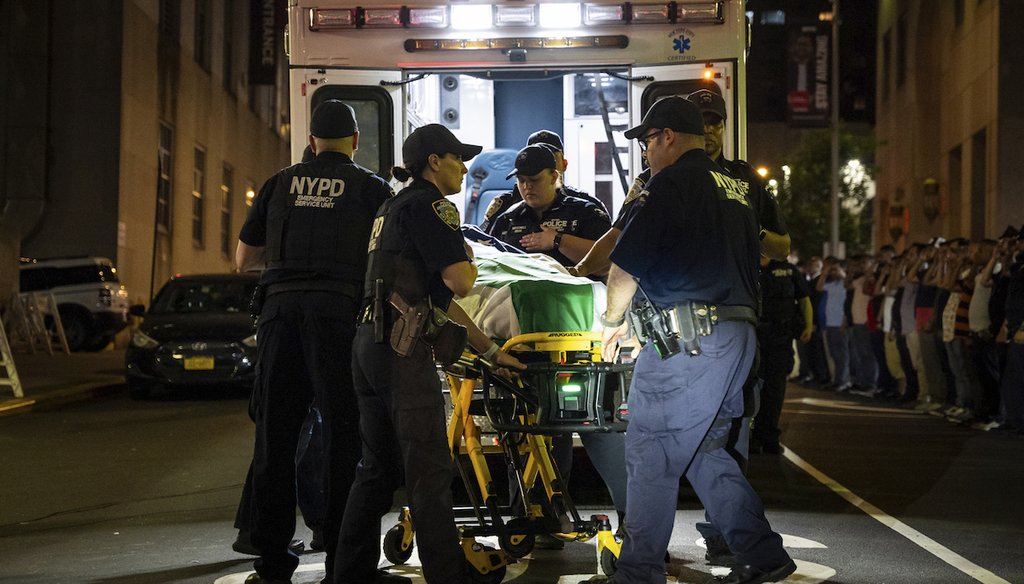
NYPD officers bring the body of police officer Didarul Islam, who was shot and killed by a gunman, to the ambulance early July 29, 2025, in New York. (AP)


If Your Time is short
-
Shane Tamura, the suspect police said committed a July 28 New York City mass shooting, had been involuntarily held for mental health evaluation and treatment in Nevada in 2022 and 2024, news outlets reported, citing unnamed sources.
-
A 2020 Nevada law allows courts to temporarily remove a person’s access to guns if they pose a risk to themselves or others. But it is rarely used.
-
Nearly half of U.S. states have similar "red flag" laws that allow law enforcement and sometimes others to petition courts to issue a high risk protection order.
Law enforcement officials said Shane Tamura, the Las Vegas man suspected of killing four people July 28 in a Manhattan office building, had a documented mental health history, raising questions about why he had access to guns.
Police said Tamura, 27, fired an M4 rifle in the building that houses the NFL headquarters, killing four people including a police officer working a corporate security detail, and then himself. News reports said Tamura, a former high school football player, had a note that said he had CTE, or chronic traumatic encephalopathy, which is associated with head injury.
New York City Police Commissioner Jessica Tisch said July 28 that police had heard about Tamura’s mental health history from Las Vegas officials. She provided no further details.
News reports, citing unnamed law enforcement sources, said Tamura had two mental health crisis holds, which allow someone to be held involuntarily for evaluation and treatment for up to 72 hours, in Nevada in 2022 and 2024.
Tisch said Tamura had a Nevada gun license and used an AR-15 style assault rifle. Tamura legally purchased a revolver in June using his concealed carry permit, Tisch said. CBS and CNN published a photo of Tamura’s 2022 permit issued by Las Vegas police.
"Red flag" laws are intended to remove weapons from unstable people before a violent act occurs. Sometimes the laws have different names, such as extreme risk protection orders or in Nevada, high risk protection orders.
The state attorney general does not list a mental health crisis hold as a reason for a high risk protection order. Nevada’s law allows law enforcement or family members to ask a court to issue an order to temporarily remove a person’s firearms or the right to possess a gun if the person poses a threat to themselves or others.
We asked the Las Vegas Metropolitan Police Department if it had taken steps to use that law to remove Tamura’s access to firearms and received no reply to that question.
Nevada’s high risk protection orders are part of a growing number of state laws that aim to prevent firearm injuries and deaths.
The Nevada law has been little used since it took effect in 2020. Experts said it’s not unusual for states to implement their red flag laws slowly, with some exceptions. Florida, for example, issued about 2,500 orders during the first 18 months after its 2018 law went into effect, said Veronica Pear, an expert on violence prevention and University of California, Davis assistant professor.
What are red flag laws?
Twenty-one states and Washington, D.C., have passed red flag laws since 1999, many with Republican support.
State laws specify who can start a civil petition process to remove or restrict access to weapons. Some states allow only law enforcement to request the orders. Other states allow family members or close contacts, such as coworkers or teachers, to file a petition. Most petitions are filed by law enforcement and are usually granted by courts.
The application used by Nevada law enforcement asks the petitioner whether the person has a firearm and requests a detailed description of conduct and acts of high-risk behavior.
Nevada has week-long and longer-term orders. The seven-day order comes after a hearing in which only one party’s argument for action has been heard. An extended order can last up to a year.
The 2022 Bipartisan Safer Communities Act, signed by former President Joe Biden, provided funding for states to implement red flag laws.
The National Alliance on Mental Illness said when "appropriately implemented, these laws can be lifesaving." The organization also said it is a harmful stereotype to link mental illness and violence.
About 3% to 5% of violent acts are committed by people with serious mental illness, such as schizophrenia, bipolar disorder or major depression. People living with mental illness are more likely to be victims of violence than members of the general population.
Nevada’s red flag law
Nevada Democratic Assemblywoman Sandra Jauregui, who was at a 2017 music festival where a shooter killed 58 people, sponsored Nevada’s 2020 law.
Former Gov. Steve Sisolak, a Democrat, signed the legislation, which Republicans opposed. Former Clark County Sheriff Joe Lombardo, the current Republican governor, campaigned in 2022 on a promise to "remove antiquated laws," including Nevada’s red flag law. But the law remains on the books with Democrats controlling the Legislature.
Nationwide, these laws have been used more than 49,000 times through 2023, Everytown for Gun Safety found.
Law enforcement attitudes and knowledge about red flag laws can affect how often they are used. Florida, New York, California and Connecticut filed orders a few thousand times each year.
Nevada got off to a slow start, but has increased its use of the law in recent years.
The Nevada Attorney General’s website shows 28 high-risk protection orders in 2024, and 20 in 2023. An office spokesperson said there were six orders so far in 2025.
Are red flag laws effective?
Analyses about whether red flag laws work as intended are mixed.
The Rand Corp., a nonprofit public policy research organization, reviewed studies about red flag laws in July 2024. Researchers found that evidence of the laws’ effects on mass shootings and violent crime was inconclusive, and limited for suicide.
Most of the laws have been implemented in the past decade, Rand found, so it is difficult to determine the effects of the laws. Also, there are state and local differences in how often the laws are used.
Other researchers point to studies showing some benefits of red flag laws in reducing crime or suicide.
In an August 2024 study, Columbia University public health researchers found that Florida’s red flag gun law, passed in response to the 2018 Parkland mass shooting, was associated with an 11% reduction in firearm homicide rates from 2019 to 2021. One of the authors said the study did not find a significant reduction in firearm suicides, and called for further study.
Extreme risk protection orders are one important law in a network of laws that work to prevent people who may harm themselves or others from accessing firearms, Pear, the University of California, Davis professor, told PolitiFact in 2022. "But there are other laws that are supported by evidence as well, such as prohibiting the purchase and possession of firearms after a violent misdemeanor conviction, waiting periods, and firearm licensing laws."
PolitiFact Researcher Caryn Baird contributed to this article.
Our Sources
White House Office of Gun Violence Prevention, A REPORT ON THE IMPLEMENTATION OF THE BIPARTISAN SAFER COMMUNITIES ACT, June 2024
Nevada Attorney General, High-risk protection order, 2025
Nevada, Application for and declaration in support of a high-risk protection order, Accessed July 28, 2025
Nevada Independent, Gun confiscation under Nevada's 'red flag' law ticking up after slow start, March 13, 2025
Nevada Independent, Nevada’s ‘red flag’ gun law sees little use two years after adoption, July 20, 2022
Nevada Attorney General, Attorney General Ford Announces Training on Nevada’s "Red Flag" Law for High-Risk Protection Orders, April 4, 2025
Joe Lombardo for governor, Second Amendment page on website, 2022
Nevada Regional Behavioral Health Policy Boards, mental health crisis holds, Accessed July 29, 2025
Giffords Law Center to Prevent Gun Violence, Extreme Risk Protection Orders, Accessed July 29, 2025
Everytown for Gun Safety, Extreme Risk Laws Save Lives, May 1, 2025
Fox 9, Who is Shane Tamura? What we know about the Midtown Manhattan shooting suspect, July 28, 2025
New York City Police Commissioner Jessica Tisch, Press conference, July 28, 2025
Fox News, NYPD Commissioner Tisch gives update on NYC shooting investigation, July 29, 2025
ABC, Manhattan shooting latest: Gunman mentioned CTE, appeared to target NFL, July 29, 2025
Wall Street Journal, Shane Tamura Had Been Under a Mental-Health Crisis Hold, July 29, 2025,
CBS News, Gunman in NYC office shooting tried to target NFL headquarters, Mayor Eric Adams says, July 30, 2025
Rand, The Effects of Extreme-Risk Protection Orders, July 16, 2024
Columbia, Red Flag Laws May Reduce the Growing Burden of Firearm Homicides, Aug. 28, 2024
Veronica Pear, UC Davis, Extreme Risk Protection Orders to Reduce Mass Shootings and Other Firearm Violence, February 2025
Health Policy, Law Enforcement Officer Knowledge of, Attitudes Toward, and Willingness to Use Extreme Risk Protection Orders, 2023
National Alliance on Mental Illness, Extreme Risk Protection/Red Flag Laws, Dec. 3, 2020
PolitiFact, National Rifle Association off target on red flag law process, Oct. 31, 2022
PolitiFact, What Illinois’ ‘red flag’ gun law means after the Highland Park shooting, July 12, 2022
PolitiFact, Gun safety ‘wrapped in a mental health bill’: A look at health provisions in the new law, July 6, 2022
PolitiFact, Ask PolitiFact: What are red flag gun laws and do they keep people safe? June 10, 2022
PolitiFact, No, Rubio’s ‘red-flag’ bill would not allow gun confiscation without due process, March 4, 2021
PolitiFact, How Florida’s red flag gun law works, Aug. 26, 2019
PolitiFact Virginia, Ralph Northam is right: GOP governors and legislatures have OK'd 'red-flag' gun laws, Jan. 23, 2019
Email interview, Mary Yatrousis, spokesperson for Giffords, July 29, 2025
Email interview, Veronica Pear, assistant professor in residence, Centers for Violence Prevention, Department of Emergency Medicine, University of California, Davis, July 29, 2025
Telephone interview, John Sadler, spokesperson for Nevada Attorney General Aaron Ford, July 30, 2025
Browse the Truth-O-Meter
More by Gabrielle Lazor