Stand up for the facts!
Our only agenda is to publish the truth so you can be an informed participant in democracy.
We need your help.
I would like to contribute


Coffee producer Jose Natal da Silva sifts coffee beans on his farm in Porciuncula, Brazil, on July 17, 2025. (AP)

Companies, consumers and foreign countries have been paying close attention to President Donald Trump’s aggressive policy of placing tariffs on foreign goods.
Soon, the courts will weigh in on whether Trump has the power to levy those tariffs in the first place — a high-stakes legal battle that will either affirm a key pillar of Trump’s economic policy or cut it off at the knees.
The Constitution says Congress holds the power to impose tariffs, not the president. However, over the years, Congress has passed multiple laws ceding some of that power to the president.
Trump has justified his most far-reaching assertions of tariff power by citing the 1977 International Emergency Economic Powers Act, which allows tariffs on all imports during an "unusual and extraordinary threat ... to the national security, foreign policy or economy of the United States."
Small businesses challenging that position in the case V.O.S. Selections v. Trump make two key arguments. They contend that the law doesn’t explicitly allow the president to impose tariffs. And they argue that neither of two Trump tariffs — the levies against Mexico, Canada, and China to counter a declared fentanyl crisis, and against a broad swath of trading partners to address U.S. trade deficits — rise to the level of an "unusual and extraordinary" emergency.
On July 31, one day before the Aug. 1 deadline for a batch of new tariffs to take effect, the U.S. Court of Appeals for the Federal Circuit will hear oral arguments in the case. The Trump administration lost the first round in May at the Court of International Trade. (That decision did not affect other Trump tariffs, such as those on steel, aluminum and cars, and proposed tariffs on pharmaceuticals and semiconductors; Trump imposed these using other legal authorities.)
The appeals court will be the last stop before expected consideration by the Supreme Court.
Here’s a primer on how this case could affect Trump’s tariff policies.
Does the International Emergency Economic Powers Act allow tariffs?
Whether the law permits the imposition of tariffs may be hard for the administration to prove.
The law "authorizes the president to take various actions, but with no mention of ‘tariffs,’ ‘duties,’ ‘levies,’ ‘taxes,’ ‘imposts’ or any similar wording," University at Buffalo law professor Meredith Kolsky Lewis said. "No president has sought to impose tariffs pursuant to the law" before Trump, she said.
The administration’s strongest argument may be that although the law "doesn't specifically authorize tariff measures, it doesn't bar them either," said David A. Gantz, a Rice University fellow in trade and international economics. "Some have questioned whether Congress intended to cede basic Commerce Clause powers so completely to the president, but the statute does not appear to ever have been seriously challenged in Congress with repeal."
Does the present situation constitute an emergency?
The second issue might be more challenging for Trump: Are trade deficits a security threat?
In asserting the authority to impose tariffs, Trump said "large and persistent annual U.S. goods trade deficits constitute an unusual and extraordinary threat to the national security and economy of the United States."
Babson College economist Kent Jones was skeptical. "Those with knowledge of trade economics scoff at the notion that a trade deficit is a national emergency," he said. "The U.S. has run trade deficits consistently for the last four decades, without signs of an economic emergency that can be systematically linked to the deficits."
The tariffs applied to dozens of countries that ship more goods to the U.S. than they import, which "suggests a lack of an ‘unusual’ threat," Lewis said. "In other words, this is commonplace."
Using fentanyl trafficking and trade deficits as examples of emergencies breaks new ground, said Ross Burkhart, a Boise State University political scientist who specializes in trade.
Although the law "does not delineate what a national emergency is, the precedent from previous administrations is not to invoke a national emergency based on day-to-day trade flows," Burkhart said.
An even more aggressive argument in the case of Brazil
Trump’s threat of a 50% levy on Brazil may be on thinner legal ground, legal experts said.
On July 9, Trump wrote a letter to Brazil’s president, Luiz Inácio Lula da Silva, explaining that the new tariff would be "due in part" to Brazil’s prosecution of former President Jair Bolsonaro, a Trump ally, as well as its treatment of U.S. social media companies. The letter also cites a "very unfair trade relationship" with Brazil.
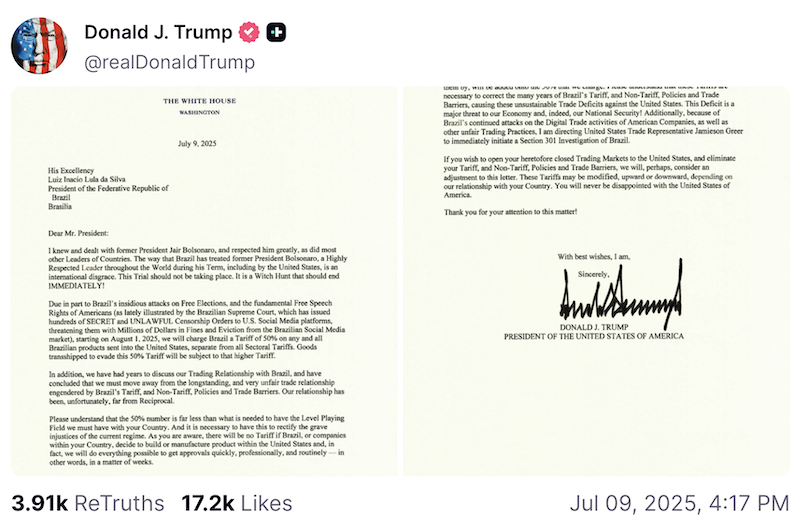
(Screengrab from Truth Social)
On July 30, Trump declared an emergency based in part on the Bolsonaro prosecution, triggering a 40% tariff, effective after a week.
Experts said Trump’s justifications ring hollow legally under the International Emergency Economic Powers Act. The Brazil policy isn’t at issue in the case being argued July 31, but it has already resulted in at least one lawsuit.
Experts told us they doubt that citing the Bolsonaro case as an emergency would survive judicial scrutiny. Bolsonaro sought unsuccessfully to hang on to power after Lula defeated him in 2022, which prompted years of investigations and charges that could land him in prison.
"I and many others would agree that the Bolsonaro trial — even if (it were) questionable, and it isn't — would not come close to meeting" the standard under the International Emergency Economic Powers Act, Gantz said.
Trump’s letter undercuts another key fact in the U.S.-Brazil trade relationship: The U.S. had a $6.8 billion trade surplus with Brazil in 2024, and surpluses in earlier years as well.
Certain U.S. sectors, such as social media and electronic payment networks, may have plausible gripes with Brazil over trade policy. Even so, Gantz said, "all of these grievances together seem to me insufficient for action under the International Emergency Economic Powers Act."
What happens next?
Most legal experts we talked to said the appeals court would have ample reason to follow the Court of International Trade’s lead in striking down Trump’s authority. "I am quite confident that the law doesn’t give a limitless grant of authority to the president simply by saying some magic words," said Julian Arato, a University of Michigan law professor.
But that result is no certainty — and ultimately, the U.S. Supreme Court will have the final say. The conservative-majority court should be a friendlier venue for the administration.
If the appeals court doesn't reverse the Court of International Trade’s ruling, "the Supreme Court will, in my opinion, likely do so," Gantz said.
And even if the Supreme Court were to rule against Trump, he could still impose tariffs under other laws.
He could use Section 301 of the 1974 Trade Act, which allows tariffs when the president determines that a foreign country "is unjustifiable and burdens or restricts United States commerce" through violations of trade agreements. This authority has been invoked dozens of times by various presidents.
Or he could use Section 232 of the 1962 Trade Expansion Act, which lets the president impose tariffs if national security is threatened; Trump and President Joe Biden used this as the basis for steel and aluminum tariffs imposed since 2018.
These more traditional mechanisms have been more battle-tested in court than the International Emergency Economic Powers Act, Gantz said, providing "a more persuasive legal basis for the tariffs."
UPDATED, July 30, 2025: This article has been updated to reflect Trump’s declaration of tariffs on Brazil, which occurred after the article’s initial publication.
Our Sources
Donald Trump, "Extending the Modification of the Reciprocal Tariff Rates," (executive order), July 7, 2025
U.S. Constitution, Article 1, Section 8
Justia, "V.O.S. Selections, Inc. v. Trump"
Donald Trump, letter to President da Silva, July 9, 2025
New York Times, "See Trump’s New Tariffs on Every Country," accessed July 29, 2025
New York Times, "E.U., Mexico, Brazil: Who Has Trump Targeted With New Tariffs?" accessed July 29, 2025
New York Times, "Trump Tariffs Ruled Illegal by Federal Judicial Panel," May 28, 2025
New York Times, "U.S.-Based Orange Juice Importer Sues Over Trump’s 50% Tariff on Brazilian Goods," July 21, 2025
American Enterprise Institute, "Amicus Brief in V.O.S. Selections, Inc. v. Trump," July 9, 2025
World Population Review, "US Trade Deficit by Country," accessed July 29, 2025
CNBC, "Trump’s trade deals and tariffs are on the chopping block in court. What happens next," July 26, 2025
CNBC, "Trump announces steep tariffs on 14 countries starting Aug. 1," July 7, 2025
CNBC, "Trump sends more letters dictating high tariff rates around the world," July 9, 2025
George Will, "This tariff court case could rein in the rampant Trump presidency" (Washington Post column), July 25, 2025
PolitiFact, "Can President-elect Donald Trump enact tariffs without Congress? And can anyone stop him?" Dec. 2, 2024
PolitiFact, "What is the Court of International Trade, which ruled against Trump’s tariffs?" May 29, 2025
Email interview with David A. Gantz, Rice University fellow in trade and international economics, July 28, 2025
Email interview with Ross Burkhart, Boise State University political scientist, July 29, 2025
Email interview with Meredith Kolsky Lewis, University at Buffalo law professor, July 29, 2025
Email interview with Kent Jones, Babson College economist, July 28, 2025
Interview with Julian Arato, University of Michigan law professor, July 28, 2025
Browse the Truth-O-Meter
More by Louis Jacobson