Get PolitiFact in your inbox.

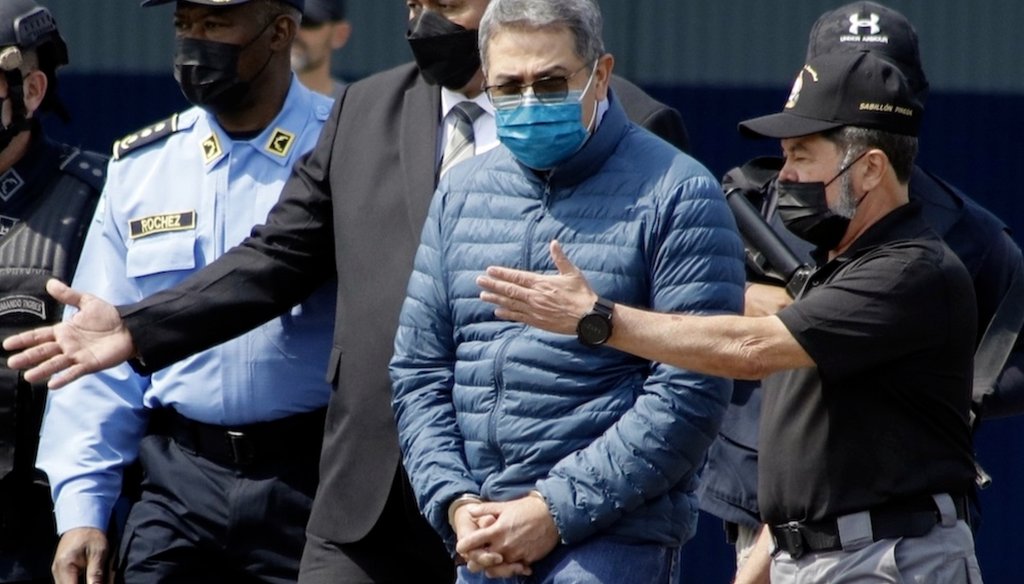
Former Honduran President Juan Orlando Hernandez in handcuffs as he is extradited to the United States on April 21, 2022. (AP)


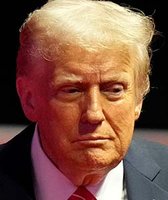
As the U.S. continued its military campaign against what the Trump administration calls "narco-terrorists" in the Caribbean, President Donald Trump announced he would pardon a former Honduran president notorious for his involvement in the U.S. drug trade.
Juan Orlando Hernández was sentenced in 2024 to 45 years prison after being convicted for conspiring to distribute over 400 tons of cocaine into the U.S.
During a Nov. 30 exchange with reporters aboard Air Force One, Trump said Hernández had been "set up" by former U.S. President Joe Biden’s administration. "If somebody sells drugs in that country, that doesn't mean you arrest the president and put him in jail for the rest of his life," Trump said, without providing evidence of a "set-up."
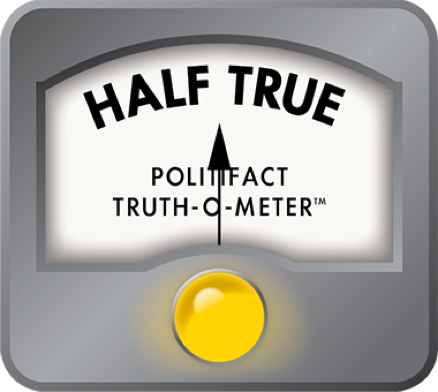
Trump inaccurately stated the nature of the former Honduran president’s arrest and conviction: The U.S. didn’t try Hernández after his presidency because he sold drugs in Honduras but because he was deeply involved in the transit of illicit drugs into the U.S.
The situation is rare but not without precedent.
The White House framed Trump’s planned pardon as an effort to correct a miscarriage of justice. At a Dec. 1 press briefing, White House Press Secretary Karoline Leavitt criticized Hernández’s three-week jury trial as being scant on evidence.
After his conviction, a judge denied Hernández’s motion for a new trial.
What was Hernández convicted of doing?
Hernández’s presidency ran January 2014 to January 2022, during which time he told U.S. officials he was working to combat drug trafficking. Trump praised his efforts in 2019.
In April 2022, the U.S. government indicted and extradited Hernández to the United States on drug- and weapons-trafficking charges. On June 26, 2024, District Judge P. Kevin Castel sentenced Hernández to 540 months in prison and 60 months of supervised release for cocaine importation and related weapons offenses.
The U.S. Justice Department said Hernández had financed his political career with drug trafficking proceeds and had used his presidential authority to traffic hundreds of tons of cocaine to the U.S.
At one point, the department said, Hernandez declared that he wanted to "stuff the drugs right up the noses of the gringos."
The prosecution included testimony from witnesses, including former traffickers. Documents presented in the case said Hernández facilitated the importation into the U.S. of more than 400 tons of cocaine — equivalent to about 4.5 billion doses — working with co-conspirators armed with machine guns, AR-15 rifles and grenade launchers.
The Honduran military and the police carried out orders from criminal groups, according to witnesses in Hernández’s trial.
U.S. prosecutors said Hernández ended up receiving millions of dollars of drug proceeds from some of the largest and most violent drug-trafficking organizations in Honduras, Mexico and other countries. He then used those bribes to fuel his rise in Honduran politics, which enabled him to protect his co-conspirators, prosecutors said.
Hernández’s brother, Juan Antonio Hernández Alvarado, a former member of the Honduran National Congress, received protection from the government under Hernández’s leadership. Hernández also received millions of dollars from "El Chapo," the former leader of the Sinaloa Cartel, Joaquín Guzman Loera, prosecutors said.
Why was the U.S. able to try a foreign head of government?
Trump said the U.S. singled out Hernández because he was the president of Honduras. It is unusual but not unprecedented for a foreign president to be prosecuted.
Under international law, a sitting head of state or head of government enjoys "complete immunity" from prosecution in the courts of another country, said Anthony Clark Arend, a Georgetown University professor of government and foreign service who specializes in international law.
However, the restrictions are looser for former heads of state. Hernández was weeks out of office at his U.S. extradition.
A former head of state or government is immune from another country’s prosecution if the prosecution is about actions carried out in their official capacity, Arend said. But the U.S. was able to prosecute Hernández because drug trafficking has historically not been considered an "official" duty.
Because he was facing drug-trafficking charges, "there would be no impediment under international law to trying him, a former president, for those charges," Arend said.
Hernández’s prosecution "seemed to have legitimacy both in the U.S. and in Honduras," said Daniel Sabet, a visiting fellow at the SNF Agora Institute at Johns Hopkins University who studies Central America. "Outside of his core supporters, the arrest was seen as legitimate."
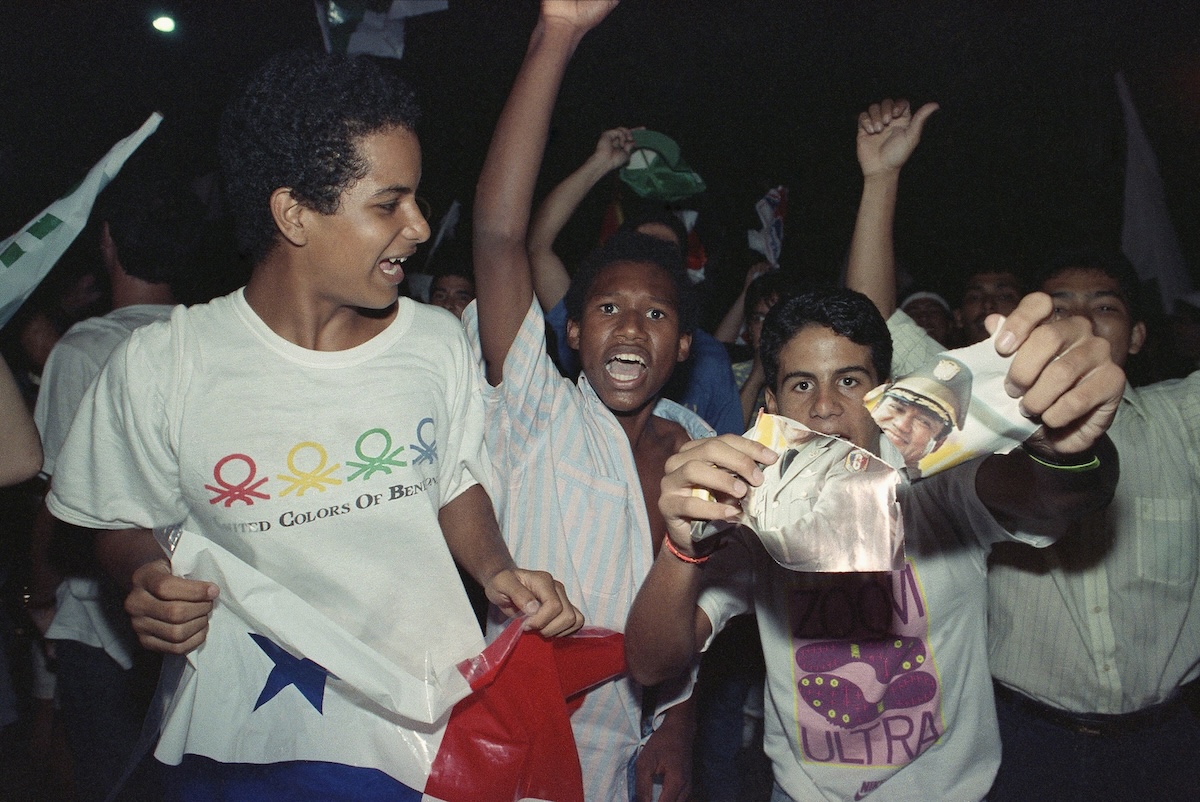
A Panamanian rips up a photo of Manuel Noriega during a street celebration on Jan. 4, 1990, in Panama City. (AP)
Such prosecutions are rare but not unprecedented, most notably the case of Manuel Noriega of Panama.
In 1989, President George H.W. Bush sent U.S. forces into Panama to seize Noriega, the country’s strongman, after his indictment by a U.S. grand jury on drug-related charges. (Noriega’s status as head of government was contested in Panama at the time, and his status was not recognized by the U.S.)
After turning himself in and being extradited to Florida, Noriega was tried and convicted on eight counts of drug trafficking, money laundering, and racketeering. He was sentenced to 40 years in prison. The prosecution was upheld by a three-judge appeals court panel in 1997, turning aside Noriega’s argument that his position as head of state should have preempted his prosecution.
Sabet also cited the case of a former Ukrainian prime minister, Pavel Lazarenko, who was arrested in the U.S. in 1999, charged with 53 counts of money laundering. He was convicted and sentenced to three years in federal prison.
PolitiFact Researcher Caryn Baird contributed to this report.
Our Sources
President Donald Trump’s Truth Social post, Nov. 28, 2025
RollCall, Press Gaggle: Donald Trump Speaks to Reporters on Board Air Force One - November 30, 2025, Nov. 30, 2025
Department of Justice, Juan Orlando Hernández, Former President of Honduras, Indicted on Drug-Trafficking and Firearms Charges, Extradited to the United States from Honduras, April 21, 2022
Department of Justice, Juan Orlando Hernández, Former President of Honduras, Sentenced to 45 Years in Prison for Conspiring to Distribute More Than 400 Tons of Cocaine and Related Firearms Offenses, June 26, 2024
The New York Times, Obama Presses Central American Leaders to Slow a Wave of Child Migrants, July 25, 2014
Trump White House, Remarks by President Trump at the Israeli American Council National Summit 2019, Dec. 7, 2019
CBS News, Transcript: Sen. Tim Kaine on "Face the Nation with Margaret Brennan," Nov. 30, 2025, Nov. 30, 2025
The New York Times, Ex-Honduras President Found Guilty in Drug Trafficking Trial, March 8, 2024
Insight Crime, Juan Orlando Hernández Sentenced to 45 Years in Prison for Drug Trafficking, June 26, 2024
Fox 5 Washington D.C., White House Press Briefing: December 1, 2025, Dec. 1, 2025
Library of Congress, "Manuel Noriega on Trial," accessed Dec. 1, 2025
SCOTUSBlog, "Former Ukrainian prime minister files appeal in two-decade saga over laundered funds," Feb. 3, 2023
Court Listener, UNITED STATES DISTRICT COURT SOUTHERN DISTRICT OF NEW YORK, UNITED STATES OF AMERICA, OPINION AND ORDER JUAN ORLANDO HERNANDEZ, May 9, 2024
United States Court of Appeals, Eleventh Circuit, United States v. Noriega (1997)
Email interview with Daniel Sabet, visiting fellow at the SNF Agora Institute at Johns Hopkins University, Dec. 1, 2025
Email interview with Anthony Clark Arend, Georgetown University professor of government and foreign service, Dec. 1, 2025