Stand up for the facts!
Our only agenda is to publish the truth so you can be an informed participant in democracy.
We need your help.
I would like to contribute

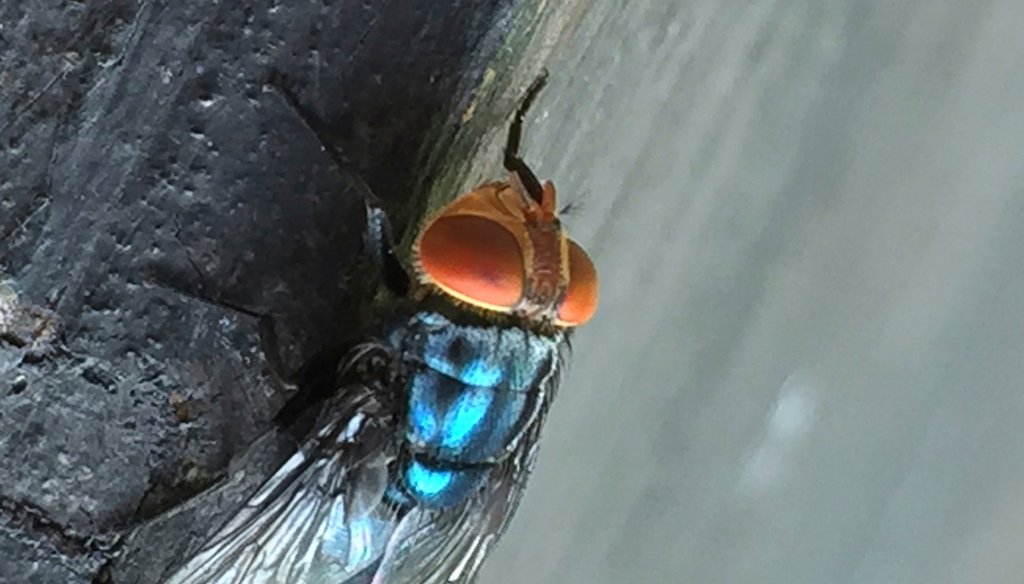
An adult New World screwworm fly sits at rest in this undated photo. (AP)

If Your Time is short
-
Screwworms are flesh-eating parasites that hatch in open wounds and burrow into skin. Left untreated, they can be deadly. The majority of cases are in livestock.
-
A Maryland resident who traveled from El Salvador was recently treated for an infection in the U.S., where screwworm has been eradicated. Officials say risk to overall public health is low as there were no signs of transmission to any person or animal in the U.S.
-
Screwworms were previously eradicated from Central and North America but since a new outbreak in 2023, cases have been reported farther and farther north, including near the U.S.-Mexico border.
A deadly flesh-eating parasitic larva was just found in a human in the U.S. Is that cause for panic?
Probably not. State and federal health officials say that the public health risk from this travel-related case is low. The nasty bugger known as the screwworm has been largely eradicated in the U.S. since the 1960s, and human cases aren’t common. Even in places where screwworms are more prevalent, they mostly infect livestock.
But an outbreak in Central America and Mexico, where they were previously eradicated, has prompted the U.S. Department of Agriculture and Texas officials to take precautions in case of an incursion across the U.S. southern border. Luckily, scientists have well-developed methods of containment and eradication.
Here’s what you should know about the New World screwworm.
Fair warning: This gets unpleasantly graphic.
What is a screwworm?
The adult screwworm is actually a fly, but it’s most dangerous in its larval stage. Flies lay their eggs in the fresh wounds or orifices of warm-blooded animals — it mostly affects livestock but can happen in pets or humans.
A wound as small as a tickbite can attract an adult female fly, which can lay 200 to 300 eggs at a time.
When the eggs hatch after a day or so, the larvae burrow into the skin like a screw (giving it its name) and begin to eat the flesh. Existing infections will often attract more flies to lay eggs, causing the infections to grow. After five to seven days, mature larvae will fall off and burrow into the ground to finish growing into flies. Left untreated, the worms can seriously damage tissue and even result in death.
An Iowa State’s Center for Food Security and Public Health fact sheet sheds light on more details about the squirmy worms that could be hard to read.
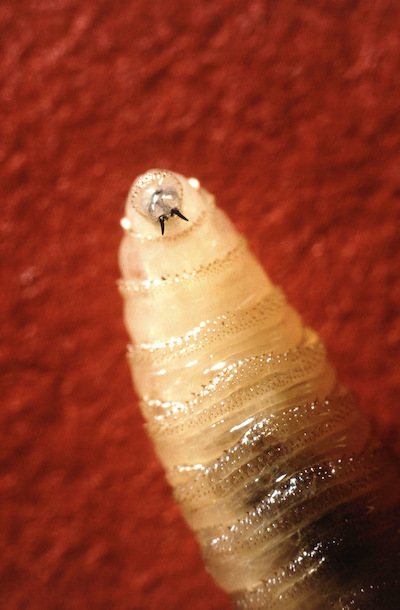
A New World screwworm larvae sits at rest in this undated photo. (USDA Agricultural Research Service via AP)
How did it get here and who is at risk?
The Centers for Disease Control and Prevention confirmed Aug. 4 that a Maryland resident who had recently returned from El Salvador was treated for screwworm, according to Health and Human Services spokesperson Andrew Nixon.
Maryland Department of Health spokesperson David McCallister told PolitiFact that the patient had recovered and "the investigation confirmed there is no indication of transmission to any other individuals or animals."
An Aug. 26 Health and Human Services Department press release stated that the USDA "initiated targeted surveillance" for the New World screwworm within a 20-mile radius around the "affected area" including parts of Maryland, D.C., and Virginia. "To date, all trap results have been negative" for screwworm, the release stated.
The infestation comes from insects, not other people, so it is not infectious like a virus or bacteria. The worms in the infection would have to mature, fall off, mate and lay more eggs in order to infect someone else.
Nixon said that the risk to U.S. public health from this case was "very low."
Screwworms don’t differentiate between humans and other mammals, although human infections are rare. "We are a source of a wound, and that's where they're going to drop their eggs," said Phillip Kaufman, a Texas A&M University entomology professor.
Since an outbreak was declared in Central America in July 2023, the Commission for the Eradication and Prevention of Screwworm said it tracked more than 49,500 cases as of July 12. The Commission’s breakdown of infections by species said that 161 cases were in humans. The vast majority, 85%, were in bovines including cattle, bison and water buffalo, with most of the rest of the cases in other non-human animals.
The flies are mostly found in South America and the Caribbean, but since the 2023 outbreak, health officials have identified more cases in Central America and Mexico. According to the CDC, people traveling to regions where the flies are present are most at risk if they have open wounds, sleep outside or are around livestock. Covering up wounds can help prevent infection.
Anyone who believes they may be infected should seek medical attention immediately. Kaufman also advised keeping an eye on pets. If they are licking the same spot repeatedly or behaving strangely, make sure there are no wounds infected with larvae.
U.S. and state officials are working to address outbreak in Central America and Mexico
If this is the first time you are hearing about screwworm, that’s largely because U.S. and Central American countries have worked together for decades to create a biological barrier in Panama’s Darién Gap and prevent the flies’ northward incursion. The effort involved releasing sterilized flies into the environment that mate but do not produce eggs.
That work led to screwworms being largely eliminated in the region, with the exception of small outbreaks and travel-related cases.
In 2023, Panama declared an outbreak. The outbreak continued moving northward as new cases emerged over the next two years in Central American countries. In 2024 cases were confirmed in Mexico, and in July a case was identified as close as 370 miles from the U.S. border.
As a result, sterile flies have been released in Mexico to curb the spread. In May, the USDA suspended imports of live cattle, horse and bison along the southern border. In June, the USDA announced an initiative to prevent a U.S. infestation including a $8.5 million sterile insect dispersal facility at an inactive air base in Texas.
"The state agencies and the federal agencies are preparing and have response plans ready to go, should something happen," Kaufman said. "It is certainly a solvable problem. We are not without answers."
Our Sources
Email statement from Andrew Nixon, spokesperson for the U.S. Department of Health and Human Services, Aug. 25, 2025
Interview with Phillip Kaufman, professor of Entomology at Texas A&M, Aug. 25, 2025
Email statement from David McCallister, spokesperson for the Maryland Department of Health, Aug. 25, 2025
HHS press release, "HHS and USDA Confirm Singular Traveler-Associated New World Screwworm Case," Aug. 26. 2025
Commission for the Eradication and Prevention of Screwworm, "Homepage," accessed Aug. 25, 2025
USDA Animal and Plant Health Inspection Service, "New World Screwworm," Aug. 25, 2025
USDA Animal and Plant Health Inspection Service, "APHIS To Hold Listening Sessions on New World Screwworm Technologies and Tools," June 23, 2025
USDA Animal and Plant Health Inspection Service, "Secretary Rollins Announces Bold Plan to Combat New World Screwworm’s Northward Spread," June 18, 2025
USDA Animal and Plant Health Inspection Service, "Secretary Rollins Suspends Live Animal Imports Through Ports of Entry Along Southern Border, Effective Immediately," May 11, 2025
USDA Animal and Plant Health Inspection Service, "Secretary Rollins Takes Decisive Action and Shuts Down U.S. Southern Border Ports to Livestock Trade Due to Further Northward Spread of New World Screwworm in Mexico," July 9, 2025
USDA Animal and Plant Health Inspection Service, "Update on USDA Efforts to Fight New World Screwworm in Mexico," May 27, 2025
USDA Animal and Plant Health Inspection Service, "USDA Announces the Phased Reopening of Southern Ports for Livestock Trade," June 30, 2025
USDA Animal and Plant Health Inspection Service, "USDA Announces Sweeping Plans to Protect the United States from New World Screwworm," Aug. 15, 2025
USDA Animal and Plant Health Inspection Service, "NWS Economic Impact Report," Jan. 2025
CBS News, "First human screwworm case linked to travel confirmed in U.S., HHS says," Aug. 25, 2025
CBS News, "Texas officials warn of "maneater" screwworm that burrows into open wounds, eyes and mouths to lay eggs," Jan. 6, 2025
CBS News, "U.S. plans to combat spread of "man-eater" screwworms with $8.5M facility of flies in Texas," June 18, 2025
Centers for Disease Control and Prevention, "About Myiasis," Sept. 13, 2024
Centers for Disease Control and Prevention, "About New World Screwworm Myiasis," Sept. 13, 2024
The Center for Food Security and Public Health, "Myiasis Caused by Old and New World Screwworms," Jan. 2025
NPR, "U.S. confirms its first human case of New World screwworm," Aug. 25, 2025
Reuters, "Exclusive: U.S. confirms nation's first travel-associated human screwworm case connected to Central American outbreak," Aug. 25, 2025
USA Today, "How dangerous is the New World Screwworm? In rare cases, its maggots will eat your flesh," May 13, 2025
U.S. Department of Agriculture, "Secretary Rollins Announces Bold Plan to Combat New World Screwworm’s Northward Spread," June 18, 2025
U.S. Department of Agriculture, "USDA Announces Sweeping Plans to Protect the United States from New World Screwworm," Aug. 15, 2025
U.S. Department of Agriculture, "New World Screwworm Domestic Readiness and Response Policy Initiative," June 18, 2025
The Washington Post, "Rare human screwworm case confirmed in Maryland," Aug. 25, 2025
World Organization for Animal Health, "New World screwworm continues to spread: WOAH calls for strong collaboration across livestock sectors and borders," Aug. 22, 2025
Commission for the Eradication and Prevention of Screwworm, "History," accessed Aug. 26, 2025
Ministerio de Desarrollo Agropecuario, "Declaran Estado de Emergencia zoosanitaria para control de Gusano Barrenador del Ganado," July 5, 2023
Browse the Truth-O-Meter
More by Grace Abels