
“Evidence suggests that 1 in 25 women who consume (abortion) pills are hospitalized.”


Our only agenda is to publish the truth so you can be an informed participant in democracy.
We need your help.

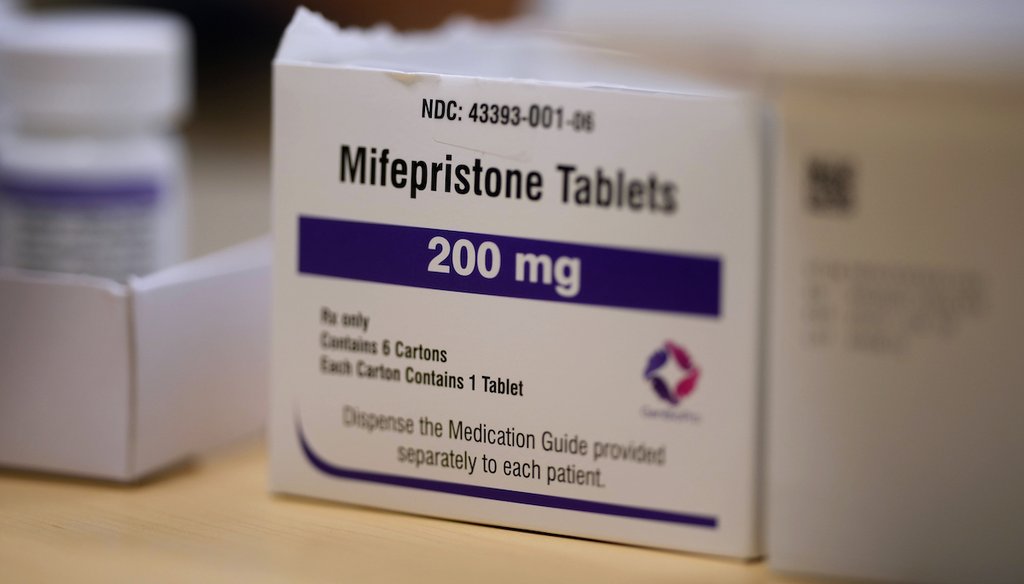
Mifepristone tablets are seen in a Planned Parenthood clinic on July 18, 2024. (AP)

Florida Attorney General James Uthmeier cited two studies listed on the U.S. Food and Drug Administration’s label for mifepristone, the first of two pills taken in early pregnancy for medication abortion.
Uthmeier conflated hospitalizations and ER visits. About 41 women of 1,043 included in the studies — roughly 1 in 25 women — visited the ER after taking abortion pills. ER visits are not proof that patients experienced serious adverse events or were hospitalized.
Eight of the 41 women were hospitalized, five related to abortion pills and three for unrelated reasons. That translates to 1 in 200 women being admitted to the hospital for reasons related to abortion pills.
Florida Attorney General James Uthmeier is suing Planned Parenthood for what he called deceptive marketing practices involving abortion pills.
In a Nov. 6 video on X, Uthmeier said Planned Parenthood "falsely marketed to women" that abortion pills are safer than over-the-counter medications.
"Evidence suggests that 1 in 25 women who consume these dangerous pills are hospitalized," Uthmeier said. "And we’ve seen dozens of reported deaths. This is wrong, and we’re going to hold them accountable."
Although Uthmeier used the word "hospitalized" to describe the outcome, text that appeared on screen in the video as he spoke said 1 in 25 women "end up in the ER," a figure that combines results from two studies Uthmeier cited. Emergency department visits are not the same as hospitalizations, which involve patients being formally admitted.
When contacted for evidence, Uthmeier’s spokesperson pointed PolitiFact to a table in the U.S. Food and Drug Administration’s label for mifepristone, the first of two pills taken in early pregnancy for medication abortion. One line in the table said two U.S. studies with 1,043 women found a 2.9% to 4.6% frequency rate for ER visits. The higher end of the range roughly correlates to 1 in 25 women.
Besides conflating hospitalizations and ER visits, Uthmeier cited studies with small sample sizes; multiple larger studies found lower rates of both ER visits and hospitalizations following medication abortion. Researchers told PolitiFact emergency department visits are not a reliable indicator of drug safety and are not proof that patients experienced serious adverse events or were admitted to the hospital.
"In large studies of medication abortion, hospitalization is very rare, generally occurring in <0.5% of patients," Dr. Daniel Grossman, a professor of obstetrics, gynecology and reproductive sciences at the University of California, San Francisco, wrote in an email to PolitiFact. Grossman said ER visits are more common because patients who do not live near their provider might have to go to an emergency department for anything that requires in-person consultation, including to confirm an abortion was successful.
The FDA label that Uthmeier cited also showed hospitalization rates of 0.04% to 0.06% among 14,339 women evaluated in three studies, or about 86 women on the higher end of the range.
The FDA label does not include the research methodology or details about the cases. The FDA didn’t answer our questions about the studies.
Danco Laboratories, which manufactures and distributes mifepristone under the brand name Mifeprex, provided the studies to PolitiFact. The two reports showed 41 women out of 1,043 visited the ER after taking abortion pills. Eight of the 41 were hospitalized and, of those, three were admitted for unrelated reasons, including pancreatitis and hip pain. That means five out of 1,043 women evaluated were hospitalized for reasons related to abortion pills.
"The actual percentage of related serious adverse events that required hospital admission in these two studies was 0.5%," said Ushma Upadhyay, a professor and public health scientist at the University of California, San Francisco.
Medication abortion is approved in the U.S. up to the 10th week of pregnancy and involves two medicines — mifepristone and misoprostol — that are typically taken 24 hours apart. Studies have found that around 95% to 98% of patients who take the medicines as prescribed will end their pregnancies without complication.
The FDA has repeatedly reaffirmed mifepristone’s safety since the drug was first approved in 2000. (Misoprostol has been on the market longer and has different uses, including preventing stomach ulcers.)
Medication abortions are common, accounting for 63% of all abortions in the U.S. in 2023, according to the Guttmacher Institute, a research organization that supports reproductive rights. More than 5 million women in the U.S. have used abortion pills to terminate pregnancies.
Over 100 studies spanning decades have found medication abortion to be safe and effective.
"We've been using mifepristone in the U.S. for over two decades and we aren't seeing legitimate studies that are documenting any medical fallout or medical complications from this drug," said Rachel Jones, Guttmacher Institute principal research scientist.
Research shows abortion pills are not associated with a high percentage of emergency room visits or hospitalizations.
The studies Uthmeier pointed to did not prove that medication abortion is dangerous, experts said
One of the studies, published in 2012, acknowledged that major adverse events attributable to medication abortion, such as hospitalizations, emergency department visits and blood transfusions, are "rare."
The vast majority of mifepristone research is in line with this.
A 2013 study that examined 233,805 medication abortions by Planned Parenthood in 2009 and 2010 found an emergency department treatment rate of 0.1%, and said significant adverse events requiring hospital admission occurred in 0.16% of cases.
A 2015 study on emergency room visits and complications after 55,000 abortions — 11,000 of which were medication abortions — found that serious adverse events occurred in 0.3% of all cases.
Emergency department visits alone are not indicative of adverse events, Upadhyay, the 2015 study’s lead author, told PolitiFact.
A 2018 study found around 51% of abortion-related ER visits involved observational care only. "This really shows that people go to the emergency department to have their questions answered. They aren’t getting any treatment. They are being observed and released," Upadhyay said.
U.S. Health and Human Services Secretary Robert F. Kennedy Jr. and FDA Commissioner Dr. Marty Makary have promised to launch another mifepristone safety review. The top health officials have referenced studies that experts say have several problems.
For example, one April report by the Ethics and Public Policy Center, a conservative nonprofit that opposes abortion, found a substantially higher rate of serious side effects from the drug compared with other studies.
The report wasn’t peer-reviewed or published in a medical journal. It didn’t disclose its data source and contained multiple methodological issues, 263 reproductive health researchers wrote in a letter to the FDA. Uthmeier cites the report in Florida’s lawsuit against Planned Parenthood.
Uthmeier said, "Evidence suggests that 1 in 25 women who consume (abortion) pills are hospitalized."
Uthmeier conflated hospitalizations with emergency department visits. Roughly 1 in 25 women visited the ER in the two studies Uthmeier cited, but only five out of 1,043 — or 1 in 200 — were hospitalized related to the abortion pill.
ER visits, which can often involve only observational care followed by release, are not a reliable indicator of drug safety, researchers said, and do not mean patients experienced a serious adverse event or were admitted to the hospital.
Several other studies found lower rates of ER treatment and hospitalizations following medication abortion.
Uthmeier’s statement contains an element of truth but ignores critical facts that would give a different impression. We rate it Mostly False.
PolitiFact Researcher Caryn Baird contributed to this report.
X.com, James Uthmeier post, Nov. 6, 2025
MyFloridaLegal.com, Attorney General James Uthmeier Brings Lawsuit Against Planned Parenthood for Deceptive Marketing Practices, Nov. 6, 2025
MyFloridaLegal.com, State of Florida lawsuit, Filed Nov. 6, 2025
U.S. Food and Drug Administration, NDA 020687, Accessed Nov. 10, 2025
U.S. Food and Drug Administration, Label for MIFEPREX® (mifepristone) tablets, for oral use, revised March 2023
FactCheck.org, Trump Officials Cite Dubious Estimates of Medication Abortion Harms, Nov. 7, 2025
PolitiFact, Do 1 in 5 women suffer complications from abortion pills? No. Group suing FDA shares flawed data, April 13, 2023
PolitiFact, An anti-abortion group claimed 28 deaths were linked to mifepristone. Here’s why that’s flawed, April 26, 2023
PubMed, Two distinct oral routes of misoprostol in mifepristone medical abortion: a randomized controlled trial, December 2008
PubMed, Extending outpatient medical abortion services through 70 days of gestational age, November 2012
PubMed, Efficacy and safety of medical abortion using mifepristone and buccal misoprostol through 63 days, April 2015
Guttmacher Institute, Medication Abortion Accounted for 63% of All US Abortions in 2023—An Increase from 53% in 2020, March 2024
Wired, The Real Reason Some Abortion Pill Patients Go to the ER, March 28, 2024
ABC News, RFK Jr. launches FDA review of abortion pill, Sept. 24, 2025
American College of Obstetricians and Gynecologists, Mifepristone in the Courts, July 24, 2024
KFF, Flawed Report Aims to Undercut Established Research on Abortion Pill Safety, June 12, 2025
Guttmacher Institute, The Misinformation Campaign Trying to Bring Down Abortion Pills, June 2025
Guttmacher Institute, The War on Mifepristone: How Junk Science and False Narratives Threaten US Abortion Access, October 2025
The New York Times, Are Abortion Pills Safe? Here’s the Evidence, Updated March 25, 2024
PubMed, Significant Adverse Events and Outcomes After Medical Abortion, January 2013
Obstetrics & Gynecology, Incidence of Emergency Department Visits and Complications After Abortion, January 2015
Obstetrics & Gynecology, Distance Traveled for an Abortion and Source of Care After Abortion, September 2017
BMC Medical, Abortion-related emergency department visits in the United States: An analysis of a national emergency department sample, June 2018
X.com, Josh Hawley post, June 2, 2025
X.com, RFK Jr. post, Oct. 2, 2025
Ethics and Public Policy Center, The Abortion Pill Harms Women: Insurance Data Reveals One in Ten Patients Experiences a Serious Adverse Event, April 28, 2025
Reproductive Health Researchers’ Comment, Aug. 27, 2025
The Washington Post, Digging into the math of a study attacking the safety of the abortion pill, May 12, 2025
Email interview, Florida Attorney General James Uthmeier press office, Nov. 10, 2025
Phone interview, Dr. Caleb Alexander, epidemiology professor at the Johns Hopkins Bloomberg School of Public Health, co-director of the Center for Drug Safety and Effectiveness, Nov. 11, 2025
Phone interview, Rachel Jones, principal research scientist at the Guttmacher Institute, Nov. 11, 2025
Email interview, Dr. Daniel Grossman, professor of obstetrics, gynecology and reproductive sciences at the University of California-San Francisco, Nov. 12, 2025
Email interview, Danco Laboratories press office, Nov. 12-13, 2025
Phone and email interview, Ushma Upadhyay, professor and public health scientist at the University of California-San Francisco, Nov. 12-13, 2025














In a world of wild talk and fake news, help us stand up for the facts.