
“The White House just announced that Trump only has four days left” because of his chronic venous insufficiency.



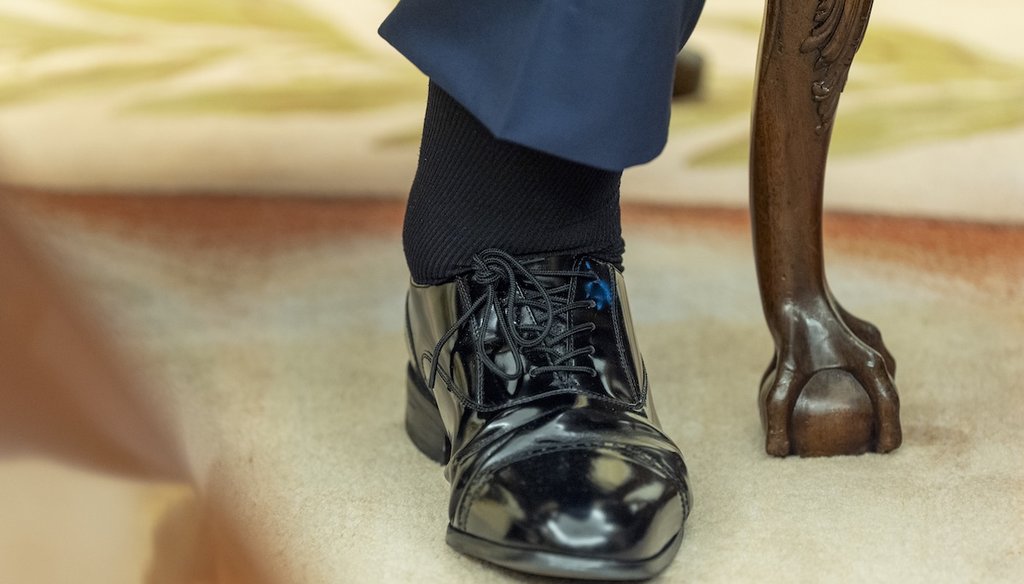
The left foot and swollen ankle of President Donald Trump are pictured as he sits with Bahrain's Crown Prince Salman bin Hamad Al Khalifa in the Oval Office of the White House, July 16, 2025, in Washington. (AP)

On July 17, the White House announced Trump has a chronic venous insufficiency, which can cause leg swelling.
Experts say the condition is common in older patients and not typically life-threatening, so there’s no reason to think someone with this diagnosis alone has only days left to live.
In announcing Trump’s condition, White House Press Secretary Karoline Leavitt said, "The president remains in excellent health."
The White House said that President Donald Trump has a common vein condition. Some TikTokkers apparently heard something more dire.
"The White House just announced that Trump only has four days left," one narrator said in a July 19 TikTok. "Trump’s cancer is getting worse — people are posting these pictures of his ankles. Swollen ankles is the symptom of chronic venous insufficiency."
The TikTok included a screenshot of a CNN chyron about the White House’s July 17 announcement of Trump’s diagnosis: chronic venous insufficiency. The TikTok user described swelling in Trump’s legs as "whatever," but characterized the overall condition as "pretty bad."
Other TikTok users posted news clips about the White House announcement and included text that read, "Donald Trump has 4 days left."
We weren't sure when to start the clock with some of these TikTok warnings — four days from White House Press Secretary Karoline Leavitt's news conference, or four days from the various days the videos appeared on social media?
It doesn't matter either way, medical experts said. The dire warnings about Trump's health were not premised in facts about chronic venous insufficiency.

(Screenshot from TikTok)
Leavitt’s announcement about Trump’s condition followed speculation about the cause of Trump’s swollen legs and bruising on his hand.
Chronic venous insufficiency occurs when the valves inside a person’s veins don’t work properly, making it difficult for blood to flow back to the heart. Most often, chronic venous insufficiency affects leg veins and can cause blood to pool in a person’s legs, but it can sometimes affect arms.
After Trump, 79, noticed some mild swelling in his lower legs, the president’s medical team conducted a comprehensive exam complete with diagnostic vascular studies, Leavitt said.
The medical team performed ultrasounds on Trump’s lower legs and found chronic venous insufficiency, which Leavitt described as "a benign and common condition, particularly in individuals over the age of 70."
Medical professionals largely agreed with the description the White House provided of the condition.
Dr. Andrea Obi, a vascular surgeon at the University of Michigan Health’s Frankel Cardiovascular Center and an associate professor of vascular surgery at University of Michigan Medical School, told PolitiFact that chronic venous insufficiency is typically considered a benign — or not significantly harmful — condition.
It’s not typically screened for, so it’s hard to gauge its exact prevalence in the U.S., but some estimates say that roughly 37% of adults have chronic venous insufficiency, "with lower rates found in younger patients, and higher rates found in older patients," Obi said.
She said that chronic venous insufficiency "can very slightly elevate" a person’s risk for deep vein thrombosis, or DVT, a condition where a blood clot forms in deep veins, "but many other risk factors also increase DVT risk to a much greater extent."
Vascular surgeon Dr. Mimmie Kwong told UC Davis Health News the most common symptom of this condition is swelling in the legs.
Dr. Jeremy Faust, an emergency physician, told CNN that Trump’s diagnosis wasn’t surprising or alarming.
"The president is an older man," Faust said. "This is a pretty normal part of aging." It’s also common for people categorized as overweight, such as Trump, he said.
When someone is diagnosed with chronic venous insufficiency, Faust said it’s important to evaluate the patient for other, more serious conditions.
According to a memorandum the White House released from the president’s doctor, Trump’s blood work came back "within normal limits."
The memorandum said the White House medical team found "no evidence" of deep vein thrombosis, arterial disease, heart failure, renal impairment or systemic illness. And an echocardiogram "confirmed normal cardiac structure and function," it said.
The president’s physician, Dr. Sean P. Barbabella, attributed the bruising on Trump’s hand to "frequent handshaking" combined with the use of aspirin as part of his "standard cardiovascular prevention regimen," the memo said.
"The president remains in excellent health," Leavitt said during the July 17 press briefing.
Obi told PolitiFact that on its own, chronic venous insufficiency generally "is not life-threatening."
The Cleveland Clinic’s primer similarly said the condition "usually isn’t life-threatening" but can cause discomfort or pain.
We searched the Nexis news database and the administration’s collection of presidential briefings and statements and found no evidence that the White House announced Trump had four days left to live before or after the TikToks were shared.
"There is no reason to think that someone diagnosed with chronic venous insufficiency has a short period of time left to live," Obi said. Symptoms can range from nonexistent to painful varicose veins, swelling or, in severe cases, open skin sores, she said.
"None of these disease manifestations have been linked to mortality risk," Obi said.
The White House declined on-the-record comment.
A person on TikTok said, "The White House just announced that Trump only has four days left," and cited his recent diagnosis of chronic venous insufficiency.
On July 17, the White House announced Trump has a chronic condition that can cause leg swelling. Experts say it is common in older patients and not typically life-threatening.
On the fourth day since the White House released news about Trump’s vein condition, he is very much alive.
We rate this TikTok claim Pants on Fire!
TikTok post, July 19, 2025
TikTok post, July 20, 2025
Email interview with Dr. Andrea Obi, a vascular surgeon at the University of Michigan Health Frankel Cardiovascular Center and an associate professor of vascular surgery at University of Michigan Medical School, July 21, 2025
The White House on YouTube, Press Secretary Karoline Leavitt Briefs Members of the Media, July 17, 2025
The White House, Memorandum From The Physician To The President, July 17, 2025
CNN, Trump diagnosed with chronic venous insufficiency following leg swelling, July 17, 2025
CNN’s YouTube channel, Trump diagnosed with chronic venous insufficiency following leg swelling, July 17, 2025
Society for Vascular Surgery — Vascular.org, Chronic Venous Insufficiency, accessed July 21, 2025
Cleveland Clinic, Chronic Venous Insufficiency (CVI), accessed July 21, 2025
Johns Hopkins Medicine, Chronic Venous Insufficiency, accessed July 21, 2025
Penn Medicine, Chronic venous insufficiency, accessed July 21, 2025
Mayo Clinic, Deep vein thrombosis (DVT), accessed July 21, 2025
Cleveland Clinic, Deep Vein Thrombosis (DVT), accessed July 21, 2025
BBC, What is Trump's vein condition and how serious is it? July 18, 2025
The Associated Press, Here’s what to know about chronic venous insufficiency, July 17, 2025
The White House, Briefings & Statements, accessed July 21, 2025
Huffpost, The White House Says Trump Has Been Diagnosed With Chronic Venous Insufficiency. Here's What That Means, July 18, 2025
UCLA Health, CVI not life-threatening, can cause complications, April 5, 2021
UC Davis Health News, President Trump diagnosed with chronic venous insufficiency: What it means, July 18, 2025
Johns Hopkins, Venous Ulcers, accessed July 21, 2025
















In a world of wild talk and fake news, help us stand up for the facts.