
The Rainmaker Technology Corp.’s cloud seeding caused the July 4 flooding in Texas.

Our only agenda is to publish the truth so you can be an informed participant in democracy.
We need your help.

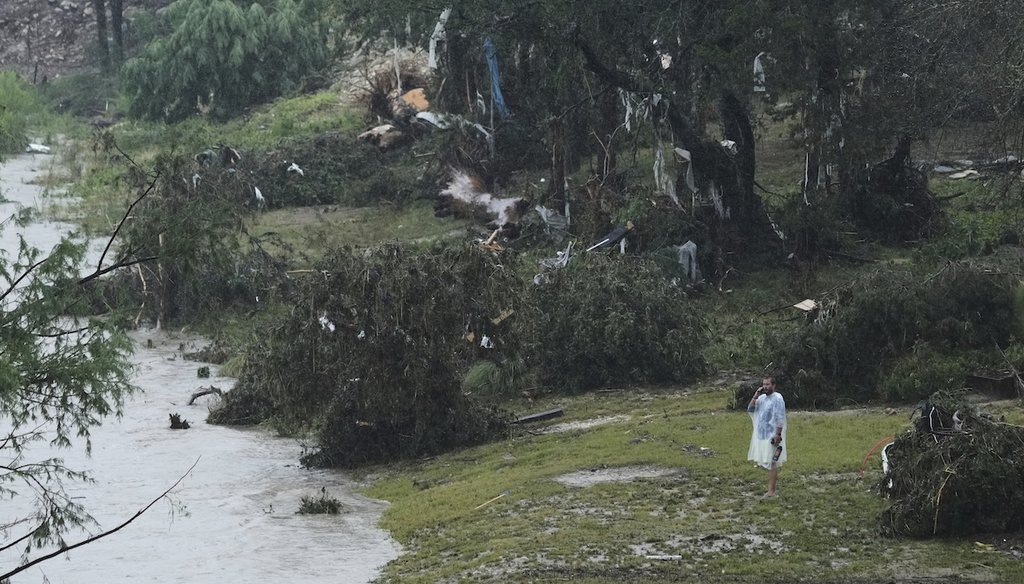
A man surveys damage left by a raging Guadalupe River, Friday, July 4, 2025, in Kerrville, Texas. (AP)

The remnants of Tropical Storm Barry dropping intense rain on a flood-prone region caused the deadly flood in Texas, meteorologists said.
Cloud seeding, the process of introducing particles into a cloud to increase precipitation, could not have caused the disaster because the process increases precipitation only by a small amount, they said.
Rainmaker Technology Corp.’s last cloud seeding efforts were July 2 and the two clouds seeded dissipated between 3 p.m. and 4 p.m. Central Time that same day, more than 24 hours before the storm that caused deadly flooding.
As the toll of disastrous flash flooding in central Texas became clear, some social media users said the devastating flooding couldn’t have happened naturally.
Social media users pushed their blame for the storm, which killed more than 100 people, on a practice called cloud seeding and a company called Rainmaker Technology Corp.
Cloud seeding is a weather modification approach that involves introducing dust or aerosol particles into clouds in the atmosphere to trigger additional precipitation. Cloud seeding is commonly used to increase precipitation, and it is employed in Texas as a rain-enhancement method.
On X, Rep. Marjorie Taylor Greene, R-Ga., said she would introduce legislation mirroring a 2025 Florida law to prohibit people from releasing substances into the atmosphere "for the express purpose of altering weather, temperature, climate, or sunlight intensity."
Many online users quickly made the leap to a recent cloud-seeding event and the storms.
Another July 5 X post posted screenshots of a National Oceanic and Atmospheric Administration document showing that Rainmaker Technology Corp. was engaged in "rain enhancement" in Texas, with the user saying it was "DIRECTLY over the FLOODED AREAS."
The narrative spread on Facebook and Instagram. President Donald Trump’s former national security adviser Lt. Gen. Michael Flynn asked Rainmaker to respond.
Rainmaker CEO Augustus Doricko replied in an X thread that the company "did not operate in the affected area on the 3rd or 4th or contribute to the floods that occurred over the region." Rainmaker Technology Corp. had last seeded clouds on July 2, more than 24 hours before the storm that caused the flooding, he said.
Greene’s proposed legislation and related social media posts reflect longstanding conspiracy theories that weather modification technology has created disasters, such as hurricanes. The theories overstate the capabilities of existing weather modification efforts and overlook the atmospheric and geological conditions in Texas that caused the intense, deadly flooding.
Doricko said that his company had seeded clouds in south central Texas on July 2, but those clouds didn’t contribute to the downpour July 4.
"The last seeding mission prior to the July 4th event was during the early afternoon of July 2nd, when a brief cloud seeding mission was flown over the eastern portions of south-central Texas, and two clouds were seeded," he wrote on X.
Those clouds dissipated between 3 p.m. and 4 p.m. Central Time, Doricko said. He added that natural clouds typically last 30 minutes to a few hours, and it’s rare for even persistent storm systems to maintain the same cloud structure for more than 12 to 18 hours.
"The clouds that were seeded on July 2nd dissipated over 24 hours prior to the developing storm complex that would produce the flooding rainfall," Doricko said.
Did Rainmaker conduct any operations that could have impacted the floods? No.
— Augustus Doricko (@ADoricko) July 5, 2025
The last seeding mission prior to the July 4th event was during the early afternoon of July 2nd, when a brief cloud seeding mission was flown over the eastern portions of south-central Texas, and two…
In the early morning hours of July 4, the National Weather Service Austin issued flash flood warnings, before the warnings were upgraded to a rare flash flood emergency alert at around 4 a.m. Between 4 and 7 a.m., the Guadalupe River surged.
Federal law requires anyone with plans to modify the weather using methods such as cloud seeding technology to report their plans to the National Oceanic and Atmospheric Administration administrator at least 10 days before any activity. NOAA’s website says reports are typically available about two months after the end of the fiscal quarter. (The current fiscal quarter began July 1.)
We contacted NOAA about weather modification activities reported in Texas starting July 1 and received no response.
Travis Herzog, a Houston-based meteorologist, said in a July 6 Facebook post that the primary cause of the deadly flood was remaining moisture from what was once Tropical Storm Barry — not cloud seeding.
"Cloud seeding cannot create a storm of this magnitude or size," Herzog said. "In fact, cloud seeding cannot even create a single cloud. All it can do is take an existing cloud and enhance the rainfall by up to 20%. Most estimates have the rainfall enhancement in a much lower range."
He said he knew of no active cloud seeding operations on July 3, but "it is physically impossible for that to have created this weather system."
Matt Lanza, a Houston-based meteorologist and editor of the extreme weather website The Eyewall, said there is no reason to think weather modification or cloud seeding played a role in the tragedy.
Cloud seeding is "typically only done in desert regions where even a few tenths of an inch more of water is highly beneficial," Lanza said. "It’s just not a possibility due to the laws of physics and atmospheric chemistry."
Uma Bhatt, a University of Alaska Fairbanks atmospheric science professor, said she thought it was unlikely cloud seeding could have caused the Texas rainfall because the storm was "so energetic and large scale."
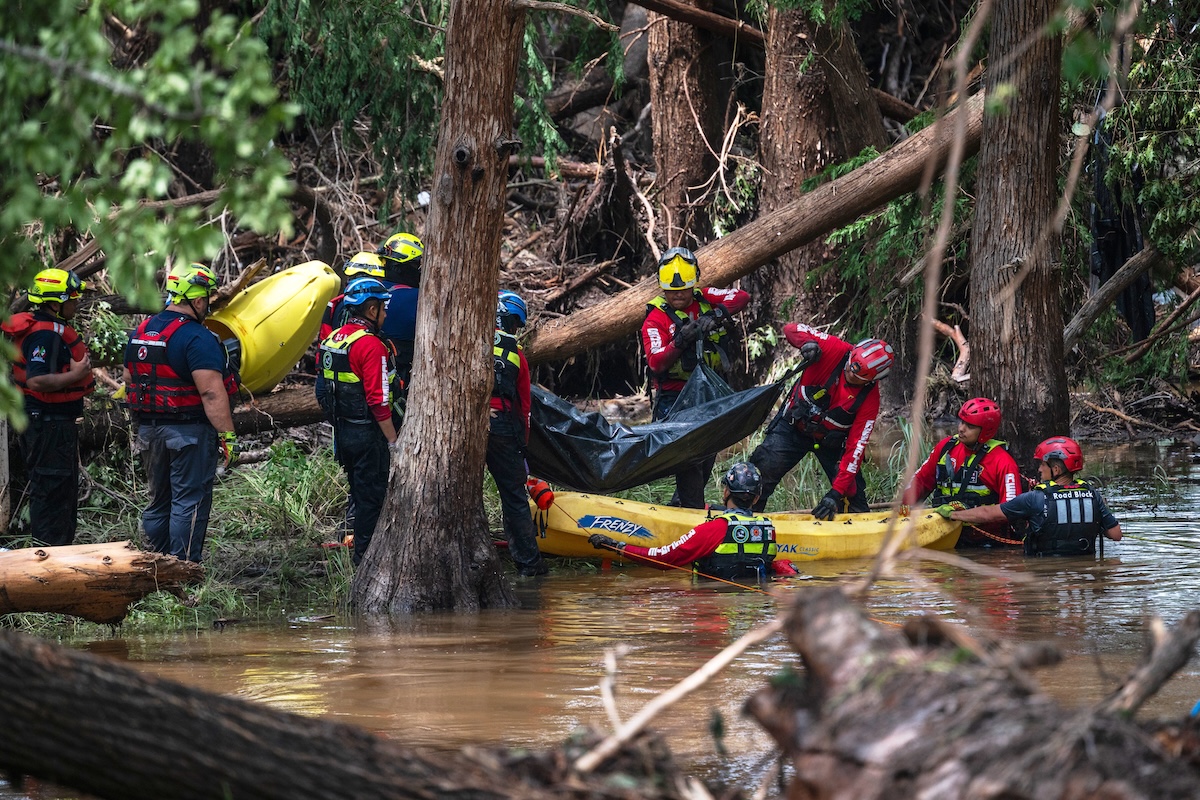
Firefighters from Ciudad Acuña, Mexico, load a body into a raft as they prepare for a water recovery along the Guadalupe River days after a flash flood swept through the area, July 7, 2025, in Ingram, Texas. (AP)
The posts claiming there is no natural explanation for the deadly floods ignore a long history of deadly flooding in the Texas Hill Country region. It is sometimes called "Flash Flood Alley" because it is one of the highest flash flood risk areas in the U.S.
The fairly dry region has steep hills and soil that doesn’t soak up much water. Water from heavy rains quickly flows into shallow creeks and those rising creeks then pour into rivers such as the Guadalupe River, creating powerful destructive flood waters.
A geological feature known as the Balcones Escarpment — a series of faults that form a continuous line of cliffs that runs through the middle of Texas and separates hill country from Texas’ coastal plains — also played a role.
The Balcones Escarpment lifts moisture from the Gulf of Mexico and can increase rainfall rates, Lanza said. In this case, he said the remnants of Tropical Storm Barry combined with the terrain and Gulf moisture "to produce tremendous rainfall rates of 4 to 6 inches in an hour at times."
Lanza said the forecasted conditions in the region supported significant rainfall and a potential significant flooding event.
"When that water falls in the slightly more rugged terrain of this region, it is basically forced down creeks and rivers at a very fast rate of speed and rise, leading to devastating flooding," he said.
In 1981, a slow moving storm over Austin caused Shoal Creek — a waterway off the Colorado River — to flood, killing 13 people. The Guadalupe River previously flooded in July 1987, when Tropical Storm Amelia moved inland and dropped torrential rain in Texas Hill Country. In 2015, the Blanco River’s rapid rise produced floods that killed 11 people near Wimberley, Texas, a city southwest of Austin and about 80 miles east of Kerrville.
Social media posts said the Rainmaker Technology Corp.’s cloud seeding caused the July 4 flooding in Texas.
The company’s CEO said its last cloud seeding activities were July 2, and the two clouds seeded dissipated between 3 p.m. and 4 p.m. that same day — more than 24 hours before the storm that caused deadly flooding.
The remnants of Tropical Storm Barry dropping intense rain on a flood-prone region caused the disaster, meteorologists said. Cloud seeding could not have caused the disaster because the process increases precipitation only by a small amount, experts said.
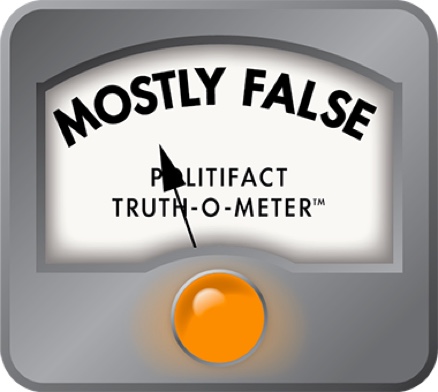
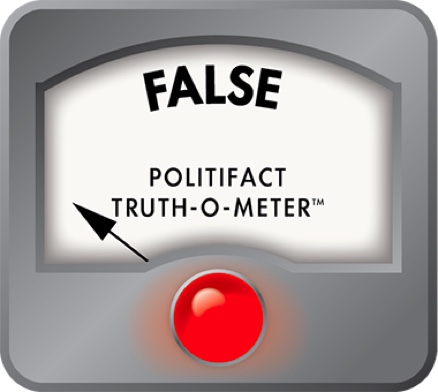
We rate these claims False.
PolitiFact Researcher Caryn Baird and PolitiFact Senior Correspondent Amy Sherman contributed to this report.
RELATED: Some viral videos of Texas flooding might be fake. Here’s how to spot them.
In2ThinAir’s X post, July 5, 2025
Facebook post, July 5, 2025
Instagram post, July 6, 2025
Instagram post, July 6, 2025
Rainmaker Technology Corporation CEO Augustus Doricko’s X thread, July 5, 2025
Travis Herzog’s Facebook post, July 6, 2025
Email interview Matt Lanza, meteorologist and editor of The Eyewall, July 7, 2025
Email interview, Andy Hazelton, associate scientist at the University of Miami CIMAS, July 7, 2025
Email interview with Uma Bhatt, a professor at the University of Alaska Fairbanks’ Department of Atmospheric Science, July 7, 2025
The New York Times, Harrowing Tales Emerge in Texas as Rescuers Keep Up Search for Missing, July 6, 2025
Texas Water Resources Institute, Do you live in Flash Flood Alley? Experts explain the Central Texas phenomenon and what residents should know, Fall 2016
Lower Colorado River Authority, Managing Floods in Flash Flood Alley, accessed July 7, 2025
Houston Chronicle, Why Texas Hill Country, where a devastating flood killed dozens, is one of the deadliest places in the US for flash flooding, July 5, 2025
ABC News, At least 27 dead at Camp Mystic as officials say they were caught off guard by storm, July 7, 2025
American Meteorological Society, Mapping Flash Flood Severity in the United States, July 7, 2025
The Washington Post, Texas Hill Country is no stranger to flash floods. Why were so many caught off guard? July 6, 2025
KVUE-TV, Flash floods have long haunted the Texas Hill Country, July 5, 2025
KVUE-TV, Remembering the 1987 Guadalupe River flash flood that killed 10 after raging through a Hill Country summer camp, July 4, 2024
Lt. General Michael Flynn’s X post, July 5, 2025
The Dallas Express, Rainmaker CEO To Speak Publicly Amid Cloud Seeding Scrutiny Over Texas Floods, July 7, 2025
Desert Research Institute, Cloud Seeding Program, accessed July 7, 2025
Government Accountability Office, Cloud Seeding Technology: Assessing Effectiveness and Other Challenges, Dec. 19, 2024
Texas Department of Licensing and Regulation, Harvesting the Texas Skies in 2022 - A Summary of Rain Enhancement Operations in Texas, accessed July 7, 2025
ABC News, Ginger Zee clears the air about cloud seeding, Nov. 19, 2024
National Oceanic and Atmospheric Administration, Fact check: Debunking weather modification claims, July 7, 2025
National Oceanic and Atmospheric Administration Library, Weather Modification Project Reports, accessed July 7, 2025
Code of Federal Regulations, Part 908—Maintaining Records And Submitting Reports On Weather Modification Activities, accessed July 7, 2025
Astrophysics Data System, The Effect of the Balcones Escarpment on Forecasting Major South Central Texas Rainfall Events,
San Antonio Express-News, Why does the Balcones Escarpment matter? It's 'where the West begins,’ Feb. 9, 2024
NPR, Here's a timeline of the catastrophic Texas floods, July 6, 2025
The Florida Senate, CS/CS/SB 56: Geoengineering and Weather Modification Activities, accessed July 7, 2025
The Associated Press, Death toll from catastrophic flooding in Texas over the July Fourth weekend surpasses 100, July 7, 2025












In a world of wild talk and fake news, help us stand up for the facts.