Stand up for the facts!
Our only agenda is to publish the truth so you can be an informed participant in democracy.
We need your help.
I would like to contribute

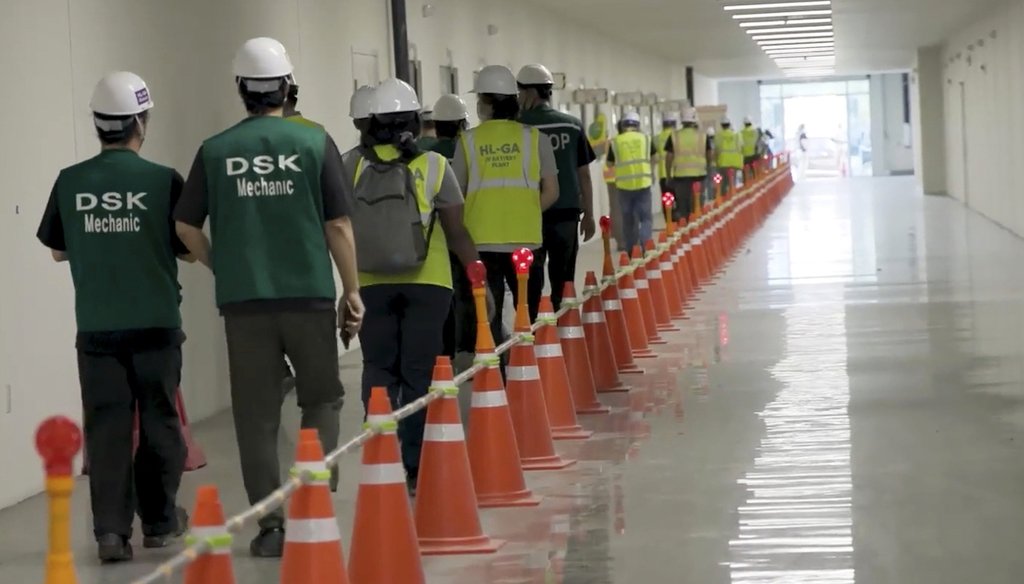
This image from video provided by U.S. Immigration and Customs Enforcement shows manufacturing plant employees being escorted outside the Hyundai Motor Group’s electric vehicle plant, Sept. 4, 2025, in Ellabell, Ga. (USCIS via AP)


The recent arrests of about 300 South Koreans at a Hyundai manufacturing plant in Georgia drew questions about the detainees’ immigration status.
When PolitiFact asked about their status, the Department of Homeland Security did not answer the question. Steven Schrank, a special agent in charge of Homeland Security investigations in Georgia and Alabama, said at a Sept. 5 press conference that the arrested workers crossed the U.S. border illegally, violated or overstayed their visas, or had entered the United States under a visa waiver program that prohibited them from working.
Immigration lawyer Charles Kuck told PolitiFact he is representing 12 of the detained people, some of whom are Korean. He said some of his clients entered the United States using either a business visa or the visa waiver program that South Korea participates in. These programs allow people to legally enter the country for a limited time and perform specific business activities. But people can’t work or be paid by U.S. companies while under these immigration statuses.
Kuck said his Korean clients had been in the United States for no more than 45 days, an allowable period of time under these programs.
Kuck also told The Associated Press that the South Korean workers are engineers and specialized equipment installers who were helping set up or repair equipment at the joint plant for Hyundai and LG Energy Solution. The plant will manufacture electric vehicle batteries, which require machines that are not made in the United States, according to Kuck. Kuck added that it would take three to five years to train U.S. workers to install or repair the plant’s equipment, which is why workers have to travel from abroad to install or repair the plant’s equipment.
The Guardian reported Sept. 10 that it had obtained an Immigration and Customs Enforcement document that says at least one of the detained workers was in the United States on a B-1 visa. The ICE document said the worker "has not violated his visa." When the Guardian asked DHS about that worker, a spokesperson said he was unauthorized to work.
Immigration officials gave the detainees two options, accept deportation with a five-year reentry ban, or stand a monthslong trial while remaining in detention, according to Yonhap, a South Korean news agency. News reports said the South Korean government would fly the workers home.
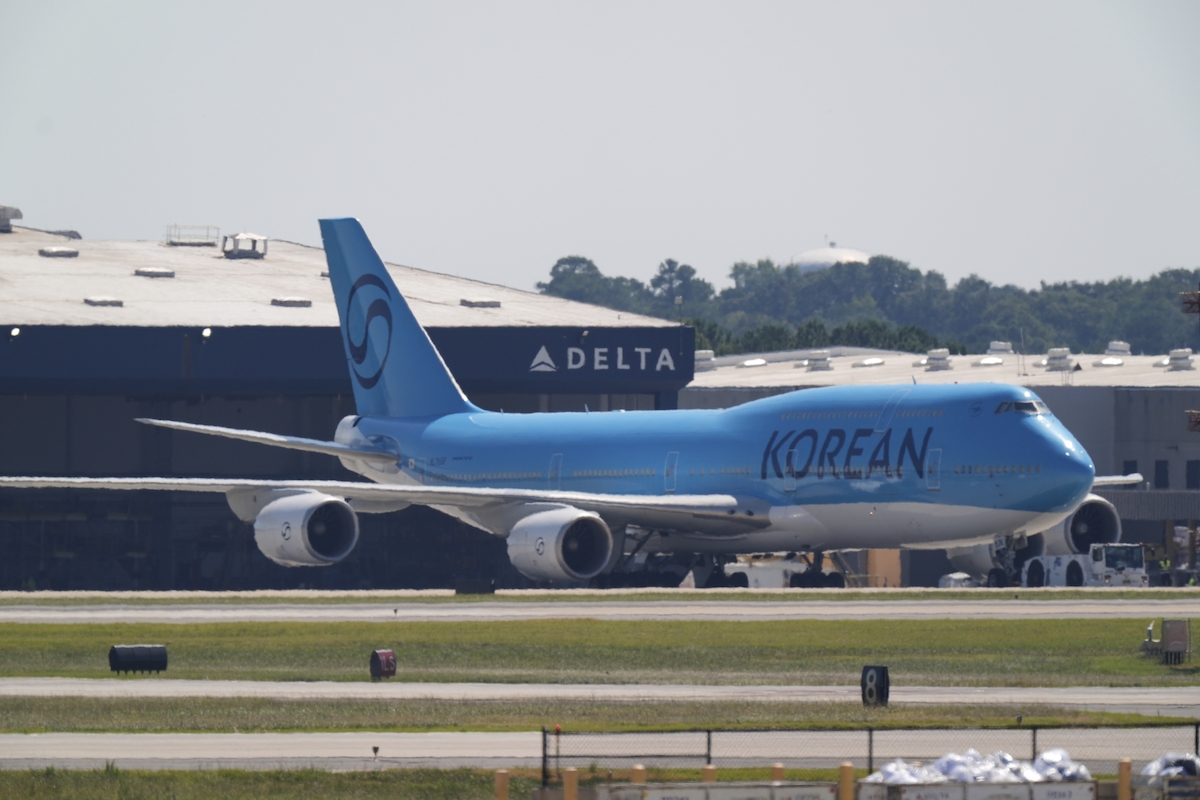
A Korean Air charter plane taxis at Hartsfield-Jackson International Airport in Atlanta, Sept. 10, 2025. (AP)
The plant is part of a 2022 agreement between Hyundai and the state of Georgia to build the company’s first U.S. factory dedicated to manufacturing batteries and electric vehicles. The immigration raid has stopped construction of the 2,900-acre EV battery plant that is expected to employ up to 8,500 people, CNN reported.
South Korean leaders, including President Lee Jae Myung, have denounced the raid, calling it "unjust infringements on the activities of our people and businesses."
What is a B-1 visa?
B visas allow people to temporarily visit the United States, and B-1 visas are for business purposes, such as training U.S. workers in a special skill for a limited time.
The business activities permitted under a B-1 visa include consulting with business associates, attending conventions or conferences, and negotiating contracts.
People seeking a B-1 visa must fill out an online application and attend an interview at a U.S. consulate abroad. Applicants must also have enough money to cover travel expenses and maintain a residence outside of the United States, to ensure they will return to their home countries.
Once granted, B-1 visas are typically good for ten years. B-1 visa holders can enter the United States multiple times during that period and they can stay in the country for up to six months at a time. In certain cases, their stay can be extended for up to one year.
As with other visas, immigration agents at ports of entry — such as airports — decide whether a B-1 visa holder can enter the country and for how long.
The State Department issued more than 31,000 B-1 visas and more than 6.4 million combined B-1/B-2 visas, for business and tourism, in fiscal year 2024, which ran from October 2023 through September 2024.
Can people work while on B-1 visas?
B-1 visa holders cannot work full-time jobs in the United States, and they cannot be paid by a U.S. company.
However, certain business-related activities are allowed. Kuck said that work is limited to negotiating contracts, meeting with business associates and performing installations and services following a sale.
B-1 visa holders can also enter the United States "to install, service, or repair commercial or industrial equipment or machinery purchased from a company outside the United States or to train U.S. workers to perform such services," according to a State Department manual about B visas.
People coming to the United States on a B-1 visa for those purposes must further have unique skills that are considered necessary for a company to fulfill a contract’s obligations. Visa holders can’t perform any assembly or construction work, for example, but they can supervise or train workers to do that work.
For years, South Korean companies have struggled to obtain U.S. work visas for the specialists they need in their high-tech plants. That’s why some people get B-1 visas or visa waivers, Park Tae-sung, vice chairman of Korea Battery Industry Association, told Reuters. The United States issues a finite number of work visas each year, and the process to obtain them can take months.
South Korea’s foreign ministry said it has told U.S. officials about difficulties its nationals face to get visas.
"We emphasized to major U.S. figures that such visas are essential for the short-term stay of Korean professionals who are needed for the initial operation of factories and for training local staff when our companies expand to the U.S.," the foreign ministry said in a statement to NBC News.
What is the Visa Waiver Program and can people work while on it?
The Visa Waiver Program is similar to a B-1 visa, but fewer people are eligible for it, and a consulate interview is not required to obtain it. The program allows most citizens from 40 participating countries, including South Korea, to travel to the United States for tourism or business for up to 90 days without a visa.
Eligible people must be approved via the Electronic System for Travel Authorization, or ESTA, an online State Department program that collects biometric data, travel and other eligibility information.
Similarly to B-1 visas, people who entered the United States via this program are not allowed to work in the country. They are allowed to attend business meetings or consultations, attend conventions or conferences, and negotiate contracts, according to the State Department.
In fiscal year 2023, around 1.9 million people entered the United States under the program for business purposes, according to DHS data.
Our Sources
CBS News, Special agent shares details of large immigration raid at Hyundai facility in Georgia, Sept. 5, 2025
The Associated Press, Attorney says detained Korean Hyundai workers had special skills for short-term jobs, Sept. 8, 2025
HMG, Our Facility, accessed Sept. 10, 2025
CNN, What we know about the agreement for detained South Korean workers to return home, Sept. 9, 2025
NBC News, South Korea readies plane to bring home workers detained in U.S. immigration raid as some consider staying to fight charges, Sept. 9, 2025
U.S. Department of State, Visitor Visa, accessed Sept. 10, 2025
USCIS, B-1 Temporary Business Visitor, accessed Sept. 10, 2025
U.S. Department of State, Table XV(A) Classes of Nonimmigrants Issued Visas (Including Border (Crossing Cards) Fiscal Years 2020-2024*, accessed Sept. 10, 2025
U.S. Department of State, Temporary Worker Visas, accessed Sept. 10, 2025
PolitiFact, What are H-1B visas and how does the Trump administration propose changing them?, Aug. 13, 2025
USCIS, H-1B Cap Season, accessed Sept. 10, 2025
Email interview with Atlanta immigration attorney Charles Kuck, Sept. 9, 2025
Phone interview with Ahmad Yakzan, immigration lawyer and founder of the American Dream Law Office, Sept. 9, 2025
Email interview with Phyllis J. Towzey, board certified specialist In labor and employment law, Sept. 9, 2025
The Guardian, Leaked Ice document shows worker detained in Hyundai raid had valid visa, Sept. 10, 2025
Yonhap, (2nd LD) Korean Air plane to depart for U.S. to bring home detained Koreans, Sept. 9, 2025
CNBC, Detained workers from Hyundai, LG Energy Solution plant could soon fly home to South Korea, Sept. 10, 2025