Stand up for the facts!
Our only agenda is to publish the truth so you can be an informed participant in democracy.
We need your help.
I would like to contribute

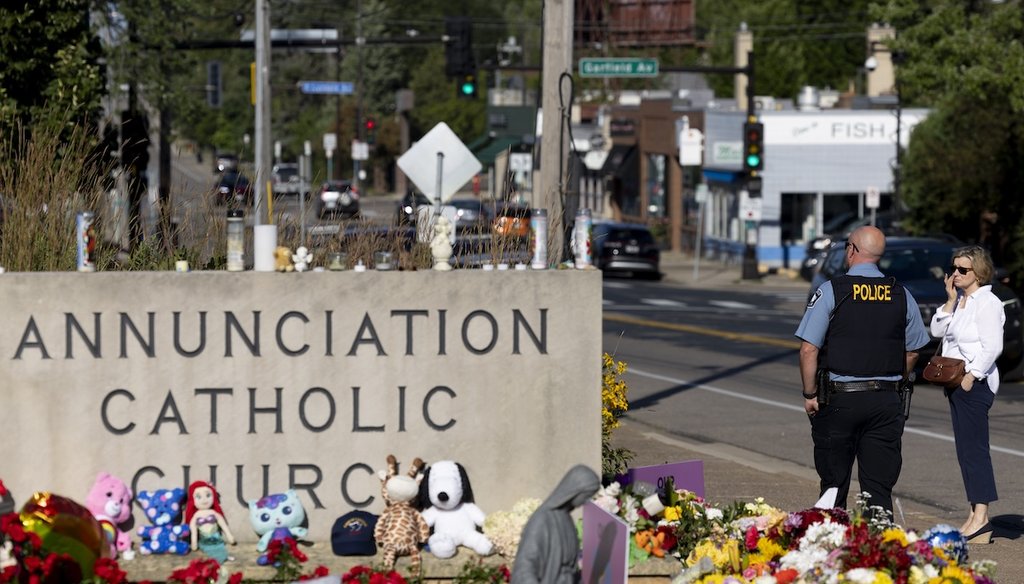
A police officer passes a mourner outside Annunciation Catholic Church after Wednesday's shooting at the school, Aug. 31, 2025, in Minneapolis. (AP)

If Your Time is short
-
Research shows that the majority of mass shootings are perpetrated by men who are not transgender.
-
It is difficult to come up with an exact figure for the percentage of mass shootings committed by trans people, because there is no widely accepted definition of "mass shooting" and it is sometimes not possible to verify a shooter’s gender identity.
-
Experts said there is no data showing trans people are more prone to violence or to committing mass shootings. Transgender people are more likely to be victims of violence than others.
As families comforted their children and police pieced together what caused a shooter to open fire on an Annunciation Catholic School Mass in Minneapolis, some Republican pundits and policy leaders repeated a familiar talking point about transgender people.
"This should never have happened," Fox News host Jesse Watters said Aug. 27, hours after 23-year-old Robin Westman’s attack killed two children and injured 21 other people. "But how did it?"
Watters highlighted Westman’s identity to say it’s part of a "pattern" of violence perpetrated by transgender people. In 2020, a judge granted Westman’s name change request — from Robert Westman to Robin Westman — in a court document that said Westman "identifies as a female and wants her name to reflect that identification."
"Statistically, the trans population has been prone to violence," Watters said, a comment viewed more than 3.7 million times on X when it was shared by conservative commentator Benny Johnson. "That’s not villainizing, that’s reality."
Four days later on CNN’s "State of the Union," White House Senior Director for Counterterrorism Sebastian Gorka made similar remarks: "In just a couple of years, we have seen seven mass shootings involving people of transgender nature or who are confused in their gender. Seven in just the last couple of years. That is inordinately high."
We’ve reviewed similar statements about transgender people committing violence. Crime and terrorism experts still agree: There is no evidence that transgender people are more likely to commit gun violence than others.
That’s partly because of the way "mass shooting" is defined and tracked and partly because the data that is collected overwhelmingly shows that the majority of shootings are perpetrated by men who are not transgender.
The Violence Prevention Project at Hamline University studied mass shootings that it defined as shootings in public places that resulted in four fatalities excluding the shooter. Its analysis found that males were the perpetrators in 98% of the shootings, female shooters accounted for 2% of the attacks and transgender people accounted for less than 1%. (The Minneapolis incident would not qualify as a mass shooting under Hamline’s definition.)
When PolitiFact asked Fox News for Watters’ evidence, a spokesperson cited shooting incidents. Gorka posted a list of six incidents on X. Out of nine cases Fox News and Gorka cited going back to 2018, four involved shooters who identified as transgender, a PolitiFact review of news reports, investigations and court records found. One was nonbinary, which means they did not see themselves as exclusively male or female; in the other cases, the perpetrator’s gender identity was not as clear as Watters and Gorka framed.
Two incidents did not qualify as a mass shooting by any definition — one because it was not a shooting, and the other because the gunfire resulted in one injury, no fatalities.
The number of mass shootings in the U.S. since 2018 ranges from the tens to the thousands, depending on the data and criteria used to measure them. The most expansive definition comes from Gun Violence Archive, a nationally recognized source for gun violence data, which counts any incident in which four or more people are shot or killed, excluding the shooter — the only definition under which the Minneapolis incident would qualify.
If all seven shooting incident attackers included in Gorka and Fox News’ lists were counted, that would be seven out of 4,147 mass shootings from 2018 to 2025, based on Gun Violence Archive data — a rate of 0.17% as of Sept. 4.
"I think (it) is reasonable to assert that, anecdotally, there have been several high profile mass shootings committed by transgender individuals in recent years, and whether that is an aberration or a new trend has not yet been confirmed statistically," said Adam Lankford, University of Alabama Department of Criminology & Criminal Justice professor and chair.
Speaking outside the school shortly after the incident, Minneapolis Mayor Jacob Frey, a Democrat, cautioned against blaming the trans community.
Anybody "using this as an opportunity to villainize our trans community or any other community out there has lost their sense of common humanity," Frey said during a press briefing outside the Annunciation school and church.
Watters and Gorka cited cases that don’t neatly fit the description of trans mass shootings
When we reached out to Fox News for evidence behind Watters’ statement, a spokesperson sent us Statista data showing that, as of Aug. 11, there had been 60 mass shootings since 2018. The spokesperson listed six cases of shooters who she said were experiencing gender dysphoria, or the experience of distress that some people feel when their sex and gender identity don’t align.
Of the nine incidents that Gorka and Fox News together mentioned, one involved a Molotov cocktail tossed at Tesla vehicles in Kansas City in March, not a shooting. Another, in which a transgender person was wanted in connection to a shooting at an Immigration and Customs Enforcement detention facility in Texas, left one police officer injured and resulted in no fatalities.
And not all of the cases involved shooters who clearly identified as trans. In a 2023 Philadelphia shooting, for example, an adviser to the district attorney’s office said the suspect "has not identified themselves as trans," NBC News reported. And defense attorneys for the suspect in a 2022 shooting at Colorado’s Club Q nightclub — who was apprehended after the attack — wrote in court documents that the shooter identified as nonbinary.
After a 2024 shooting at Perry High School in Iowa, people claimed the shooter was trans because his social media posts contained LGBTQ+ symbolism and messages in support of transgender people. Officials, however, did not comment about the shooter’s gender identity.
Even in Westman’s case, tabloid reports premised on a YouTube video said Westman’s writings included some ambiguity around being transgender.
Data shows trans people conduct a very small percentage of mass shootings
Because there’s no one, agreed-upon definition for what qualifies as a mass shooting, organizations that track these incidents arrive at different figures. Besides the Gun Violence Archive, here are two:
-
The FBI threshold for a "mass killing" involves "three or more killings in a single incident," which is not exclusive to shootings. The agency separately tallies "active shooter" incidents, defined as "one or more individuals actively engaged in killing or attempting to kill people in a populated area." From 2018 to 2024, the FBI reported 70 active shooter incidents that met the definition of "mass killings."
-
Statista pulled its tally of 60 incidents since 2018 from a Mother Jones tracker, which has the same fatality threshold as the FBI does for mass killings, but specifies that incidents should be in a "public place."
Judging by any of those definitions, the number of trans mass shooters would not show any statistical evidence that trans shooters are disproportionately more prone to violence than nontransgender people.
An August 2025 report from the LGBTQ+ policy research center Williams Institute at the University of California, Los Angeles found that 2.8 million people ages 13 and above identify as transgender in the U.S. That’s 1% of people in the U.S. aged 13 and older.
"If trans persons are 1% of the general population, but only 0.17% of the population of mass shooters, then they are under-represented in this group," said Laura Dugan, Ohio State University of human security and sociology professor.
A 2023 FBI report on active shooters cited the Covenant Presbyterian School shooting in Nashville, Tennessee, where the assailant was identified by authorities as "female/transgender male." All of the other 48 active shooters that year were male, the report said.
"When you're looking at the average violence across the community, disproportionately, you know it's white, straight men," said Mia Bloom, Georgia State University professor of communication and Middle East studies.
Trans people are more likely to be victims, not perpetrators, of violence
Data has also shown that trans people are more likely to be victims of violence than their cisgender peers, experts said.
The UCLA Williams Institute found transgender individuals were more than four times more likely to be victimized than cisgender people, and are more likely to experience violent crime.
Similarly, the research arm of the gun violence prevention organization Everytown for Gun Safety found that "transgender, nonbinary and gender-questioning young people reported higher rates of being impacted or knowing someone impacted by a mass shooting (22%), compared to their cisgender LGBQ+ peers (19%)."
RELATED: No evidence of growing trend of trans radicalization or terrorism, experts say
RELATED: No evidence of rising LGBTQ+ violent extremism or 'trans terrorism'
CORRECTION, Sept. 10: A previous version of the story included the wrong date for our Gun Violence Archive data analysis. The correct date is Sept. 4.
Our Sources
Email exchange with a Fox News spokesperson, Aug. 29, 2025
Email interview, Adam Lankford, University of Alabama Criminology & Criminal Justice chair and professor, Aug. 28, 2025
Phone interview, Victor Asal, University at Albany Department of Political Science professor, Aug. 28, 2025
Email interview, Nicholas Scott Meyerson, assistant professor at Johns Hopkins University Department of Health Policy and Management, Aug. 28, 2025
Phone interview, Mia Bloom, Georgia State University, Professor of Communication and Middle East Studies, Aug. 29, 2025
Email interview, Kristin A. Goss, Duke University Susan B. King Distinguished Professor of Public Policy, Aug. 28, 2025
Phone and email interview, Laura Dugan, Ohio State University Ralph D. Mershon Professor of Human Security and Professor of Sociology, Aug. 28, Sept. 4 and Sept. 8, 2025
Fox News YouTube video, Our leaders keep failing us: Watters, Aug. 27, 2025
X post by Benny Johnson, Aug. 27, 2025
CNN Transcripts, State of the Union, Aug. 31, 2025
X post by Sebastian Gorka, Aug. 28, 2025
PolitiFact, No evidence of growing trend of trans radicalization or terrorism, experts say, March 31, 2023
PolitiFact, No evidence of rising LGBTQ+ violent extremism or 'trans terrorism', Feb. 26, 2024
C-SPAN, Minnesota Governor Tim Walz News Conference on Annunciation Catholic School Shooting, Aug. 27, 2025
Statista, Number of mass shootings in the United States between 1982 and August 2025, accessed Aug. 29, 2025
PolitiFact, ‘Gender dysphoria’: What it is, what it isn’t and how history has changed its view, May 22, 2023
The Washington Post, Suspects in Texas ICE shooting tied to trans, anti-fascist activism, Aug. 17, 2025
NBC News, Philadelphia shooting suspect isn't trans, officials say, but speculation continues, July 5, 2023
NBC News, Musk and far-right figures seize on Iowa shooter’s possible LGBTQ identity, Jan. 5, 2024
NBC News, Colorado Springs suspect identifies as nonbinary and uses they/them pronouns, defense lawyer says, Nov. 23, 2022
Congressional Research Service, How to Define Mass Shootings: Potential Policy Implications, Nov. 19, 2024
FBI, Active Shooter Incidents in the United States in 2024
Gun Violence Archive, General Methodology, accessed Sept. 4, 2025
Mother Jones, A Guide to Mass Shootings in America, accessed Aug. 29, 2025
Mother Jones, US Mass Shootings, 1982–2025: Data From Mother Jones’ Investigation, accessed Aug. 29, 2025
National Review, Why the Rise in Trans Shooters?, April 19, 2024
Gun Violence Archive homepage, Sept. 4, 2025
Daily Mail, Minneapolis shooter was 'tired of being trans' and had been 'brainwashed' into being female, Aug. 28, 2025
New York Post, Minneapolis school shooter Robin Westman confessed he was ‘tired of being trans’: ‘I wish I never brain-washed myself’, Aug. 28, 2025
FBI, Active Shooter Incidents in the United States in 2018
FBI, Active Shooter Incidents in the United States in 2019
FBI, Active Shooter Incidents in the United States in 2023
Violence Prevention Project, Key Findings, accessed Sept. 4, 2025
Andrew R. Flores, Ilan H. Meyer, Lynn Langton, Jody L. Herman, Gender Identity Disparities in Criminal Victimization: National Crime Victimization Survey, 2017–2018, April 2021
UCLA School of Law, Williams Institute, How Many Adults and Youth Identify as Transgender in the United States?, August 2025
UCLA School of Law, Williams Institute, Transgender people over four times more likely than cisgender people to be victims of violent crime, March 23, 2021
Everytown Research & Policy, The Relationship Between Firearms, Mass Shootings and Suicide Risk among LGBTQ+ Young People, June 6, 2024
Jared R. Dmello, Mia Bloom and Sophia Moskalenko, LGBTQ+ Victimization by Extremist Organizations: Charting a New Path for Research, March 6, 2025