Get PolitiFact in your inbox.

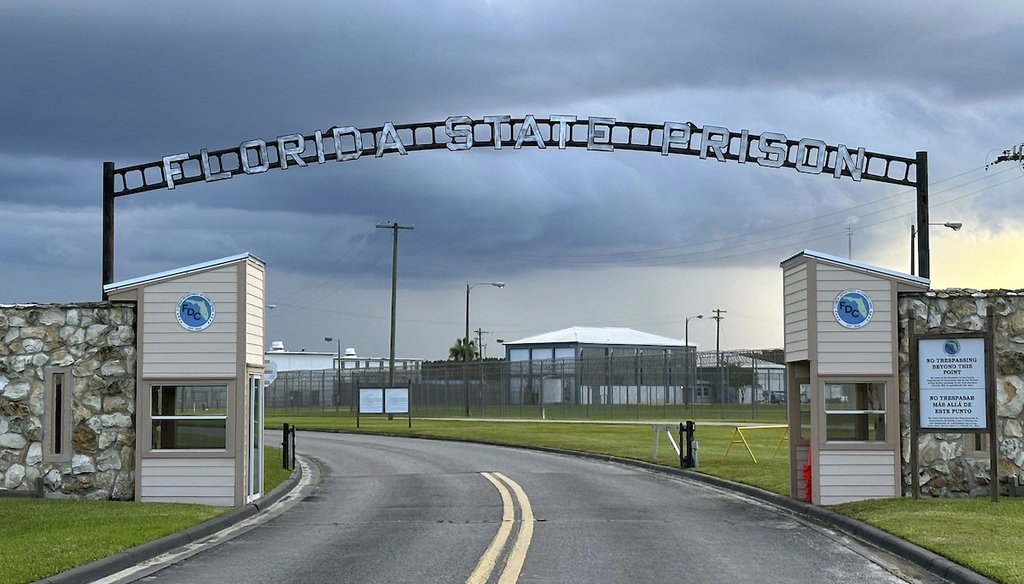
Clouds hover over the entrance of the Florida State Prison in Starke, Fla., Aug. 3, 2023. (AP)

If Your Time is short
-
Florida Gov. Ron DeSantis has approved a record 19 executions in 2025 — and has carried out 17 so far — the highest ever in a single year in both the state and the U.S. since the 1970s.
-
The state also has the highest number of exonerations. Thirty people in Florida have had their death sentences overturned since the 1970s because of wrongful convictions or inconclusive evidence.
-
Death penalty supporters and opponents have offered competing studies on whether capital punishment deters crime. Most experts find data to be inconclusive, and say it isn’t well known whether the promise of swift executions would be more of a deterrent.
Florida has executed more people in 2025 than in any single year since the death penalty was reinstated in 1976. The state carried out its 17th execution Nov. 20, with two more scheduled by the end of the year.
When asked about the increase, Republican Gov. Ron DeSantis said COVID-19 and other factors slowed executions in some years. He said he believes the system for executions should move more quickly. DeSantis has authorized 28 executions since he assumed office in 2019, with zero executions in 2020, 2021 and 2022. His predecessor, Republican Sen. Rick Scott, oversaw 28 executions over eight years.
"It's an appropriate punishment for the worst offenders. We have lengthy reviews and appeals that I think should be shorter," DeSantis said in a Nov. 3 news conference.
Referring to inmates on death row for crimes committed decades ago, DeSantis said victims’ families are owed quicker executions and that a more streamlined process could deter crime.
Death penalty supporters and opponents have long offered competing studies on whether capital punishment deters crime. Some point to comparable violent crimes in states with and without the death penalty. Others argue there are statistical correlations between the death penalty and certain crime reductions.
Experts said it isn’t well understood whether the promise of swift executions would be more of a deterrent; they said it’s inconclusive whether such a change would have a meaningful effect.
Mark Schlakman, senior director for Florida State University’s Center for the Advancement of Human Rights and a Florida death penalty expert, said research generally shows that swift and severe punishment may be a deterrent, but it isn’t clear whether that extends to the death penalty and how quickly it’s carried out.
Here is what we know about capital punishment in Florida.
How long do Florida inmates spend on death row? How does that compare with the rest of the country?
Death row timelines vary by jurisdiction, but the average time for Florida inmates is around 22.6 years, according to 2023 Bureau of Justice Statistics data.
Florida’s average is in line with other states with the death penalty and the federal system.
Lengthy stretches between sentencing and execution are common.
"Death sentences are the most serious sanctions that governments can inflict on human beings, so all must be carefully reviewed for accuracy and fairness before an execution is scheduled," said Robin Maher, executive director of the Death Penalty Information Center, a nonprofit that provides capital punishment data. "A thoughtful and careful review of the claims in a case often takes time."
Many cases get sent back to lower courts when constitutional errors are identified. Appeals can take years if the government is slow to respond or rule on a petition, Maher said.
Maher’s group found that since 1973, about 200 people on death row have been exonerated in the U.S. — with some spending more than 40 years to prove their innocence.
Currently, 27 states, the federal government and the U.S. military authorize capital punishment. The first Trump administration resumed federal executions in 2020 after a 17-year hiatus.
How many people have been exonerated in Florida?
Thirty people have been exonerated in Florida since the 1970s, more than any other state. Illinois is second with 23, followed by Texas with 18.
Some experts point to Florida’s broad death penalty criteria and overburdened public defender system as reasons for the high number, and said the state has a shortage of experienced defense attorneys.
Stephen Harper, a Florida International University emeritus professor who runs a legal clinic for death penalty cases, told the Florida Phoenix that Florida prosecutors also have wide discretion on when they can seek the death penalty.
Mishandled evidence and unreliable forensic procedures have also played a role in the state’s wrongful convictions, experts said. DNA evidence has been a contributing factor in several of Florida’s exonerations.
"There have been cases advanced by ‘junk science’ that were ultimately discredited and also instances of prosecutorial overreach, which isn’t necessarily unique to Florida," Schlakman said.
How has death penalty sentencing evolved in Florida?
Florida’s lawmakers have altered capital punishment sentencing multiple times over the past decade, with the latest changes making it easier for prosecutors to get death sentences and have them upheld.
In 2020, the state’s Supreme Court ended the practice of having courts review capital sentences. These reviews required an appeals court to compare a death penalty sentence with similar cases to ensure constitutional standards were met and the sentence was warranted.
In 2023, Florida enacted two laws that broadened capital punishment sentencing. One lowered the threshold from requiring a unanimous jury vote of 12 to 0 to a vote of 8 to 4 — the lowest in the country. The state also expanded the death penalty to apply to some non-homicide crimes, such as certain sexual offenses against children.
Florida is "one of just two states to allow non-unanimous death sentencing, making it a clear outlier even among active death penalty states," Maher said. The other state, Alabama, requires 10 votes in favor of a death sentence.
Does quick death penalty sentencing serve as a crime deterrent, as DeSantis said?
Criminal justice and capital punishment experts said data neither supports nor negates the idea that the death penalty or swifter executions deter crime.
Daniel Nagin, who chaired the National Research Council’s Committee on Deterrence and the Death Penalty, previously said the "certainty of apprehension" has been shown to be a more effective crime deterrent, versus the severity of consequences.
Studying deterrence related to the death penalty is challenging, experts said. Capital punishment is applied rarely, making it difficult to disentangle the number of homicides the sentence could have deterred from changes in homicide rates caused by other factors.
In 2012, the National Research Council released Deterrence and the Death Penalty, a review of more than three decades of studies on capital punishment’s effect on homicide rates. The group concluded the research wasn’t conclusive and recommended against using the studies to inform policy decisions.
Our Sources
YouTube, Gov. DeSantis press conference, Nov. 3, 2025
WUFT, In Florida’s 17th execution this year, inmate dies by lethal injection, Nov. 21, 2025
The Tampa Bay Times, DeSantis signs death warrant in 1987 murders, Nov. 19, 2025
Florida Department of Corrections, Corrections Offender Network, Accessed Nov. 13, 2025
WUSF, Gov. Ron DeSantis says executions are about justice amid modern-era record, Nov. 4, 2025
CBS News, What's driving the rise in U.S. death row executions in 2025?, Nov. 12, 2025
Tallahassee Democrat, Florida, the death penalty serves no useful purpose | Opinion, Nov. 6, 2025
The Conversation, Under Ron DeSantis’ leadership, Florida leads the nation in executions in 2025, Nov. 11, 2025
Cornell Law School, death penalty, Accessed Nov. 13, 2025
Death Penalty Information Center, History of the Death Penalty in Florida, Accessed Nov. 13, 2025
Death Penalty Information Center, Executions by State and Year, Accessed Nov. 13, 2025
VPM.com, PolitiFact VA: Does the Death Penalty Deter Murder?, Feb. 19, 2021
PolitiFact, Lt. Gov. hopeful Jeff Bartos says the death penalty is a deterrent. Researchers disagree., Oct. 11, 2018
CBS News, Florida's new law allows death penalty for some child sex trafficking cases, Oct. 2, 2025
American Bar Association, Florida Supreme Court Overturns Precedent Throughout 2020, Jan. 25, 2021
Death Penalty Information Center, Murder Rate of Death Penalty States Compared to Non-Death Penalty States, Accessed Nov. 13, 2025
The National Research Council, DETERRENCE AND THE DEATH PENALTY, 2012
Email interview, Robin Maher, executive director of the Death Penalty Information Center, Nov. 13, 2025
Phone interview, Mark Schlakman, senior program director for FSU’s Center for the Advancement of Human Rights and an expert on Florida’s death penalty process, Nov. 14, 2025