Stand up for the facts!
Our only agenda is to publish the truth so you can be an informed participant in democracy.
We need your help.
I would like to contribute

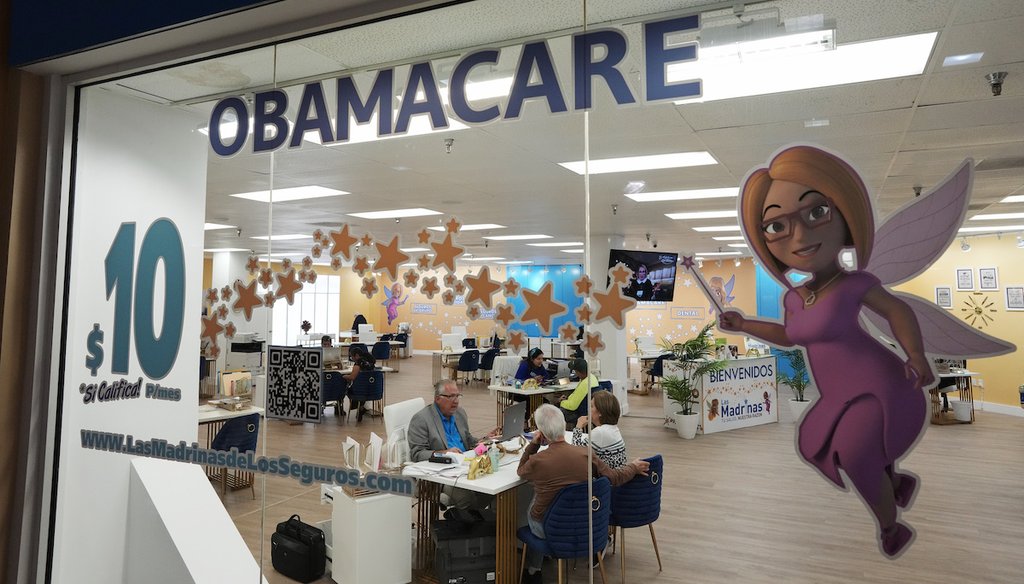
An insurance agent talks with clients inside the main location of Las Madrinas de los Seguros, Spanish for "The Godmothers of Insurance," at a shopping center in Miami, on Dec. 5, 2023. (AP)

The government shutdown failed to resolve differences between Republicans and Democrats over policies related to Obamacare’s affordability.
Republicans refused to go along with Democrats’ proposal to extend expiring COVID-19-era subsidies for people who buy their insurance on the Affordable Care Act marketplace. The Senate voted Nov. 10 to fund the government through January without the subsidies. Senate Majority Leader John Thune, R-S.D., said the Senate would vote later this year on extending them.
Most people who use Affordable Care Act marketplaces obtain subsidies.
In 2021, then-President Joe Biden signed legislation that made the subsidies more generous. The legislation reduced the maximum amount purchasers would have to pay for coverage and enabled households with incomes higher than 400% of the federal poverty level to receive subsidies. Previously, the subsidies were capped at 400% of the poverty limit for a household, which in 2024 was $60,240 for a one-person household.

Congress renewed these enhanced subsidies in 2022 through the end of 2025.
The subsidies proved popular; the number of people receiving them increased from about 11 million to more than 24 million people, the vast majority of whom receive an enhanced premium tax credit.
If enhanced tax credits expire, many enrollees will continue to qualify for smaller tax credits, while others will lose eligibility altogether.
President Donald Trump, who unsuccessfully pledged to repeal and replace Obamacare, said he wants to give people money to buy their own health insurance, without providing details.
Democrats will likely campaign on Obamacare costs through the midterms, particularly if Republicans vote against extending the subsidies in the coming weeks. We fact-checked some recent Democratic talking points.
"The five states that are most impacted by a failure to extend the Affordable Care Act tax credits are West Virginia, Wyoming, Alaska, Mississippi and Tennessee." — Rep. Hakeem Jeffries, D-N.Y., at a Nov. 10 press conference
This is accurate, according to one analysis of premium payment increases for consumers choosing plans in the same tier, without the enhanced subsidies. Jeffries was citing the liberal Center for American Progress Action Fund.
"Most impacted" can mean many things, not just premium spike size. Florida has 4.7 million people enrolled in Affordable Care Act plans in 2025, more than any other state. About 97% of enrollees receive a discount that makes their plans cheaper.
One analysis puts Texas ahead of Florida for the overall number of people who will not enroll in ACA plans in 2026 if the subsidies expire. Texas has a larger state population.
"Forty-five percent of the people, of the Americans, who are going to lose health care or be at risk of losing health care if they don't on the other side of the aisle extend the Affordable Care Act tax credits, 45% of them are registered Republicans." — Jeffries at a Nov. 10 press conference
Jeffries’ statistic for Republican voters affected by the ACA subsidies comes from a May poll by KFF, a leading health policy think tank.
The poll found Republicans make up 45% of adults who purchase their own health insurance, most of whom do so through the ACA marketplaces. That included 31% who defined themselves as MAGA Republicans and 14% called themselves non-MAGA Republicans. (The survey defined MAGA Republicans as Republicans and Republican-leaning independents who support Trump’s Make America Great Again movement.) About 35% enrolled through the marketplace were Democrats and 20% were independents.
The rates were lower for Medicaid enrollees, KFF found: 27% self-identified as MAGA or non-MAGA Republicans.
Jeffries predicted that this group is at risk of losing health care entirely, but we don’t yet know exactly how many would drop their insurance because of rising costs.
The Congressional Budget Office expects 2 million more people would be uninsured in 2026, increasing to 3.7 million in 2028. More people are likely to drop ACA coverage but not become uninsured, for example changing to a job that offers health insurance.
"If this is the so-called 'deal,' then I will be a no. That’s not a deal. It’s an unconditional surrender that abandons the 24 million Americans whose health care premiums are about to double." — Rep. Ritchie Torres, D-N.Y., Nov. 9 X post
This is largely accurate.
Torres told us he was referring to a Sept. 30 analysis by KFF that found that the expiration of the credits "is estimated to more than double what subsidized enrollees currently pay annually for premiums — a 114% increase from an average of $888 in 2025 to $1,904 in 2026." About 24 million people are on the marketplace, and most receive subsidies.
Sen. Bernie Sanders, I-Vt., went further Nov. 9 when he said ending the subsidies "raises health care premiums for over 20 million Americans by doubling, and in some cases tripling or quadrupling" the cost.
Many low-income people would see their out-of-pocket premiums increase from zero to hundreds of dollars, said Larry Levitt, KFF’s executive vice president for health policy.
"It would cost $38 billion to extend ACA credits next year and prevent millions of people from losing their healthcare. Reminder: Trump sent $40 billion to Argentina for no reason." — Rep. Zoe Lofgren, D-Calif., Nov. 7 on Bluesky
Lofgren’s statement about the cost of ACA enhanced subsidies is in the ballpark, but she exaggerated what the federal government sent to Argentina.
Extending the enhanced subsidies would cost about $350 billion over a decade including about $38 billion next year, the center-right American Action Forum found.
Other estimates are lower or higher. Levitt told us the net effect on the federal budget in 2027, which is a more complete year, is $31.9 billion.
Romina Boccia, director of budget and entitlement policy at the libertarian Cato Institute, said factoring in direct costs, interest payments and spending in other programs averages around $48.8 billion more each year.
Regarding Argentina, Lofgren was referring to the Trump administration’s announcement in October that it agreed to a $20 billion currency swap and facilitated $20 billion in private financing.
The funds to support Argentina couldn’t be shifted to health care credits. The U.S. Treasury dedicates a pool of funds for onetime U.S. intervention in foreign exchange markets.
Chief Correspondent Louis Jacobson contributed to this article.
RELATED: Government shutdown fact-checks about SNAP, WIC, Obamacare and immigration
Our Sources
C-SPAN, House, House Minority Leader Jeffries Holds News Conference on Day 41 of Government Shutdown, Nov. 10, 2025
Rep. Ritchie Torres, X post, Nov. 9, 2025
Sen. Bernie Sanders, X post, Nov. 9, 2025
KFF, KFF Health Tracking Poll: The Public’s Views of Funding Reductions to Medicaid, June 6, 2025
Roll Call, Interview: Laura Ingraham Interviews Donald Trump on Fox's The Ingraham Angle, Nov. 10, 2025
Committee for a Responsible Federal Budget, Understanding the ACA Subsidy Discussion, Nov. 5, 2025
Center for American Progress Action Fund, How premium costs for subsidized ACA marketplace enrollees would rise if enhanced financial help expires, Sept. 29, 2025
Fox News, Top Democrat presses Trump administration on Argentina 'bailout' during shutdown, Oct. 31, 2025
PolitiFact, Yes, ACA subsidies cut and premium rise could mean your health insurance bill goes up 75%, Sept. 17, 2025
PolitiFact’s Trump-O-Meter, Repeal Obamacare, 2017-2020
Email interview, Anna Bahr, Sen. Bernie Sanders spokesperson, Nov. 10, 2025
Telephone interview, Rep. Ritchie Torres, Nov. 10, 2025
Email interview, Mark Shepard, Harvard Kennedy School associate professor of public policy, Nov. 10, 2025
Email interview, Larry Levitt, KFF’s executive vice president for health policy, Nov. 10, 2025
Email interview, Cynthia Cox, KFF vice president and Director of the Program on the ACA, Nov. 11, 2025
Email interview, Romina Boccia, director of budget and entitlement policy at the Cato Institute, Nov. 11, 2025
Email interview, Keith Nagy, U.S. Rep. Zoe Lofgren spokesperson, Nov. 11, 2025
Email interview, Christiana Stephenson, U.S. Rep. Hakeem Jeffries spokesperson, Nov. 11, 2025