Stand up for the facts!
Our only agenda is to publish the truth so you can be an informed participant in democracy.
We need your help.
I would like to contribute
Trump has moved to modernize the electric grid but faced some criticism

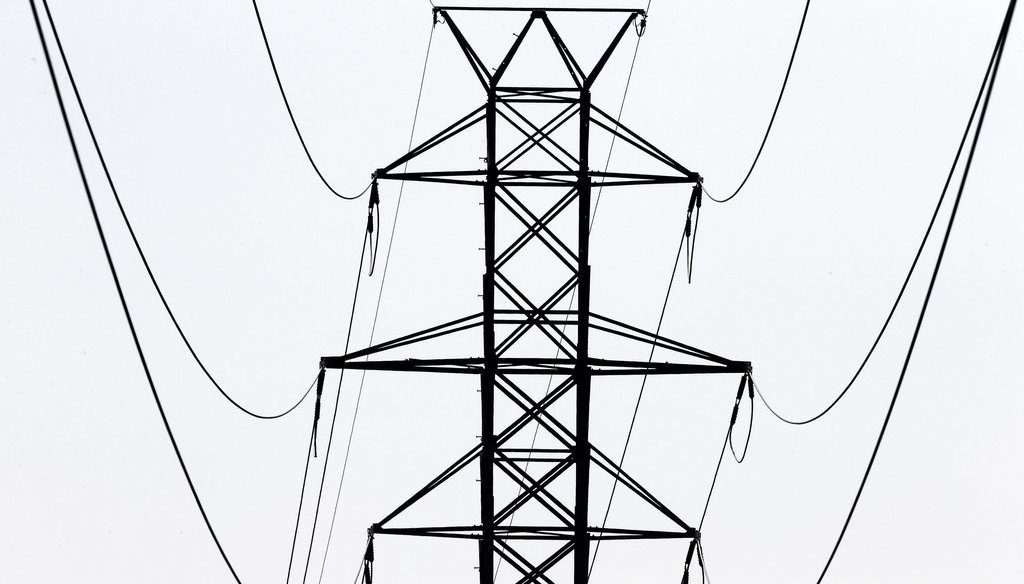
Power transmission lines carry electricity along the Interstates 40 and I-85 corridor in Orange County near Hillsborough, N.C., on Aug. 14, 2018. (AP)

President Donald Trump says he wants to modernize the electric grid to prevent blackouts and reduce electricity costs.
Surging electricity demand — fueled by manufacturing growth, artificial intelligence data centers and population shifts — threatens grid reliability.
The average U.S. household spent about $142 a month on electricity in 2024, with some states paying far more.
The Energy Department said in July that 100 times as many blackouts could darken communities by 2030 if the country keeps shutting down power plants without building new ones.
The administration has taken several steps to deliver on Trump's campaign promise to strengthen the grid.
What the administration has done
In April, Trump signed an executive order directing the Energy Department to protect the electric grid by:
-
Using emergency powers faster and more often. The order directs the department to streamline orders under Section 202(c) of the Federal Power Act. That means the department should issue emergency orders faster when the power grid is at risk — to keep certain power plants running during extreme weather, for example.
-
Finding where the grid is weakest. The department must create a uniform method to figure out which parts of the country face the highest risk of outages or blackouts.
-
Speeding up construction and approvals. The order tells federal agencies to accelerate permitting for energy projects, such as new transmission lines or power plant upgrades.
The order also requires the department to "systemize and expedite" emergency orders and to measure how close each region is to running out of power. In July, the department issued Section 202(c) orders in some states to keep certain oil- and coal-fired units operating through seasonal peaks.
The White House said the order is necessary to shore up reliability.
Pushback and legal challenges
The Energy Department's use of emergency power has triggered legal challenges. Michigan Attorney General Dana Nessel, a Democrat, petitioned the D.C. Circuit Court of Appeals to review an Energy Department order that forced the J.H. Campbell coal plant in the state to stay open past its planned retirement. Nessel said ratepayers will bear heavy costs as a result.
A 17-state coalition also sued the administration over energy-policy actions it says favor fossil fuels over renewables, arguing that the federal government is undermining state autonomy.
Both cases are pending.
Some energy-efficiency advocates also see a contradiction between the administration's rhetoric about modernizing the grid and rolling back conservation standards.
Andrew deLaski, executive director of the Appliance Standards Awareness Project, a group that advocates for energy-efficiency standards, said one of the best ways to protect the grid is to use conservation policies that reduce energy waste.
"The administration has proposed to weaken those standards for more than a dozen products," deLaski said, "and that takes us in precisely the wrong direction."
Our ruling
Trump promised to modernize U.S. electric grid systems to improve reliability and reduce costs. His April 8 executive order and the Energy Department's follow-up mark the first major steps toward that goal, expanding federal emergency powers and launching grid assessments.
But large-scale construction and permanent modernization funding have yet to materialize. We will revisit this promise as the administration's grid program develops. For now, this promise remains In the Works.
READ MORE: Tracking Trump's progress on second term promises
Our Sources
GovInfo's GPO, Executive Order 14262—Strengthening the Reliability and Security of the United States Electric Grid, April 8, 2025
U.S. Energy Information Administration, Residential electric bills in Hawaii and Connecticut are twice those in New Mexico, Utah, May 12, 2025
U.S. Department of Energy, Department of Energy Releases Report on Evaluating U.S. Grid Reliability and Security, July 7, 2025
Holland and Knight, Executive Order Strengthens the Reliability and Security of the U.S. Electric Grid, April 14, 2025
The White House, Fact Sheet: President Donald J. Trump Strengthens the Reliability and Security of the United States Electric Grid, April 8, 2025
Michigan Department of Attorney General, AG Nessel Files Motion to Halt DOE's Third Order Forcing Continued Operation of Campbell Plant Under Fabricated Emergency, Nov. 20, 2025
Michigan Advance, Nessel challenges federal order extending operations at West Michigan's J.H. Campbell coal plant, Nov. 20, 2025
New York Times, 17 States Sue Over Trump's Halting of Wind Power Projects, May 5, 2025
U.S. Energy Information Administration, 2024 Average Monthly Bill- Residential, Accessed Nov. 20, 2025