Stand up for the facts!
Our only agenda is to publish the truth so you can be an informed participant in democracy.
We need your help.
I would like to contribute
No significant refill yet for Strategic Petroleum Reserve, but new law set to advance Trump’s pledge

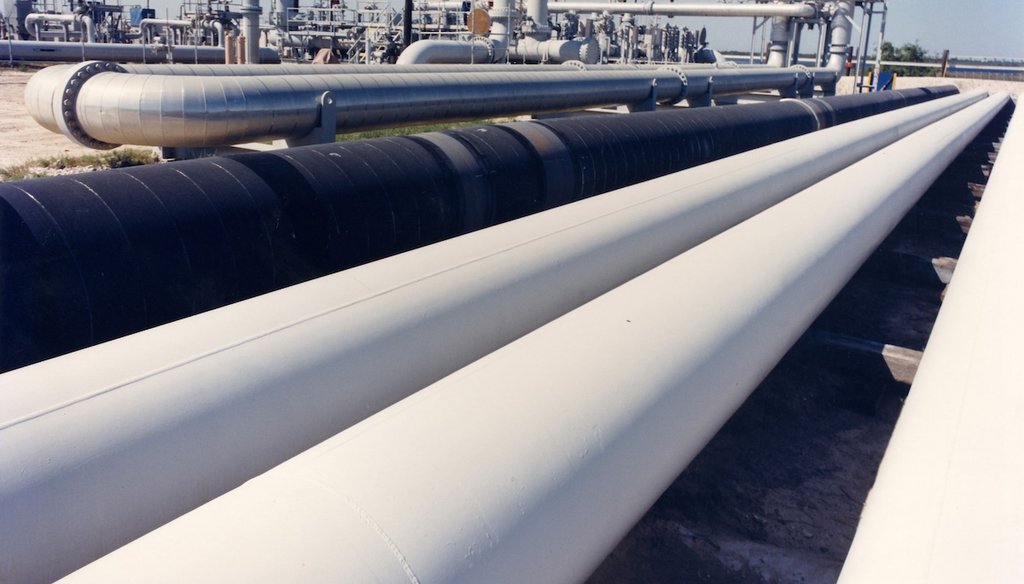
Crude oil pipes at the Bryan Mound site near Freeport, Texas. (Department of Energy via AP)

As a presidential candidate in 2024, Donald Trump said, "We have to fill up the strategic reserves immediately." He was referring to an extensive network of caverns in Louisiana and Texas known as the Strategic Petroleum Reserve that stores crude oil that the United States can use in the event of a global oil shock.
Trump has criticized his predecessor, former President Joe Biden, for releasing close to 300 million barrels from the reserve when gasoline prices soared starting in 2022, stemming from an economic resurgence after the coronavirus pandemic and Russia's invasion of Ukraine, which led many countries to boycott Russian oil.
Now, almost six months into Trump's second term, the amount of oil stored at the reserve hasn't risen by much.
Still, Trump's One Big Beautiful Bill, which he signed July 4, includes $218 million for maintenance and repairs to the reserve, and $1.3 billion to purchase new petroleum for the reserve.
The Trump administration hasn't acted "immediately" to refill the reserve, as Trump said he would. But a fast refill is being prevented by maintenance concerns, and funding for both repairs and new crude oil purchases are included in legislation Trump signed.
The reserve, which dates from OPEC's 1973 and 1974 oil embargo, has a capacity of more than 700 million barrels, stored in underground geological formations known as salt domes. The reserve stores crude oil rather than gasoline, partly because crude oil is more stable.
Under Trump, the volume of oil stored in the reserves has grown, slightly. When Trump took office, the reserve had 395 million barrels of crude oil; by late June, it had risen about 2%, to a little less than 403 million barrels, according to the Energy Department's Energy Information Administration. The reserve is roughly 60% full.
This small increase isn't attributable to Trump policies. Reuters reported that the Biden administration ordered 15.8 million barrels delivered from January to May 2025, and the Energy Department confirmed to PolitiFact that the 2% increase "reflect(s) barrels secured under solicitations issued prior to January 20, 2025."
At the current rate, it would take several years to replenish the oil sold from 2021 to 2023, said Hugh Daigle, a University of Texas at Austin associate professor of petroleum and geosystems engineering. So "this doesn't exactly look like a concerted effort to refill the reserve," Daigle said.
From a price perspective, now could be a good time to refill the reserve, experts said, because crude oil prices are relatively low — about $65 a barrel. In 2023, the Energy Department "signaled a willingness to consider (purchases) when oil prices are below $72 a barrel," said Skip York, a fellow at Rice University's Center for Energy Studies.
But the reserve's aging facilities likely preclude a rapid infusion of oil.
The reserve needs $100 million in repairs before the facility can be fully refilled, Energy Secretary Chris Wright said in April. His House committee testimony blamed the Biden administration's rapid drawdowns for causing some of the damage; the Energy Department told PolitiFact that the reserve was "severely weakened by the previous administration's mishandling," including delays in infrastructure work.
However, the Biden-era actions may not be the only reasons for the infrastructure challenges. Studies conducted about a decade ago warned that the reserve facility was reaching or exceeding its expected lifespan, E&E News reported.
Waiting to refill the reserve "may be a prudent decision, or even a necessity, given the potential damage that might be caused by rapid refilling," said Clark Williams-Derry, an energy finance analyst at the Institute for Energy Economics and Financial Analysis.
Given the provisions in the One Big Beautiful Bill, we rate this promise In the Works.
Our Sources
Energy Information Administration, "Weekly U.S. Ending Stocks of Crude Oil in SPR," accessed July 2, 2025
Text of Big Beautiful Bill Act, July 2, 2025
Congressional Research Service, "The Strategic Petroleum Reserve: Background, Authorities, and Considerations," May 30, 2020
Reuters, "US will not complete oil deliveries into its reserve until year-end," June 26, 2025
Reuters, "U.S. lawmakers, officials, Trump, on oil reserve release," Nov. 23, 2021
E&E News, "Aging caverns imperil Trump push to refill petroleum reserve," June 13, 2025
Email interview with Clark Williams-Derry, energy finance analyst at the Institute for Energy Economics and Financial Analysis, June 28, 2025
Email interview with Hugh Daigle, University of Texas-Austin associate professor of petroleum and geosystems engineering, June 27, 2025
Email interview with Skip York, fellow at Rice University's Center for Energy Studies, June 30, 2025
Statement by the Energy Department to PolitiFact, July 1, 2025