Stand up for the facts!
Our only agenda is to publish the truth so you can be an informed participant in democracy.
We need your help.
I would like to contribute
Trump shifts homelessness pledge toward enforcement, funding changes, but no federal ‘tent cities’

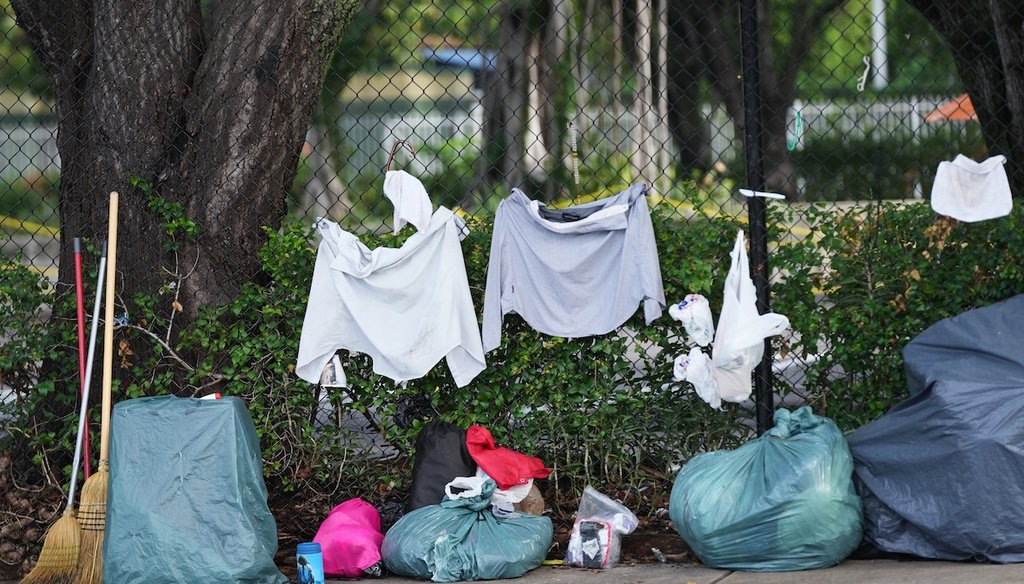
Personal belongings on a sidewalk in Miami near where members of the Miami Street Medicine team are providing medical services to homeless people on Aug. 23, 2025. (AP)

President Donald Trump campaigned on a promise to create large, federally supported "tent cities" for people experiencing homelessness on inexpensive land, staffed with doctors, psychiatrists, social workers and drug rehabilitation experts.
Eleven months into his second term, Trump has made significant shifts in federal homelessness policy, but his administration has so far not moved on a "tent city" program with accompanying services.
The administration's most consequential actions on homelessness to date involve proposed changes to homelessness funding, an executive order emphasizing enforcement, and efforts to restructure or eliminate federal homelessness coordination agencies.
Local governments in California, Arizona and the Midwest, along with national nonprofits, have sued or criticized the administration's homelessness policies.
HUD's proposed overhaul of homelessness funding
In December 2025, the Department of Housing and Urban Development announced major changes to its $3 billion Continuum of Care homelessness grant program, a program created in 1987 to give money to states, local governments and nonprofits to deliver services to homeless people, including veterans, families, and people with disabilities.
HUD proposed a funding cap on permanent housing and shifting dollars toward transitional housing linked to conditions or service requirements.
Cities, counties, and providers sued, arguing that the changes violated the law and would destabilize programs that reduce homelessness. Facing multiple lawsuits, HUD withdrew the new grant rules shortly before a scheduled federal court hearing, though officials said they would issue revised rules later.
Executive order emphasizing encampment sweeps and civil commitment
Trump's executive order, released July 24, focused on removing encampments from public spaces and expanding pathways for forced treatment or civil commitment for people with severe mental illness or substance use disorders.
These policies represent a shift toward enforcement-first approaches, rather than the integrated service villages envisioned in Trump's promise.
Some advocacy groups reacted strongly against this approach, warning that it could displace people without offering stable alternatives.
The Trump administration also moved to eliminate the U.S. Interagency Council on Homelessness, a federal body that has coordinated homelessness policy across more than a dozen agencies.
The administration's homelessness actions are a new direction in federal strategy, but none of the actions so far would lead to what Trump promised. This promise is Stalled.
Our Sources
White House, "Ending Crime and Disorder on America's Streets," July 24, 2025
Democracy Forward, "Local Governments and Nonprofit Groups Challenge Unlawful New Trump-Vance Administration Restrictions That Threaten Proven Solutions to Homelessness," Dec. 1, 2025
National Alliance to End Homelessness, "Statement on Trump Administration's Executive Order on Homelessness," July 25, 2025
Southern Poverty Law Center, "Trump's Executive Order Worsening Homelessness Crisis, Explained," accessed Dec. 18, 2025
Politico, "HUD temporarily pauses homelessness funding overhaul just ahead of court hearing," Dec. 8, 2025
Reuters, "Trump administration to rethink changes to homelessness grant program after lawsuits," Dec. 8, 2025
NPR, "Trump administration has gutted an agency that coordinates homelessness policy," April 16, 2025
Axios, "HUD halts funding shift, but Phoenix housing still at risk," Dec. 10, 2025